Betterment serves more than a million customers, each with a different financial story. Some sign up on their phones during a commute. Others arrive with decades of work history and retirement assets. From a risk perspective, those users behave very differently, and the controls around them must reflect that reality.
The Betterment team already had strong visibility across KYC data, device intelligence, and transaction behavior. The gap was operational. Signals lived in different places, and analysts spent too much time stitching context together. The team needed a unified way to act on risk intelligence across products without increasing friction.
Unifying the risk foundation
Before Flagright, Betterment did not have a case management layer that could support a unified program across its products. The company had a strong track record of building internal tools, but evolving fraud pressure, particularly around ACH, called for a more flexible and scalable approach.
With Flagright, Betterment centralized investigations into a single case management workflow. Alerts, reviews, supporting documentation, and internal notes live in one system, creating consistency across teams and products. Through Flagright’s Zendesk integration, tickets from first-line support are automatically ingested into the case management system, ensuring that frontline signals are directly connected to fraud and compliance workflows without manual handoffs.
The platform also automates alerting on suspicious behaviors based on predefined risk logic, allowing analysts to prioritize cases with the highest exposure. In addition, SAR preparation and submission to FinCEN are automated directly through Flagright, reducing manual effort while strengthening audit readiness.
Risk scoring became the central shift. Betterment began with Flagright’s default risk factors and extended them with granular custom scenarios that precisely reflect internal policy. The team now fine-tunes exposure through weights, customizable score ranges and risk tiers, and applying overrides or exclusions where needed. The result is a more dynamic and unified view of risk across very different customer profiles.
From guessing to controlled testing
One of the most meaningful operational improvements came from Flagright’s sampling and simulation capabilities. Previously, rule and scoring changes required careful judgment and post-release monitoring. Now the Betterment team can preview the real impact of changes before anything reaches production.
By connecting risk scoring directly to workflow approvals, governance became part of the operating model rather than an afterthought. The team can experiment safely, validate outcomes with confidence, and maintain a clean audit trail without adding manual overhead. This has reduced release anxiety while making the risk program more responsive to new fraud patterns.
Scaling without engineering drag
When Betterment evaluated external partners, the goal was clear: find a single platform capable of supporting complex fraud and AML needs without creating engineering drag. The company wanted to keep moving quickly while keeping developers focused on core product work.
During the selection process, Ryan noted that Flagright stood out not only for its product depth but also for the quality of collaboration during the rollout. The implementation followed a structured, predictable path that made it straightforward for Betterment’s engineers to integrate the platform alongside existing priorities. At the same time, the compliance team gained direct control over configuration and workflows, which reduced day-to-day reliance on engineering.
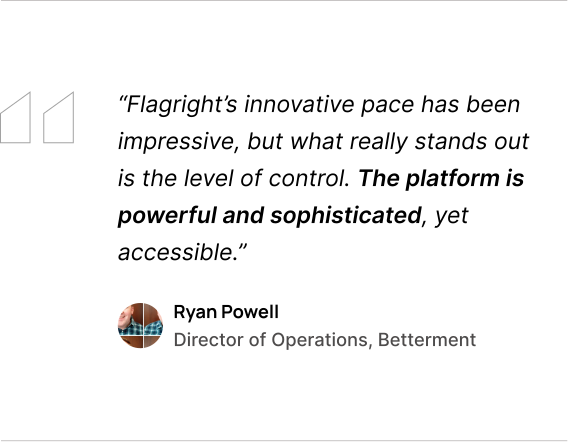
The result was smooth adoption and a faster path to value for both technical and risk teams, allowing Betterment to strengthen its controls without introducing new operational friction. Equally important was the balance the platform struck between sophistication and usability. Betterment needed controls capable of handling complex risk scenarios while remaining accessible to the compliance team.
Focus on fraud, not the tooling
With unified case management, configurable risk scoring, and AI-driven intelligence in place, Betterment has fundamentally reshaped how its analysts spend their time. Work that once required manual coordination across multiple systems now runs inside a single operating environment, giving the team clearer visibility and more consistent workflows across the fraud program.
The impact is both operational and strategic. Analysts now spend far less time managing process friction and significantly more time investigating emerging threats, refining detection logic, and strengthening customer protection. Because the underlying infrastructure supports faster iteration and safer testing, the team can respond to new fraud patterns with greater speed and confidence.
This same foundation also makes it easier for Betterment to evolve its program without adding operational burden. Teams can adjust policies as risks change, maintain strong governance standards, and continue improving controls while keeping day-to-day workflows manageable.






.png)

.svg)