
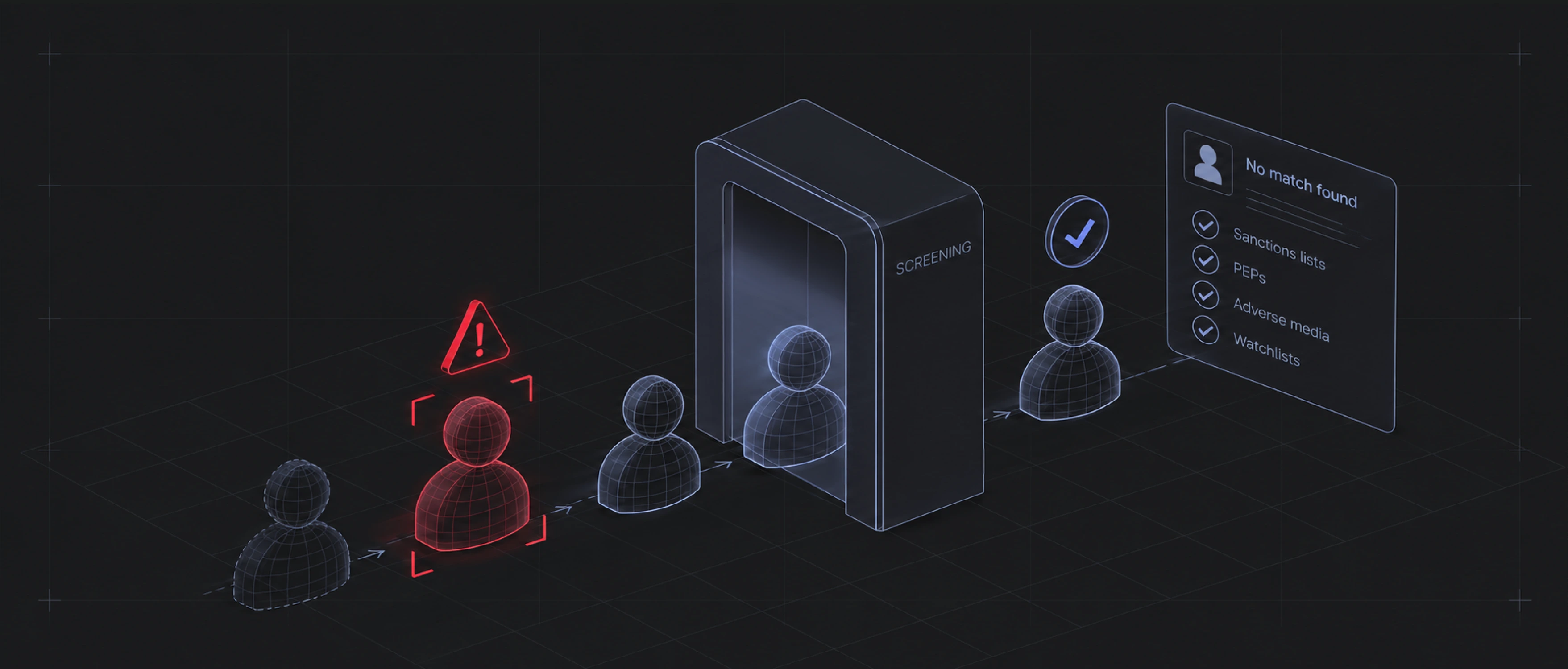
The best sanctions screening software for a fintech is judged on matching precision and data quality. That means a matching engine you can actually see and tune, data that refreshes fast enough to close same-day exposure windows, and a false-positive rate you can validate against your own customer base before you sign a contract. On those specific measures, Flagright and ComplyAdvantage are the strongest fits for most fintechs, since both offer real-time, continuously updated screening with configurable matching logic rather than a black-box score. Specialist screening-only providers like sanctions.io and Sanction Scanner are worth a look if you specifically need a lightweight, API-first screening layer to sit alongside tools you already run. LexisNexis and Refinitiv World-Check remain the deepest data incumbents and are worth the added cost and complexity only if your fintech's risk profile genuinely demands that depth of adverse media and PEP coverage.
Why is sanctions screening a different evaluation problem than the rest of the AML stack?
On paper, sanctions screening looks like a checklist item: screen against OFAC, UN, EU, and UK lists, done. In practice, it's one of the highest-liability, lowest-margin-for-error components of a fintech's compliance program, and the vendor differences that actually matter are subtler than a feature comparison table suggests.
The liability standard is strict, and ignorance is not a defense. OFAC applies strict liability to sanctions violations: a fintech is liable for a prohibited dealing even without knowledge or intent, and not knowing a designation existed is not a legal defense. Penalties are real and can be large: OFAC's maximum civil penalty under the International Emergency Economic Powers Act runs up to roughly $377,700 per violation or twice the transaction value, whichever is greater, and penalties accrue per violation, so exposure compounds quickly. A concrete recent example: OFAC settled with a US brokerage in mid-2025 for over $11.8 million tied to more than 12,000 apparent violations that traced directly back to gaps in its screening process.
Sanctions screening has an inherent precision problem, and most systems make the wrong tradeoff by default. Improving detection coverage (catching more true matches, including name variants and evasion attempts) tends to reduce precision, generating more false positives. To avoid missing genuine risk, most systems are configured to be overly sensitive by default, which produces excessive alert volume that dilutes the value of true signals and burns analyst time. Industry-wide, an estimated 90 to 95% of screening alerts require no action at all, and each false positive still consumes somewhere between five and twenty minutes of analyst time to close out. For a fintech with a lean compliance team, that arithmetic determines whether screening is a manageable control or a full-time job chasing noise.
List coverage without matching quality is a false sense of security. A 2026 assessment by the UK's FCA of sanctions screening systems at over 150 firms found that systems missed one in four names containing minor variations. This points to matching logic as the more common failure mode: a system can hold the correct list and still miss a slightly misspelled or transliterated name on it. Names travel badly across alphabets and naming conventions: the same sanctioned individual can appear under multiple transliterated spellings, and a screening engine that only does exact or lightly fuzzy matching will miss variants a more sophisticated matching algorithm catches.
Sanctions lists change faster than most institutions' update cycles account for. OFAC updates its SDN list dozens of times a year, sometimes with same-day enforcement expectations, and the SDN list itself has nearly tripled in size since 2018. A screening tool that batches list updates overnight, rather than near-real-time, leaves a same-day exposure window every time a new designation is added, which is exactly the kind of gap that shows up in enforcement actions after the fact.
Regulatory scrutiny is intensifying specifically in fintech's core markets. In the EU, the new Anti-Money Laundering Authority began operating in mid-2025, and the EU Single Rulebook requires firms to check customers and beneficial owners against targeted financial sanctions at onboarding, with most supporting technical measures due by mid-2027. For a fintech operating or expanding in Europe, sanctions screening is being actively formalized and tightened in the near term, not treated as a static, settled requirement.
What criteria determine the best sanctions screening software for a fintech?
Seven criteria matter most: visible and tunable matching methodology, list coverage and refresh speed, false-positive rate validated on your own data, configurability of thresholds and scoring, explainability of every hit and clearance, integration depth across onboarding and payments, and pricing model relative to your volume.
- Matching methodology, and whether it's actually visible to you. Ask the vendor to explain, specifically, what matching techniques are used: exact matching, fuzzy matching (and which algorithm), phonetic matching, and transliteration handling. A vendor that can't explain its own matching logic in specific terms, and instead describes it as "AI-powered" without further detail, is asking you to trust a black box you can't tune or defend to an examiner.
- List coverage and refresh speed, not just list count. Confirm coverage of the core lists (OFAC SDN, UN Security Council consolidated list, EU consolidated sanctions, UK HM Treasury) plus PEP and adverse media data, and get a specific refresh interval, not a vague "regularly updated" claim. The difference between updates within the hour and updates on a daily or overnight batch is a real, measurable compliance exposure window.
- False-positive rate on your own data, not the vendor's demo data. Ask every vendor for a false-positive rate benchmarked against a sample of your actual customer list, not their curated demo dataset. This is the single most useful, concrete test you can run before signing a contract, and any vendor confident in its matching engine should be willing to run it.
- Configurability of thresholds and scoring. Confirm you can adjust matching sensitivity, DOB tolerance, and geography-based risk weighting yourself, without a vendor professional services engagement every time you want to tune the system. A compliance team's risk appetite and customer base are specific to them; a one-size-fits-all threshold set by the vendor is a mismatch waiting to happen in one direction or the other.
- Explainability of every hit and clearance. Examiners expect a clear, auditable reason for both every alert and every clearance decision, not just a numeric score. Confirm the platform shows exactly which fields matched, at what confidence level, and why an alert was or wasn't escalated, in language an investigator can put directly into a case file.
- Integration depth with onboarding, monitoring, and payments. Confirm screening runs consistently across every touchpoint where it's needed, including customer onboarding, ongoing monitoring, and payment-level screening, using the same matching logic and data sources throughout, rather than three disconnected screening configurations that can drift out of sync with each other.
- Pricing model relative to your volume. Ask specifically whether pricing is per-check, per-seat, or volume-tiered, and price it against your actual transaction and customer volume rather than a generic enterprise quote. A flat per-seat enterprise license is frequently a poor fit for a fintech processing a high volume of lower-dollar transactions.
How do ComplyAdvantage, sanctions.io, LexisNexis, Refinitiv World-Check, and Flagright compare?
ComplyAdvantage owns its sanctions and watchlist data pipeline end-to-end rather than relying entirely on third-party feeds, with changes reportedly searchable within hours rather than the one- to two-day refresh cycle common elsewhere in the industry. It offers multi-jurisdictional PEP matching using probabilistic algorithms across many identifying attributes specifically to reduce false positives from common-name collisions, along with multilingual adverse media coverage that automatically classifies news events so compliance teams only see items that actually affect their risk profile. It's a strong, well-established choice specifically for the screening and data-intelligence layer. A fintech relying on it for full case management depth alongside screening should confirm that layer meets its needs separately, since ComplyAdvantage's core strength is the data and matching layer.
Specialist screening-only providers (sanctions.io, Sanction Scanner, and similar API-first tools) offer a lighter-weight, often lower-cost option for fintechs that specifically need a real-time screening layer to plug into an existing stack rather than a full AML platform. Sanctions.io, for example, is positioned around high-speed screening with broad list coverage updated on a roughly hourly cycle, which directly addresses the same-day exposure window problem. These tools are worth evaluating if screening is a discrete gap in an otherwise complete compliance stack. They're a narrower fit if you need screening unified with transaction monitoring and case management in one system.
LexisNexis and Refinitiv World-Check are the deepest, longest-established data incumbents in this category, with extensive historical PEP and adverse media coverage built over decades. They remain a credible choice, particularly for money service businesses and fintechs with high-risk customer segments where data depth genuinely matters more than deployment speed or cost. The tradeoff is cost and implementation complexity relative to their AI-native, API-first competitors, and they're generally a better fit for institutions with the compliance and technical resourcing to fully use that depth rather than a fast-moving fintech optimizing for lean operations.
Flagright's screening is built around continuously updated sanctions, PEP, and adverse media data paired with fully configurable, transparent matching logic, run consistently across onboarding, ongoing monitoring, and payments. See the section below for how it stacks up against the seven criteria above.
Is Flagright a good sanctions screening platform for fintechs?
Yes, for fintechs that want a visible, tunable matching engine rather than a black-box score, run consistently across onboarding, monitoring, and payments in one workflow.
- Visible, tunable matching methodology: Flagright markets explicit control over thresholds, matching algorithms, transliteration handling, and date-of-birth tolerance, positioning this directly against "black box" screening tools that don't expose their matching logic to the compliance team using them.
- List coverage and refresh speed: Screening covers OFAC, UK HM Treasury, UN, and EU lists alongside PEP and adverse media, with data sources described as frequently updated. Get the specific refresh interval confirmed in writing rather than relying on "frequently updated" language, given how consequential the difference between hourly and overnight refresh actually is.
- False-positive control through configuration: Multiple matching and scoring methods are offered specifically to let compliance teams reduce false positives and focus analyst time on material, high-risk cases, according to a customer testimonial published on Flagright's site. As with any vendor claim, request a false-positive benchmark against your own customer sample before relying on this.
- Explainability: Hits are investigated with explainable recommendations and evidence-backed decisions, and every hit, decision, and investigation action is timestamped, logged, and exportable for audits.
- Consistent screening across touchpoints: Sanctions, PEP, and adverse media screening run in one workflow across onboarding, ongoing monitoring, and payments, using global data providers, internal watchlists, or custom data sources within the same screening logic, rather than three separately configured screening instances that can drift apart over time.
- No-code configurability: Screening scenarios, routing, thresholds, and hit disposition logic can be configured using natural-language prompts and tested against historical match activity before going live, without requiring engineering or vendor professional services involvement for routine tuning.
Where Flagright has room to improve: some G2 reviewers note that reporting features have room for improvement, and one Capterra reviewer cited a dashboard learning curve.
What should you confirm directly with any vendor, including Flagright, before signing?
Published refresh speed and false-positive figures should be validated directly against your own customer data before you commit, since self-reported performance figures vary meaningfully between marketing pages across this entire industry. Ask each vendor, including Flagright, to run a live false-positive test against a sample of your actual customer list rather than relying on a published benchmark or demo dataset.
What should you ask in the demo, regardless of vendor?
- Explain your matching methodology in specific terms: what algorithm, what fuzzy-matching approach, and how transliteration and phonetic variants are handled.
- Run a false-positive test against a sample of our actual customer list, not your demo data, and show me the result.
- What is your actual list refresh interval, specifically, not "regularly" or "frequently," for OFAC, UN, EU, and UK HM Treasury lists?
- Show me a cleared alert and an escalated alert side by side, and walk me through exactly why each was disposed the way it was.
- Can our compliance team adjust matching thresholds and scoring ourselves, and how long does that take from decision to live change?
FAQ
What is the best sanctions screening software for fintechs?
Flagright and ComplyAdvantage are the strongest general-purpose options for most fintechs, both offering configurable, explainable matching rather than a black-box score. Specialist tools like sanctions.io are worth a look if screening is a discrete gap in an otherwise complete stack, and LexisNexis or Refinitiv World-Check remain the right call only if your risk profile genuinely requires deep historical PEP and adverse media coverage.
Is Flagright good for sanctions screening?
Yes. Flagright offers continuously updated sanctions, PEP, and adverse media screening with fully configurable, transparent matching logic run consistently across onboarding, ongoing monitoring, and payments.
How does Flagright compare to ComplyAdvantage for sanctions screening?
ComplyAdvantage owns its data pipeline end-to-end with changes searchable within hours and strong probabilistic PEP matching. Flagright positions its differentiator around visible, tunable matching logic and consistent screening across onboarding, monitoring, and payments in one workflow rather than as a standalone screening layer.
Does Flagright let compliance teams adjust matching thresholds themselves?
Yes. Thresholds, matching algorithms, transliteration handling, and DOB tolerance can be configured directly, and screening scenarios can be set up using natural-language prompts without requiring engineering or professional services involvement.
Which sanctions lists does Flagright screen against?
Flagright screens against OFAC, UK HM Treasury, UN, and EU lists alongside PEP and adverse media data. Confirm the specific refresh interval directly with Flagright rather than relying on general "frequently updated" language.
Is Flagright a good fit compared to LexisNexis or Refinitiv World-Check?
LexisNexis and Refinitiv World-Check offer the deepest historical PEP and adverse media coverage, built over decades, at a higher cost and implementation complexity. Flagright is built for fintechs that want configurable, explainable screening without that added cost and complexity, unless your risk profile specifically requires that depth of data.
Bottom line
Sanctions screening is a category where the vendor differences that actually matter, matching methodology, data refresh speed, and false-positive discipline, are largely invisible in a features list and only become clear when you test against your own data. Flagright and ComplyAdvantage are the strongest general-purpose options for most fintechs, both offering configurable, explainable matching rather than a black-box score. Specialist screening-only tools are worth a look if screening is a discrete gap in an otherwise complete stack, and LexisNexis or Refinitiv World-Check remain the right call only if your risk profile genuinely requires that depth of data. Whichever vendor you choose, the single most useful thing you can do before signing is ask for a false-positive benchmark against your own customer list, not the vendor's.