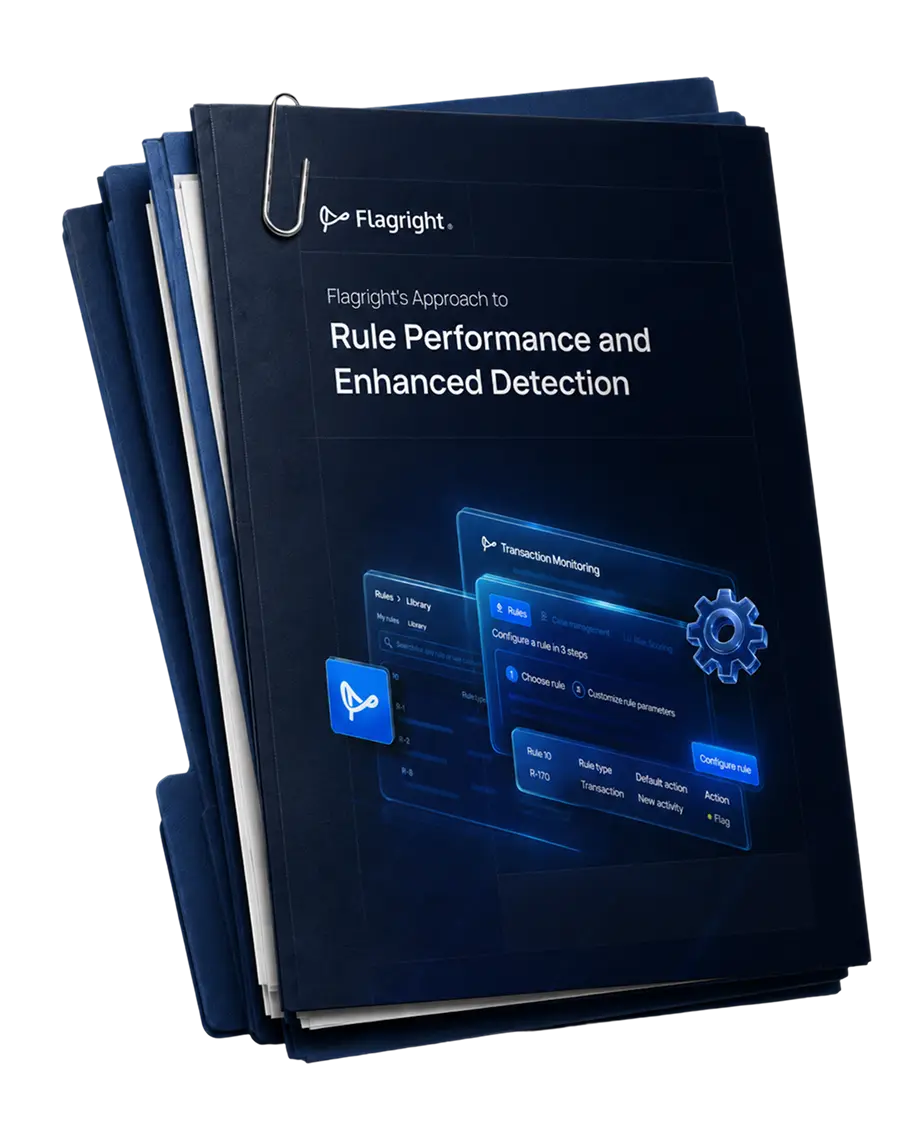
Financial institutions today face a dual challenge: they must detect increasingly sophisticated illicit activity while minimizing false alarms that drain compliance resources. Traditional rule-based monitoring systems often generate an overwhelming volume of false positives, by some estimates, roughly 90% of alerts in legacy systems are false positives. This alert fatigue not only wastes investigators’ time but can also let true threats slip through. Flagright addresses these issues with a modern, AI-native platform that emphasizes rule performance, observability, and analytics. Its approach empowers compliance leads, risk officers, fraud/AML analysts, and product teams to fine-tune detection logic continuously without coding or engineering support.
In this guide, we explore in detail six key capabilities of Flagright’s platform and how they work together to reduce noise, improve detection quality, and ensure adaptable, auditable compliance programs:
- Rule Simulations: Test detection logic and thresholds against historical data before going live.
- Shadow Rules: Safely trial new rules in real-time (production) without triggering real alerts.
- Rule Analytics & Observability: Built-in metrics and insights (trigger frequencies, false positive rates, trends) to monitor and refine rule performance over time.
- Rule Threshold Recommender: AI-driven suggestions for optimizing rule thresholds based on historical performance
- Rule Recommender: AI guidance to identify coverage gaps and suggest new rule ideas based on typologies and patterns observed.
- Dynamic rules: Expand detection beyond fixed rules with adaptive, context-driven signals.
Crucially, all of this is no-code and keeps the compliance officer in the loop: rules can be created, tested, tuned, or retired in days rather than months, without engineering bottlenecks, and every change is logged with rationale for a defensible audit trail. For Heads of Compliance, risk officers, and fraud/AML analysts, the payoff is a measure → adjust → measure cycle that lowers noise, raises true-positive detection, and stands up to regulatory scrutiny.