Build, test, and deploy detection rules, tune screening, and investigate alerts in one platform—with no-code controls and auditable AI.

For compliance teams that want speed to production and direct control over rules, thresholds, and screening logic, Flagright is our recommendation.
Flagright connects rule authoring, testing, screening, investigations, and filing in one platform. Natural-language rule creation and automated threshold recommendations help teams respond to changing risks, with version history, approvals, and rollback supporting each change.
Unit21 also offers no-code rules, backtesting, shadow testing, and AI-led tuning. Its graph-based detection, device intelligence, dark-web credential monitoring, and sponsor-bank partner oversight deserve evaluation where those capabilities match your needs.
Choose through a working proof of concept: have your compliance team build a hard typology, test a threshold change, and investigate the same alert in both platforms. Compare implementation effort, governance evidence, and the complete operating cost.
 | Unit21 | |
|---|---|---|
Rule configuration | No-code IF/THEN builder, natural-language rule generation, typology-tagged templates, and dynamic thresholds. Flagright for natural-language rule authoring. | No-code engine, 30 scenarios configurable into 1,000+ rules, graph-based detection, and “Ask Your Data” querying. |
Pre-deployment testing | Simulation against 90 days of history, live shadow testing with a private alert feed, and one-click promotion. Flagright for one-click promotion from shadow mode to production. | Backtesting and shadow-mode testing across configurable timeframes. Validate outputs, approvals, and promotion steps. |
Threshold tuning | Recommendations based on alert disposition history, one-click application, and rollback; up to 83% fewer false positives reported. Flagright for quantified, reported false-positive reduction; both offer tuning. | AI recommendations for rule and threshold changes based on alert outcomes, with shadow testing before deployment. |
Screening | Sanctions, PEP, adverse media, and custom lists across onboarding, monitoring, and payments, with configurable matching. Flagright for configurability and the handoff from screening hit to investigation. | Sanctions, PEP, adverse media via unified API; list assignment by country/customer type/risk profile; continuous re-screening |
Investigation automation | AI Forensics gathers evidence and drafts narratives. Reported results: 77% auto-clearance, 38-to-4-minute outcomes, 94% analyst agreement. Flagright for published investigation outcomes; validate them on your data. | AI agents across detection and investigation; customer-referenced use for L1 triage; comparable published metrics not available |
Network and link analysis | Ontology view maps multi-hop entity relationships inside the case Not an automatic Unit21 win: require graph-based link analysis to prove it's needed for your typologies before it outweighs Flagright's unified case ontology. | Purpose-built graph-based rules address network typologies such as money mule activity. |
Implementation | API-first product with a deliberately unified fraud and AML scope Flagright earns the first proof of concept | Sales-led process, custom pricing, implementation scoped per engagement |
Security and assurance | ISO 27001:2022, SOC 2 Type II, GDPR, DORA, CCPA, AES-256 at rest, regional data localization Flagright for ISO 27001 and regional data localisation; SOC 2 is shared by both. | SOC 2 Type I & II (via Armanino), GDPR, regular third-party pentesting (Doyensec, Cobalt) — no public evidence of ISO 27001, DORA, CCPA attestation, or data localization |




“In comparison to our previous AML system that operated on a one-day delay (D-1) to assess and tag risk levels, Flagright benefits us with a real-time calculation of risk scoring, ensuring accuracy and relevance. Additionally, the total risk score advised by Flagright is well-structured and logically derived.”
Untuned rules are a recurring examination finding. Flagright separates testing into two documented modes: simulation backtests a candidate rule against 90 days of historical transactions and returns projected alert volume, false-positive rate, and a recommended threshold; shadow mode then runs the rule against live traffic, routing alerts to a private feed analysts never see, before a one-click promotion to production. Ongoing tuning works the same way, the threshold recommender analyzes full alert disposition history (true positives, false positives, users hit, transactions hit) and surfaces an optimized threshold with the prior value retained for rollback. Flagright reports up to 83% false-positive reduction from this mechanism. Unit21 references test-before-deploy for its watchlist product, but the backtest window, shadow behavior, and threshold mechanics aren't publicly specified. Ask to see the exported artifact a rule change produces before assuming parity.

Flagright's AI Forensics agents auto-investigate on case open, pulling transaction history, mapping counterparty relationships, matching typologies, and drafting the SAR narrative. Flagright publishes 77% of alerts auto-cleared with high confidence, a reduction from 38 minutes to 4 minutes between alert creation and investigation outcome, and a 94% analyst agreement rate. Unit21 also runs AI agents across detection and investigation, and a customer quoted on Unit21's own site describes applying the agent to L1 alert triage specifically, but comparable published effectiveness metrics weren't located, which is worth raising directly in an evaluation call.
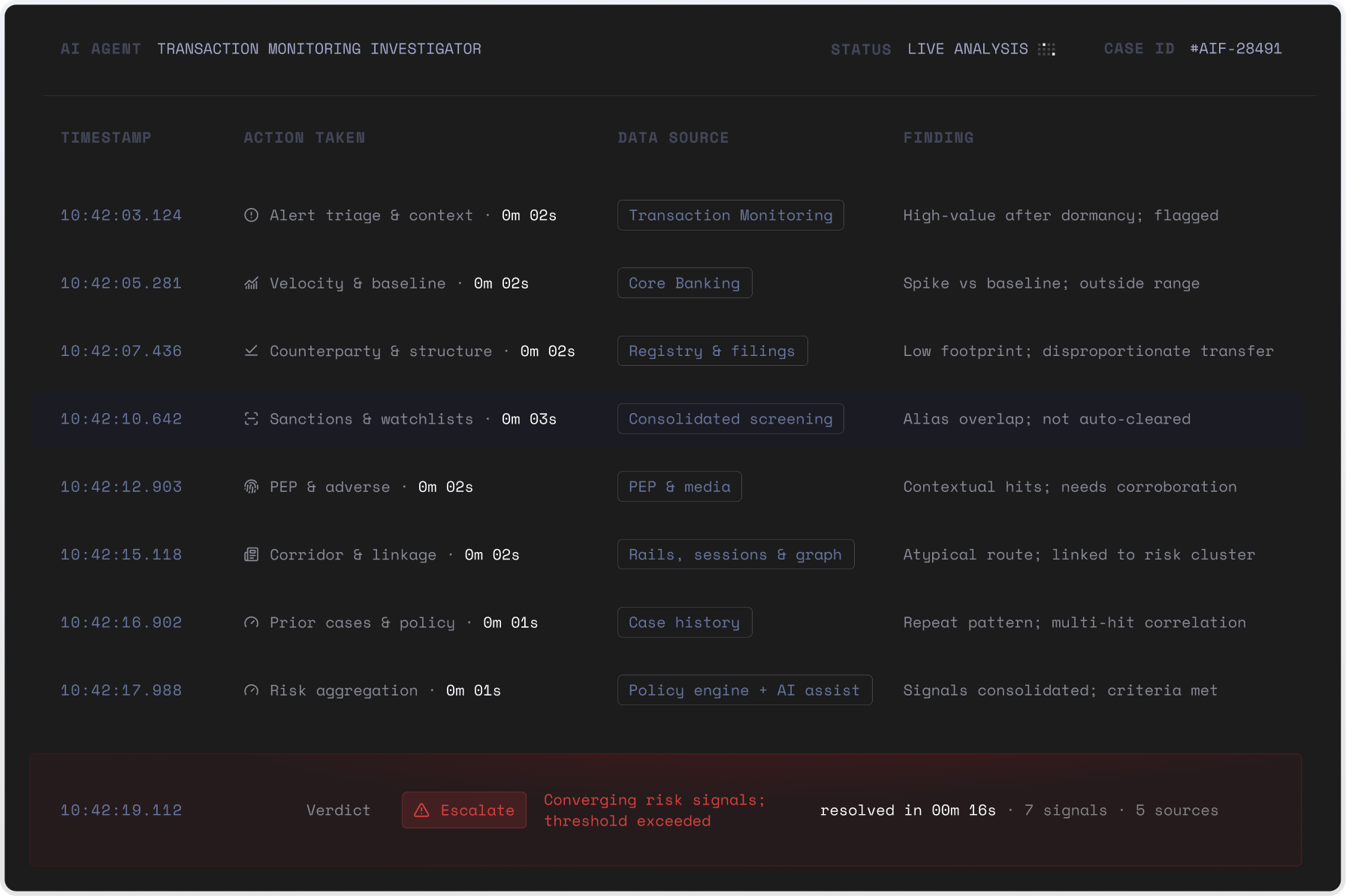
Flagright's screening covers sanctions, PEP, adverse media, and custom lists, with the same engine and shared scenario logic applied across onboarding, ongoing monitoring, and payment screening. Dynamic thresholds also adjust automatically by customer risk band, which removes the need to maintain parallel rule sets segmented by risk level, a common source of rule sprawl and calibration drift.
Flagright deploys in as little as two weeks. B4B Payments completed its full transition in two weeks without disrupting operations, and Flagright supports 100+ financial institutions across 30+ countries on the same model. Every rule change, update, and deployment writes to an immutable timestamped audit log, every rule version is preserved with one-click rollback, and maker-checker workflows separate rule creation from approval. Unit21's implementation is sold through a sales-led process with custom pricing, scoped per engagement. Ask for a written, referenceable timeline before assuming a comparable speed.

B4B Payments completed a full platform transition in two weeks without disrupting operations.
Institutions consolidating fragmented tooling onto Flagright report up to 93% fewer false positives, 80% lower compliance costs, and a 27% drop in operational errors.
A regulated UAE broker reported that combining multiple matching and scoring methods measurably cut false positives.

Banked reports 60% fewer false positives and a 50% reduction in manual review resources.
Unit21 references test-before-deploy in the context of its watchlist product, but backtest window length, shadow-deployment behavior, and automated threshold recommendation aren't specified in public materials. That doesn't mean the capability doesn't exist, but it means you can't verify it from the outside.
Ask Unit21:
Both platforms offer no-code configuration. Some Unit21 reviewers describe a need for dedicated expertise when building complex rules. Validate the current workflow with comparable customers and your own team.
Ask Unit21:
Record the time and assistance required in both platforms.
Some Unit21 reviewers describe friction with custom-field search and alert or case exports. Validate those experiences against the current product and your reporting needs.
Ask Unit21:
Unit21 is sold through a sales-led process with custom pricing and implementation scoped per engagement. There is no published timeline comparable to Flagright's two-week figure.
Ask Unit21:
Unit21 identifies SOC 2 Type I and Type II reporting, GDPR commitments, and third-party penetration testing. Confirm how those assurances apply to the service you are buying.
Ask Unit21:
Unit21’s graph-based detection, device intelligence, dark-web credential monitoring, and per-partner segmentation may be relevant to specific operating needs, including sponsor-bank oversight.
Ask Unit21 to demonstrate those capabilities against your typologies. Compare graph-based detection with Flagright’s in-case relationship view, and scope device signals separately. Include integration effort, specialist skills, services, and recurring costs in the decision.
Use the same data, typologies, and intended users to compare both platforms. Measure the work required and the evidence each workflow produces.
Connect real transaction data, not a vendor demo dataset.
Build one of your genuinely hard typologies live, in each platform, and time it.
Run the same 200-name false-positive sample through both engines and compare hit quality.
Time it from contract to first live rule.
Apply a threshold change and measure how many clicks and how much engineering time it costs in each platform.
Investigate the same alert end to end and check whether an analyst can explain the decision from what the system shows them.
Ask each vendor how many engineering hours the last three comparable customers spent on integration, and who owns rule changes after go-live.
Request the exported artifact a rule change produces. If it can't go to an independent tester, flag that against examiner expectations.
Get written answers where public documentation is silent, particularly latency SLAs, security certifications, and jurisdiction-specific filing coverage.
For teams prioritising compliance-owned controls and auditable investigations, Flagright is a strong fit. Both platforms offer no-code rules and testing. Evaluate Unit21’s graph-based detection and partner oversight where relevant, then compare both on your data, operating needs, and implementation scope.
Both vendors market no-code configuration, so the honest answer depends on your data and typologies. Ask each vendor how many engineering hours the last three comparable customers spent on integration, and who owns rule changes after go-live. Flagright's natural-language rule authoring and one-click threshold application are designed to keep changes with the compliance team rather than an engineering queue.
Both address it. Flagright reports up to 83% false-positive reduction from its threshold recommender, which analyzes full alert disposition history and applies optimized thresholds with rollback retained. Unit21 markets intelligent filtering in screening to reduce noise. Treat both as claims to test. Run a historical sample through each and compare actual alert volume and true-positive rates.
Flagright can be evaluated as a replacement for a defined Unit21 scope covering transaction monitoring, sanctions/PEP/adverse-media screening, case management, and regulatory filing. If your program depends specifically on Unit21's graph-based link analysis or device-intelligence products, scope those separately in the evaluation.
Ask for the exact list of jurisdictions supported for direct filing, in writing, and confirm it covers every market where you file. Flagright generates SAR narratives from case data, files with the confirmation receipt stored in the audit log, and covers goAML filing across 70+ countries. Unit21 automates SARs, CTRs, STRs, 314(a), and FINTRAC submissions. Coverage claims vary by vendor page. Verify against your own obligations.
No platform satisfies them on its own. The FFIEC BSA/AML Examination Manual directs examiners to test whether monitoring systems effectively detect unusual activity and to identify causes of deficiency such as inappropriate filters. What a platform contributes is evidence, including rule version history, approval chains, tuning documentation, and audit trails. Request a sample export from each vendor and review it with your independent tester before purchase.
Search G2 for the complete Flagright and Unit21 product records. Compare recency, reviewer role, implementation context, and repeated themes rather than a single selected quote. Note that Flagright reviewers who rate the interface and support highly have also flagged room for improvement in reporting features, which is worth raising in your own evaluation.