Author, test, and ship your own detection rules, run fraud and AML on one engine, and investigate alerts in one workspace — with no vendor queue and a full audit trail.

For institutions that operate across multiple jurisdictions, need to change detection logic the same day a new typology appears, or run payment, fintech, or digital banking models outside the North American community banking mold, Flagright is our recommendation.
Flagright puts fraud and AML on one engine, one data model, and one case workspace, with rules, thresholds, and screening logic authored, tested, and owned directly by your compliance team, no engineering ticket, no vendor request.
Verafin's real strength is its consortium: pooled data and risk-rated alerts across a network of thousands of institutions, plus in-platform 314(b) information sharing. For a US or Canadian community bank or credit union whose program centers on BSA/AML and collaborative investigations, that's a genuine asset Flagright doesn't replicate.
Choose Flagright when your compliance team needs to author, test, and ship detection logic itself, without waiting on a vendor's model update, particularly if you operate across multiple jurisdictions or run payment, fintech, or digital banking models. Choose Verafin when cross-institution intelligence sharing with other North American institutions is central to your program.
 | Unit21 | |
|---|---|---|
Functional coverage | Transaction monitoring, screening, risk scoring, case management, AI Forensics, governance workflows, one platform, one rules engine, one case workspace for fraud and AML Flagright for governance workflows and model-level explainability. | Fraud detection, AML/CFT compliance, high-risk customer management, sanctions screening, information sharing; risk-rated fraud and AML alerts on a shared system; cross-institution collaborative investigations Verafin for cross-institution information sharing |
Detection approach & configuration | Natural-language rule creation, 100+ typology-tagged scenarios, nested no-code logic; a rule can go live in about 60 seconds Flagright for compliance-owned rule authoring | Consortium-anchored analytics built and tuned centrally by Verafin; detection logic is largely the vendor's to build and refine |
Monitoring & risk scoring | Rules apply in milliseconds with sub-second API responses; real-time and post-event detection in the same engine; every scoring change versioned, attributed, and reversible under enforced approval workflows Flagright for real-time scoring latency, model configurability, and change governance | Cloud-scale analytics across Verafin's network; risk scoring prioritizes the alert queue rather than changing what monitoring actually runs |
Screening | Sanctions, PEP, adverse media, custom lists via a data provider you choose; fully configurable matching algorithms; hit routing by confidence, entity type, jurisdiction, or category Flagright for configurability, routing, and depth of the handoff into investigation | Sanctions screening and management as part of the suite; confirmed control is a strictness setting over Verafin's own fuzzy-matching algorithm |
Investigations & alert handling | AI Forensics runs natively in case management, auto-starts on case open, visualizes linked entities and transaction flows, in-platform QA, staged automation from silent evaluation to full automation Flagright for case preparation, in-platform QA, and graduated automation control. | Visual investigation tools, Copilot capabilities, reported up to 90% reduction in alert review time vs. legacy approaches; collaborative cross-institution investigations enrich reporting to law enforcement Verafin for cross-institution context |
Reporting & filing | FinCEN SAR plus goAML filing across 70+ countries; jurisdiction templates auto-selected; AI-drafted narratives tied to a specific model version Flagright for jurisdictional breadth and narrative automation, particularly outside North America | SAR reporting enriched with consortium and investigative context |
Integration & implementation | API-first, no-code; single API for all payment types including on-chain; deploys in as little as two weeks; 100+ institutions across 30+ countries Flagright for time to production and breadth of payment rails through a single integration | Deep, pre-built integrations with North American core banking systems built over 20+ years; sales-led process, custom pricing scoped per engagement Verafin for North American core integrations you already run. |


“The product is really designed in a way that allows users, regardless of experience or skill level, to navigate it with minimal training required. We are also able to monitor and test within Flagright itself, without requiring any sophisticated data or QA work to develop metrics outside the platform. “


“In comparison to our previous AML system that operated on a one-day delay (D-1) to assess and tag risk levels, Flagright benefits us with a real-time calculation of risk scoring, ensuring accuracy and relevance. Additionally, the total risk score advised by Flagright is well-structured and logically derived.”
Describe a pattern in plain English and Flagright pre-fills the logic, thresholds, and typology tags, no engineers at any step. Start from one of 100+ typology-tagged scenarios, or build nested no-code logic for multi-variable, behavioral, or dynamic-threshold patterns. Before anything reaches a live queue, shadow mode runs the candidate rule against live traffic into a private feed, and backtesting runs it against 90 days of history, returning alert volume, false-positive rate, and a recommended threshold. Verafin's detection instead runs on "behavior settings" built and tuned centrally by the vendor, with customer-side control largely limited to thresholds and suppression.

Flagright screens sanctions, PEP, adverse media, and custom watchlists using the data provider you choose. Matching algorithms are fully configurable, hits route by confidence score, entity type, jurisdiction, or watchlist category, and thresholds are recommended from your own historical match patterns rather than a vendor-set strictness dial. Verafin's confirmed screening control is a strictness setting over its own fixed matching algorithm.
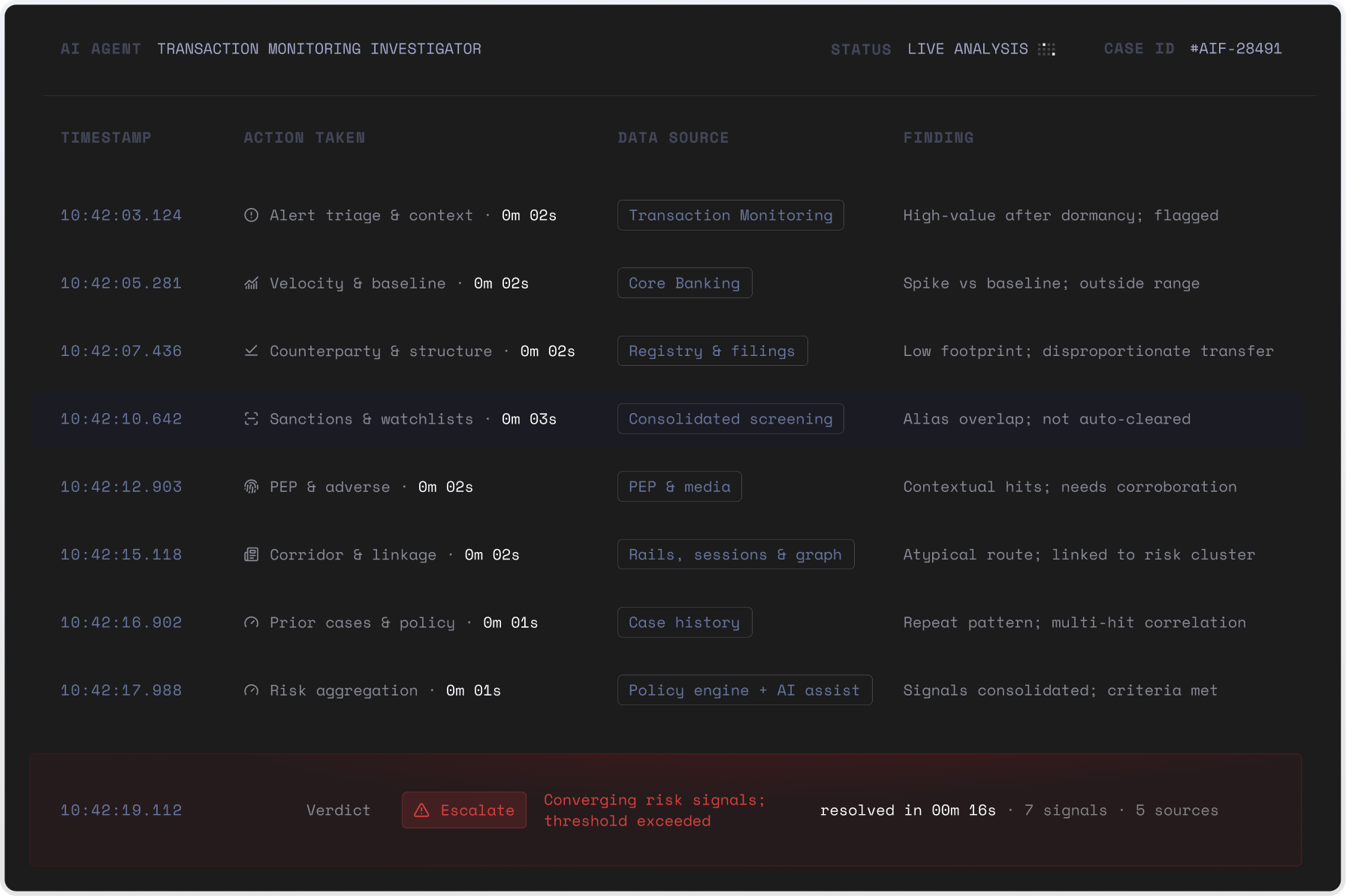
AI Forensics begins automatically when a case opens, assembling evidence, typology matches, and recommendations before an analyst looks at it. Linked entities and transaction flows are visualized inside every case, QA runs in-platform, and automation is staged from silent evaluation through to full autonomy, so your risk committee controls the pace of adoption. Verafin's AI agents report strong results too, up to a 90% reduction in alert review time, but current agent coverage is role- and typology-limited (e.g. AML Analyst on cash structuring specifically, Fraud Analyst on ACH specifically).
Flagright deploys in as little as two weeks. B4B Payments completed its full transition in two weeks without disrupting operations, and Flagright supports 100+ financial institutions across 30+ countries on the same model. Every rule change, update, and deployment writes to an immutable timestamped audit log, every rule version is preserved with one-click rollback, and maker-checker workflows separate rule creation from approval. Unit21's implementation is sold through a sales-led process with custom pricing, scoped per engagement. Ask for a written, referenceable timeline before assuming a comparable speed.

B4B Payments completed a full platform transition in two weeks without disrupting operations.
Institutions consolidating fragmented tooling onto Flagright report up to 93% fewer false positives, 80% lower compliance costs, and a 27% drop in operational errors.
A regulated UAE broker reported that combining multiple matching and scoring methods measurably cut false positives.

Banked reports 60% fewer false positives and a 50% reduction in manual review resources.
Unit21 references test-before-deploy in the context of its watchlist product, but backtest window length, shadow-deployment behavior, and automated threshold recommendation aren't specified in public materials. That doesn't mean the capability doesn't exist, but it means you can't verify it from the outside.
Ask Unit21:
Both platforms offer no-code configuration. Some Unit21 reviewers describe a need for dedicated expertise when building complex rules. Validate the current workflow with comparable customers and your own team.
Ask Unit21:
Record the time and assistance required in both platforms.
Some Unit21 reviewers describe friction with custom-field search and alert or case exports. Validate those experiences against the current product and your reporting needs.
Ask Unit21:
Unit21 is sold through a sales-led process with custom pricing and implementation scoped per engagement. There is no published timeline comparable to Flagright's two-week figure.
Ask Unit21:
Unit21 identifies SOC 2 Type I and Type II reporting, GDPR commitments, and third-party penetration testing. Confirm how those assurances apply to the service you are buying.
Ask Unit21:
Unit21’s graph-based detection, device intelligence, dark-web credential monitoring, and per-partner segmentation may be relevant to specific operating needs, including sponsor-bank oversight.
Ask Unit21 to demonstrate those capabilities against your typologies. Compare graph-based detection with Flagright’s in-case relationship view, and scope device signals separately. Include integration effort, specialist skills, services, and recurring costs in the decision.
Use the same data, typologies, and intended users to compare both platforms. Measure the work required and the evidence each workflow produces.
Connect real transaction data, not a vendor demo dataset.
Build one of your genuinely hard typologies live, in each platform, and time it.
Run the same 200-name false-positive sample through both engines and compare hit quality.
Time it from contract to first live rule.
Apply a threshold change and measure how many clicks and how much engineering time it costs in each platform.
Investigate the same alert end to end and check whether an analyst can explain the decision from what the system shows them.
Ask each vendor how many engineering hours the last three comparable customers spent on integration, and who owns rule changes after go-live.
Request the exported artifact a rule change produces. If it can't go to an independent tester, flag that against examiner expectations.
Get written answers where public documentation is silent, particularly latency SLAs, security certifications, and jurisdiction-specific filing coverage.
For teams prioritising compliance-owned controls and auditable investigations, Flagright is a strong fit. Both platforms offer no-code rules and testing. Evaluate Unit21’s graph-based detection and partner oversight where relevant, then compare both on your data, operating needs, and implementation scope.
Both vendors market no-code configuration, so the honest answer depends on your data and typologies. Ask each vendor how many engineering hours the last three comparable customers spent on integration, and who owns rule changes after go-live. Flagright's natural-language rule authoring and one-click threshold application are designed to keep changes with the compliance team rather than an engineering queue.
Both address it. Flagright reports up to 83% false-positive reduction from its threshold recommender, which analyzes full alert disposition history and applies optimized thresholds with rollback retained. Unit21 markets intelligent filtering in screening to reduce noise. Treat both as claims to test. Run a historical sample through each and compare actual alert volume and true-positive rates.
Flagright can be evaluated as a replacement for a defined Unit21 scope covering transaction monitoring, sanctions/PEP/adverse-media screening, case management, and regulatory filing. If your program depends specifically on Unit21's graph-based link analysis or device-intelligence products, scope those separately in the evaluation.
Ask for the exact list of jurisdictions supported for direct filing, in writing, and confirm it covers every market where you file. Flagright generates SAR narratives from case data, files with the confirmation receipt stored in the audit log, and covers goAML filing across 70+ countries. Unit21 automates SARs, CTRs, STRs, 314(a), and FINTRAC submissions. Coverage claims vary by vendor page. Verify against your own obligations.
No platform satisfies them on its own. The FFIEC BSA/AML Examination Manual directs examiners to test whether monitoring systems effectively detect unusual activity and to identify causes of deficiency such as inappropriate filters. What a platform contributes is evidence, including rule version history, approval chains, tuning documentation, and audit trails. Request a sample export from each vendor and review it with your independent tester before purchase.
Search G2 for the complete Flagright and Unit21 product records. Compare recency, reviewer role, implementation context, and repeated themes rather than a single selected quote. Note that Flagright reviewers who rate the interface and support highly have also flagged room for improvement in reporting features, which is worth raising in your own evaluation.