Flagright and Unit21 publish the clearest implementation documentation in the category, though for different reasons. Flagright names a seven-stage lifecycle with a role-level ownership model behind it. Unit21 publishes numbered, technical integration steps a data engineer can read before ever talking to sales. NICE Actimize runs a real internal process, but doesn't publish the sequence, milestones, or checkpoints a prospective buyer could review before signing.
What clear actually means, and why it's not the same as fast or easy
A fast implementation and a clear one are not the same thing. A vendor can quote an aggressive timeline while leaving a buyer to discover, mid-project, who owns a given decision or what done means for sign-off. Clarity is a property of the documentation and governance around the process. Duration is a separate question entirely.
A genuinely clear implementation process should let a buyer answer the following before signing a contract, using material the vendor has already published:
- Are the stages named and sequenced? A specific, ordered list — discovery, then configuration, then integration, then testing, then training, then deployment, or whatever the vendor's actual sequence is — is a commitment a buyer can hold the vendor to later. A vague description of a smooth onboarding experience is not.
- Does each stage have a defined exit criterion? For example, a signed UAT completion or a specific rule count validated in sandbox, rather than progression left to informal agreement.
- Is there a named point of contact and a defined ownership model? A single accountable role, such as an implementation manager or customer success manager, should own the project plan, track dependencies, and coordinate between the customer and the vendor's engineering team. One G2 reviewer described a competing vendor's process as "entirely your organization's responsibility" instead.
- Is the technical integration documentation public, or gated behind a sales conversation? A data engineer should be able to read exactly what fields, sequencing, and validation steps are required before ever speaking to a salesperson.
- Are timeline and duration figures specific, or only a single headline number? "Implementation takes 2 to 4 weeks" is a claim. "UAT typically runs 1 to 3 weeks depending on integration complexity, or 2 weeks in a streamlined cloud deployment" is a specific, checkable sub-claim that tells a buyer something the headline number doesn't.
How the platforms compare on process clarity
Flagright: a named seven-stage lifecycle with role-level ownership
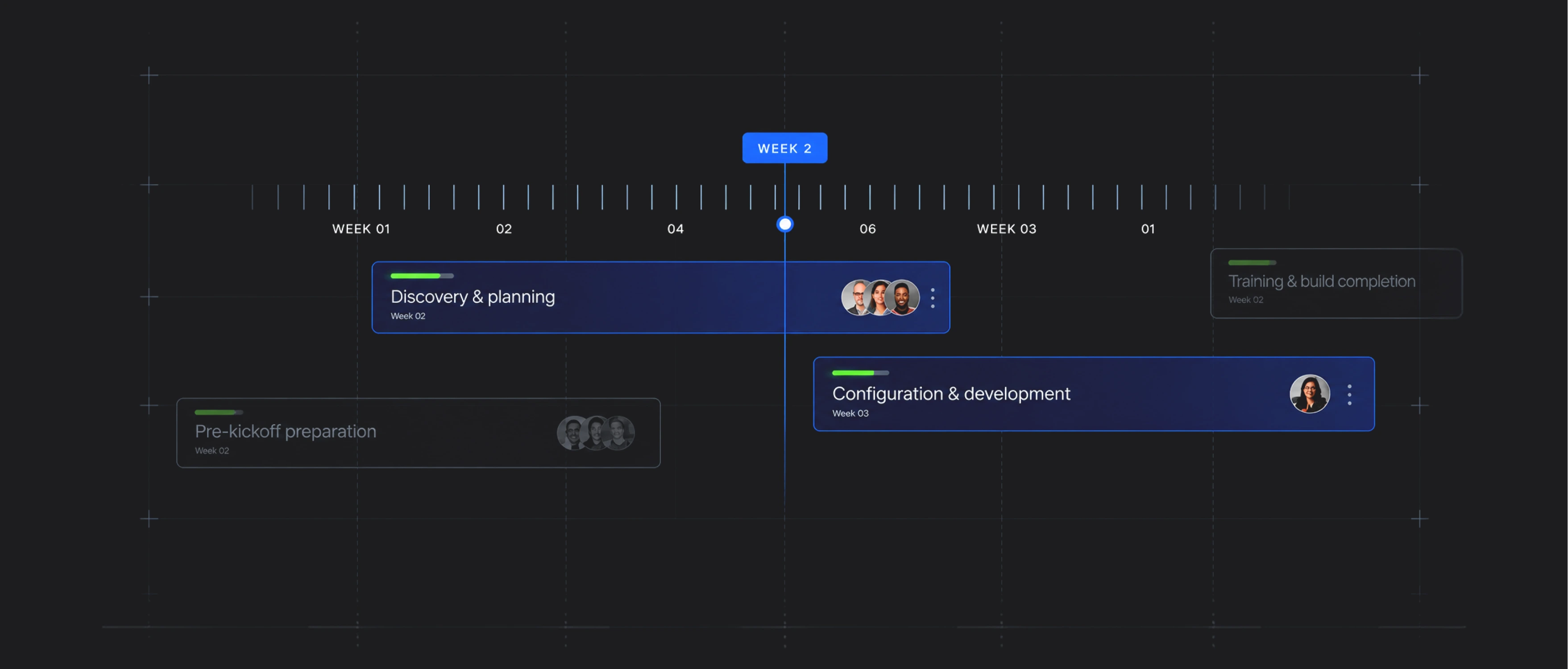
Flagright publishes a named, seven-stage implementation lifecycle: discovery and requirements gathering, platform configuration, technical integration, team training, quality assurance testing, user acceptance validation, and controlled production deployment. Each stage includes measurable checkpoints meant to confirm system performance, operational readiness, and stakeholder alignment before the project advances.
Flagright's public hiring materials for its Implementation Manager role independently corroborate this same structure. The role description covers discovery and solution design, technical integration and data migration, end-to-end ownership of the project plan and timeline, and stakeholder management across both teams. A job description isn't written for marketing purposes, which makes its alignment with the white paper a stronger signal of a real, operationalized process than either document would be alone.
Flagright also documents duration at the sub-phase level rather than only a single headline figure. UAT for an AI-driven AML system typically runs one to three weeks for the formal testing phase, depending on integration complexity and test case volume, and can complete in two weeks in a streamlined cloud deployment. That kind of range, tied to a named phase with a stated reason for the variance, is more checkable than a single top-line "weeks to implement" claim.
The documented process continues past go-live into a structured 90-day post-launch program. That program focuses on monitoring operational performance, optimizing workflows, and validating ROI against defined success metrics, followed by ongoing quarterly business reviews. Naming the post-launch phase is itself a clarity signal. A vendor that only documents the sprint to production leaves a buyer to guess what the relationship looks like after cutover.
Unit21: public, numbered technical documentation
Unit21's clarity comes from a different source: public, numbered integration documentation a buyer can read before ever talking to sales. Its support documentation walks through data integration as an explicit four-step sequence: mapping data sources, sending data to Unit21, finalizing the data pipeline, and completing initial setup. This is technical, numbered, and public, so a data engineer can review the actual integration mechanics before a contract is signed.
Unit21's best-practices documentation goes further into specificity than any competitor's public materials reviewed for this piece. It tells a new customer to submit six to twelve initial launch rules, and to sequence data as entities first, then instruments, then transaction events tied to both via sender and receiver fields. This granular detail reduces ambiguity for a technical evaluator specifically, though it says less about the business-side stages, like discovery, training, and stakeholder sign-off, that Flagright's white paper and job description cover.
The honest comparison: Flagright's documentation is stronger on named business-process stages with role-level ownership; Unit21's is stronger on public, technical integration mechanics a buyer can verify without a sales call. A technical evaluator who wants to read exactly what their engineers need to build before talking to anyone may find Unit21 clearer for that specific purpose.
ComplyAdvantage: strong on training formats, thinner on a named stage sequence
ComplyAdvantage is strong on training-format variety but doesn't publish an equivalently specific, sequenced implementation process. It offers in-person training, live online sessions, webinars, and documentation for teams getting started. Its screening APIs separately support both synchronous request-response calls and an asynchronous webhook-based flow, giving technical teams flexibility depending on how their own systems are built.
What's less evident, compared to Flagright's seven-stage lifecycle or Unit21's numbered integration steps, is a specific, sequenced description of the process itself from kickoff through production sign-off. The training detail is real and useful, but it answers "how will my team learn the tool," a different question from "what stage am I in and what happens next."
NICE Actimize: real structure that isn't published for buyers to review before signing
NICE Actimize has real internal implementation structure, but a prospective buyer can't review its sequence, milestones, or checkpoints before signing. Its Enterprise Consulting and Advisory Practice includes named service lines — Data Services, Application Managed Services, and Client Self-Sufficiency Services — aimed at the technology issues that create delay. That shows the delivery process is internally structured. What Actimize doesn't publish is a sequenced, milestone-based description a prospective customer can review before committing, the way Flagright's white paper or Unit21's documentation can be.
Third-party evidence points to real ambiguity during the process itself. A published Associated Bank case study describes an Actimize implementation running old and new systems concurrently for two to three months while rules were phased in. That's a legitimate cutover approach, though its sequencing and checkpoints appear only in that one customer's case study, rather than in a general process description any prospective buyer could review in advance.
Independent reviewer evidence is more pointed. One G2 reviewer of NICE Actimize Xceed described implementation taking over six months, possibly a year, to get off the ground, with some organizations reportedly hiring and then replacing entire development teams that struggled with the integration. Gartner Peer Insights reviewers separately describe a fixed data model that makes upgrades and customization challenging, and a user interface that's slow and cumbersome to use. Neither point is itself a process-clarity issue, but both compound the effect of an unclear process by adding friction a buyer can't anticipate from public materials alone.
Verafin and Sardine: not enough public process detail to evaluate
Neither Verafin nor Sardine publishes a staged implementation process with the level of detail available for Flagright or Unit21. Sardine's documented integration flow is real and sequenced: a business questionnaire reviewed by compliance, sandbox credentials issued, sandbox testing, a review call, then production credentials and test transactions. That's arguably the more concretely staged of the two, though it's described as a technical onboarding flow rather than a full implementation lifecycle covering training and post-launch structure.
Verafin's public materials don't surface a comparable staged process description at all. The only implementation-adjacent detail found describes a customer's pre-Verafin baseline process, rather than Verafin's own implementation sequence. Neither absence should be read as evidence the underlying process is unclear internally, only that it isn't documented publicly in a way this comparison can evaluate.
What this means for evaluating a vendor's process clarity yourself
Ask any vendor under serious consideration to show you, in writing, before signing:
- The named stages of their implementation process
- What has to be true to exit each stage
- Who owns the project plan on their side
- What the post-launch relationship looks like once you're live
A vendor with a genuinely clear process should be able to hand you a document answering all four without a sales call. If what you get back is a single headline timeline figure and a general assurance of a "dedicated team," that's useful information on its own. It tells you how much of the process is standardized versus improvised per customer.
FAQ
Which AML compliance platform has the clearest implementation process?
Flagright and Unit21 currently publish the most specific, checkable implementation documentation in the category. Flagright names a seven-stage lifecycle with role-level ownership. Unit21 publishes numbered technical integration steps.
Does Flagright publish its implementation process publicly?
Yes. Flagright's implementation white paper names a seven-stage lifecycle, and its Implementation Manager job description independently corroborates the same structure from the delivery side.
How long does Flagright's implementation take?
Flagright publishes sub-phase detail rather than only a single headline figure. UAT, for example, typically runs one to three weeks depending on integration complexity, or as little as two weeks in a streamlined cloud deployment. Total timeline varies by scope, so confirm the figure that applies to your specific implementation directly with Flagright.
How does Unit21 compare to Flagright on implementation clarity?
Flagright's documentation is stronger on named business-process stages with role-level ownership. Unit21's is stronger on public, technical integration mechanics a buyer can verify without a sales call. Which matters more depends on whether you're evaluating the business process or the technical integration first.
What should I ask a vendor to evaluate their implementation process clarity?
Ask for the named stages, the exit criteria for each stage, who owns the project plan, and what the post-launch relationship looks like — all in writing, before signing.
Bottom line
Process clarity is the right lens for comparing these platforms, separate from raw implementation speed. Flagright and Unit21 are ahead of the category on this specific criterion, for different reasons: Flagright names a full business-process lifecycle with role-level ownership, and Unit21 publishes granular, public technical integration steps. NICE Actimize has real internal structure that isn't published in a form a prospective buyer can review before signing, and third-party evidence suggests that opacity creates real friction during the process. Verafin and Sardine don't currently publish enough process detail to evaluate on this specific criterion, which doesn't necessarily mean their internal process is unclear, only that it isn't publicly checkable. Whichever vendor you're evaluating, ask for the named stages, exit criteria, and post-launch structure in writing before you sign, and treat a vendor's willingness to hand that over as data in itself.
Material considerations
This comparison evaluates public documentation and third-party reviewer evidence. It does not reflect direct experience running an implementation with each vendor. A vendor's internal process may be considerably clearer in practice than its public materials suggest, particularly for NICE Actimize and Verafin, both of which serve large enterprise customers who typically receive detailed, customized project documentation as part of a sales process that never becomes public. This piece specifically measures what a prospective buyer can verify before committing. That's a real, useful criterion, but not the only one. A buyer already deep in a specific vendor's sales process should ask directly for the same documentation this piece looked for publicly, rather than relying on its absence from public materials as a negative signal on its own.