
For most credit unions, the right AML platform meets NCUA's expectation of a risk-based, examiner-defensible BSA/AML program without requiring a bank-scale compliance budget or headcount to run it. Newer AI-native platforms, including Flagright, are worth serious consideration for credit unions that want real-time monitoring, no-code rule configuration, and a lower total cost of ownership. Catalyst, the largest check processor for U.S. credit unions, selected Flagright in August 2026, which strengthens that case. NICE Actimize and other bank-centric enterprise incumbents are generally not a fit. They are built for compliance departments and budgets that most credit unions don't have.
Why credit unions buy differently than banks
Credit unions carry the same BSA/AML legal obligation as banks, but operate under a meaningfully different set of constraints. A platform evaluation that ignores those constraints ends up recommending tools built for the wrong buyer.
The regulatory bar is the same; the resources to meet it usually aren't. Federally insured credit unions must maintain written AML/CFT programs, file SARs and CTRs, and comply with FinCEN's CDD rule, the same baseline obligations that apply to banks. But credit unions typically operate with far smaller compliance teams, smaller technology budgets, and in many cases older core banking infrastructure than the banks they're regulated alongside. They're also balancing a member-centric mission and community trust that shapes how aggressively they can staff up compliance. The regulatory expectation doesn't scale down for a smaller institution; the resourcing usually does. That's exactly the gap a platform needs to close.
NCUA examines for risk-based tailoring. A generic, one-size-fits-all checklist doesn't meet that bar. NCUA's supervisory priorities put explicit emphasis on BSA/AML/CFT programs tailored to a credit union's specific risk profile, rather than a one-size-fits-all template. Examiners look for evidence that compliance resources are concentrated on the credit union's actual highest-risk areas. A platform that only offers generic, unconfigurable rule sets works against that expectation; a platform with flexible, no-code rule tuning supports it directly.
The consequences of an ineffective program are not hypothetical. NCUA and FinCEN have taken real enforcement action against credit unions with deficient AML programs. A Florida credit union was fined $300,000 by FinCEN for willful BSA violations tied to high-risk money services business activity that flowed nearly $2 billion through the institution, before NCUA ultimately liquidated it. A Michigan credit union received a cease-and-desist order requiring it to deploy automated suspicious-activity monitoring after cannabis-related AML deficiencies. These cases underscore that examiners hold credit unions to the same effectiveness standard as banks, regardless of size, which is why "we're too small to need this" is not a defensible compliance posture.
Member trust is part of the product itself. A credit union's relationship with its membership is central to its identity in a way that's less true for a transactional retail bank relationship. A compliance program that creates friction — false-positive-driven account freezes, slow investigations, a poor member experience during onboarding — works against that relationship, even when it's technically compliant.
Evaluation criteria
1. Budget fit relative to asset size. Credit union technology budgets scale with asset size far more tightly than a bank's does. A platform with enterprise pricing built around large-bank transaction volumes and headcount, regardless of how strong the product is, is the wrong fit if it consumes a disproportionate share of a smaller credit union's compliance budget.
2. 314(b) and cross-institution collaboration. Section 314(b) of the USA PATRIOT Act allows financial institutions to share information about suspected money laundering or terrorist financing with each other under a safe harbor. For credit unions, participation in an active, well-populated 314(b) information-sharing network can materially improve detection of cross-institution fraud and laundering patterns that a single credit union's own data would never surface. Ask specifically how large and active any vendor's 314(b) network is, since the value of this feature is entirely a function of how many other institutions are actually using it.
3. Member-base risk segmentation. Confirm the platform can segment and tier a credit union's member base by risk, rather than applying identical monitoring rules across every account. A credit union's member composition, often geographically concentrated and sometimes tied to a specific employer group, community, or affinity population, doesn't map cleanly onto generic bank risk models.
4. Regulatory reporting depth for NCUA and FinCEN. Confirm direct electronic SAR and CTR filing to FinCEN is built in, rather than a manual export-and-file process. Ask how the platform supports 314(a) searches and OFAC/SDN screening specifically. A 314(a) search requires checking 12 months of account records and six months of transaction records, including non-account holders. Examiners increasingly treat a sub-24-hour turnaround as a mark of a mature program.
5. Implementation timeline and ongoing support model. Ask directly what implementation looks like: how long it takes, how much internal staff time it requires, and what ongoing support looks like once live. A credit union with a lean compliance team benefits disproportionately from a vendor that provides direct, responsive human support rather than a ticket queue, since a two- or three-person team often can't afford to wait days for an answer during an active investigation.
6. Total cost of ownership versus false-positive burden. As with any AML platform decision, the sticker price is only part of the cost. A platform that generates excessive false positives effectively taxes a credit union's smallest resource, staff time, more than a modestly higher subscription fee would.
How the main options stack up
Nasdaq Verafin remains, by a wide margin, the most entrenched AML platform in the credit union segment specifically. It is the exclusive AML technology partner endorsed through CUNA Strategic Services. More than 2,800 financial institutions globally, representing over $13 trillion in collective assets, now use the platform, combining BSA/AML compliance, fraud detection, and a consortium-based information-sharing network into one system. Verafin's approach uses AI-driven risk segmentation to stratify high-risk members and reduce the workload and false-positive burden of monitoring them. It also supports direct electronic filing of SARs and CTRs, alongside a fully integrated case management workflow for enhanced due diligence reviews.
Verafin has also moved to expand its AI capability specifically for this segment. Its Agentic AI Workforce is already in use at more than 650 financial institutions. A second phase, expected to reach general availability in Q3 2026, introduces an Agentic AML Analyst that automates triage of AML alerts, launching with a specific focus on cash structuring detection. It also adds an Agentic Fraud Analyst and a new auto-dispositioning capability. This is a genuine, credit-union-relevant development: a platform-agnostic, cross-institutional data network scaling agentic triage is a meaningful capability upgrade for institutions already on Verafin. It's worth noting this is a company announcement about a near-term rollout; independent verification hasn't happened yet.
Reviewers describe Verafin as reducing false positives compared to legacy systems, with strong customer support and an intuitive interface for investigations. Initial implementation and data integration, though, has been described as time-consuming. Verafin uses custom, quote-based pricing scaled to asset size and functional needs rather than a published rate card, so a credit union needs to go through a sales consultation to get an actual number. For many smaller credit unions, the practical tradeoff is that Verafin's breadth, institutional track record, and expanding agentic AI roadmap come at a cost and implementation timeline worth weighing against leaner, faster-deploying alternatives.
NICE Actimize and other bank-centric enterprise platforms are built for large, complex, multinational financial institutions with heavy transaction throughput and dedicated compliance departments. They're technically capable, but not designed around a credit union's budget or team size. The implementation complexity that comes with their depth of configurability is a real cost for an institution without the internal resourcing to absorb it. These platforms belong on the shortlist only for the largest credit unions operating at a scale that starts to resemble a regional bank. For most credit unions, they're not the right starting point.
Where Flagright fits
Flagright is an AI-native AML compliance platform with a dedicated offering for credit unions specifically. It's built around member screening, transaction monitoring, dynamic risk scoring, case management, and regulatory reporting in one unified system. The strongest recent evidence for its fit in this segment is a named customer win: Catalyst, the largest check processor for U.S. credit unions, selected Flagright in August 2026 to strengthen transaction monitoring, customer risk scoring, and AML compliance across its payment and treasury services. That's a specific, credit-union-infrastructure customer win, more substantial than a generic testimonial.
Regulatory reporting: The platform supports direct SAR and CTR filing to FinCEN via API, with auto-populated narratives. It also screens members against OFAC, 314(a), and adverse media on a continuous basis, covering the recurring mandatory workflows credit union compliance teams run most often. Flagright's own published guidance on 314(a) response specifically targets the sub-24-hour turnaround examiners favor, treating automated cross-system search as the mechanism for getting there.
No-code configurability: AML and fraud detection rules can be built from pre-configured templates without requiring code. Maker-checker approvals, escalation paths, and jurisdiction or risk-level routing can also be defined without engineering dependency, which directly supports NCUA's expectation of a program tailored to the credit union's own risk profile, rather than a generic template.
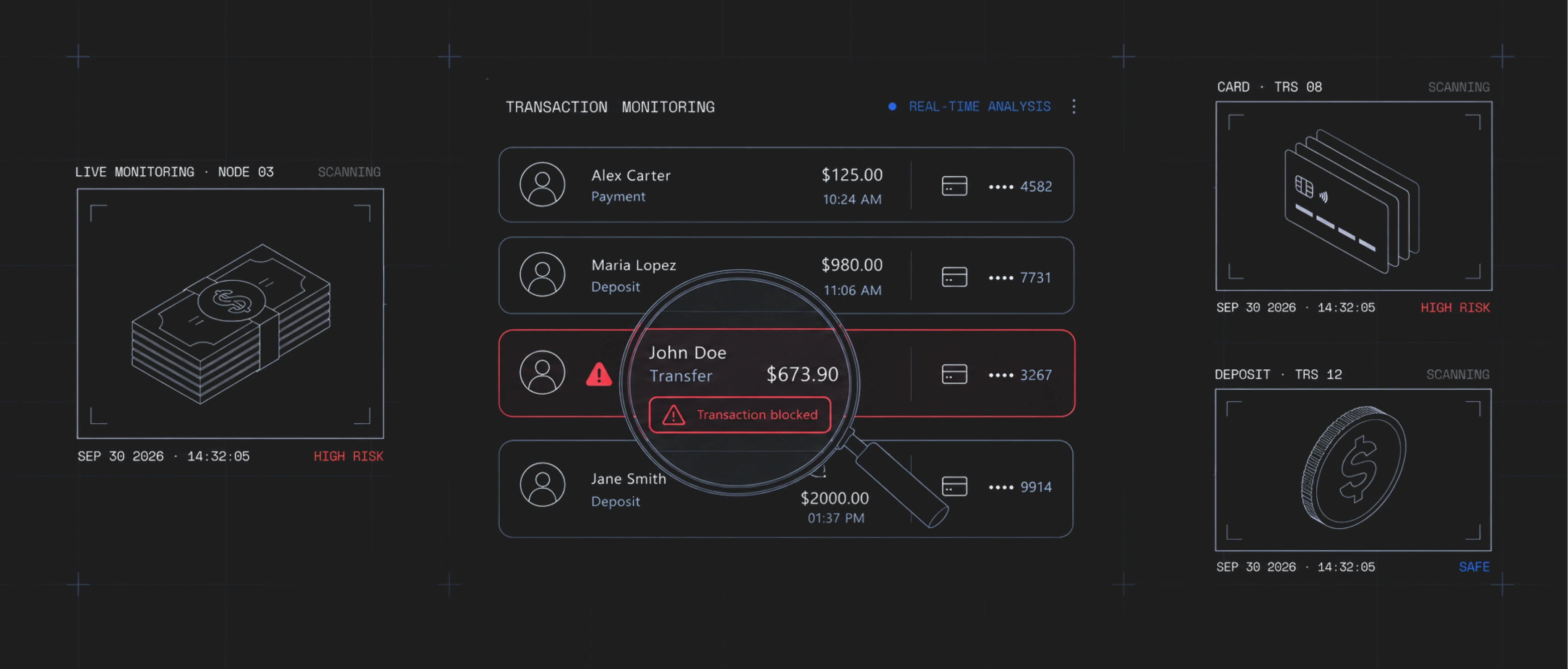
Real-time monitoring: Member transactions can be blocked, suspended, or flagged in real time before they settle, rather than only being reviewed after the fact.
Support model: Flagright markets a support model built around a dedicated customer success manager and direct access to compliance practitioners, rather than a ticket queue. That's a meaningful difference for a two- or three-person compliance team that can't afford multi-day turnaround during an active investigation. A credit union customer testimonial on Flagright's own site describes the platform as intuitive to learn and the support as responsive; as with any vendor-published testimonial, this reflects an individual customer's experience.
Total cost of ownership: Flagright markets AI Forensics and automation designed to reduce false positives and analyst workload. The company's own investor coverage notes that its headline false-positive reduction figures are self-reported and not independently audited, so credit unions should treat these as directional and request an institution-specific pilot before relying on them.
Where it has room to improve: Flagright is a substantially younger company than Verafin. Even with the Catalyst win, it doesn't have Verafin's decade-plus track record with credit union examiners, or an equivalent, well-populated 314(b) collaboration network, at this stage. Some G2 reviewers also note that reporting features have room for improvement, and one Capterra reviewer cited a dashboard learning curve. A credit union weighing Flagright against Verafin is weighing a newer platform's speed, configurability, and support model against an incumbent's longer institutional track record and larger information-sharing network. That tradeoff is worth evaluating directly in the demo, rather than assuming an answer in either direction.
Material considerations before deciding
- Ask directly how large and active a vendor's 314(b) or consortium network actually is; a large headline institution count means little if the credit union's peer set within it is thin.
- If evaluating Verafin's new agentic AML and fraud analysts, ask specifically what is generally available today versus still in beta, since the rollout is phased through 2026.
- Request a reference from a credit union of comparable asset size for any vendor, rather than a general customer logo, since credit union budgets and staffing scale tightly with asset size.
- Confirm 314(a) search turnaround time in a live demo against the sub-24-hour benchmark examiners increasingly expect, rather than accepting a general "automated" claim.
- Treat any self-reported false-positive reduction figure as directional, and request an institution-specific pilot before relying on it for a board or examiner presentation.
FAQ
Which AML software should a credit union choose?
It depends on budget and priorities. Verafin is the most entrenched choice, with the longest credit-union-specific track record and the largest 314(b) information-sharing network. Newer AI-native platforms like Flagright are worth serious consideration for credit unions that want real-time monitoring, no-code configuration, and a lower total cost of ownership. Bank-centric enterprise platforms like NICE Actimize are generally the wrong fit outside the largest credit unions.
Is Nasdaq Verafin required for credit unions, or just the most common choice?
It's not required. Verafin is the CUNA Strategic Services-endorsed platform and the most widely adopted in the credit union segment, largely because of its long track record with examiners and its consortium information-sharing network. NCUA doesn't mandate a specific vendor, though. Newer platforms can meet the same regulatory requirements, and the right choice depends on a credit union's budget, staffing, and how much it values network size versus deployment speed and configurability.
What is 314(b) information sharing and why does it matter for a credit union's platform choice?
Section 314(b) of the USA PATRIOT Act lets financial institutions share information about suspected money laundering or terrorist financing with each other under a legal safe harbor. A platform's value here scales directly with how many other institutions are actively participating in its network, since the point is catching cross-institution patterns a single credit union's own data would never reveal.
How fast should a credit union be able to complete a 314(a) search?
FinCEN requires searching 12 months of account records and 6 months of transaction records, including non-account holders. Many examiners now treat a sub-24-hour turnaround as best practice, even though no regulation states that exact timeframe. Credit unions should ask any vendor to demonstrate this workflow end to end, rather than take a general automation claim at face value.
Are bank-centric enterprise AML platforms like NICE Actimize ever the right choice for a credit union?
Generally only for the largest credit unions, whose asset size and transaction complexity start to resemble a regional bank. These platforms are built for large compliance departments and enterprise budgets that most credit unions don't have. Their implementation complexity is also a real cost for an institution without the internal resourcing to absorb it.
Should a credit union trust a vendor's self-reported false-positive reduction numbers?
Treat them as directional rather than proven for your institution. Most vendors in this category, including both incumbents and newer entrants, publish false-positive reduction figures without disclosing an independent audit methodology. Ask for an institution-specific pilot using your own transaction data before relying on any vendor's headline number in a board or examiner presentation.
Does a newer AML vendor without Verafin's track record carry more risk for a credit union?
It carries a different kind of risk, rather than automatically a larger one. A newer platform may have a shorter history with credit union examiners and a smaller information-sharing network. But it may also offer faster deployment, more configurable no-code rules, and a lower total cost of ownership. Named customer wins in the credit union sector specifically, rather than testimonials alone, are a reasonable way to gauge how proven a newer vendor actually is in this segment.
Bottom line
For most credit unions, the choice comes down to how much weight to put on network size and track record versus deployment speed, configurability, and cost. Verafin is the safest default for a credit union that wants the largest 314(b) network and the longest institutional history with examiners, and it's worth the cost and consultation-based pricing for those priorities. Flagright and similar AI-native platforms are worth serious evaluation for a credit union that wants real-time monitoring, no-code rule tuning, and a lower total cost of ownership, particularly given Flagright's growing list of named credit-union-sector customers. NICE Actimize and comparable bank-centric enterprise platforms remain the wrong starting point for all but the largest credit unions. Whichever platform you evaluate, get a live demo of 314(a) turnaround time, ask exactly how populated any information-sharing network really is, and request an institution-specific pilot before trusting a vendor's false-positive numbers.