
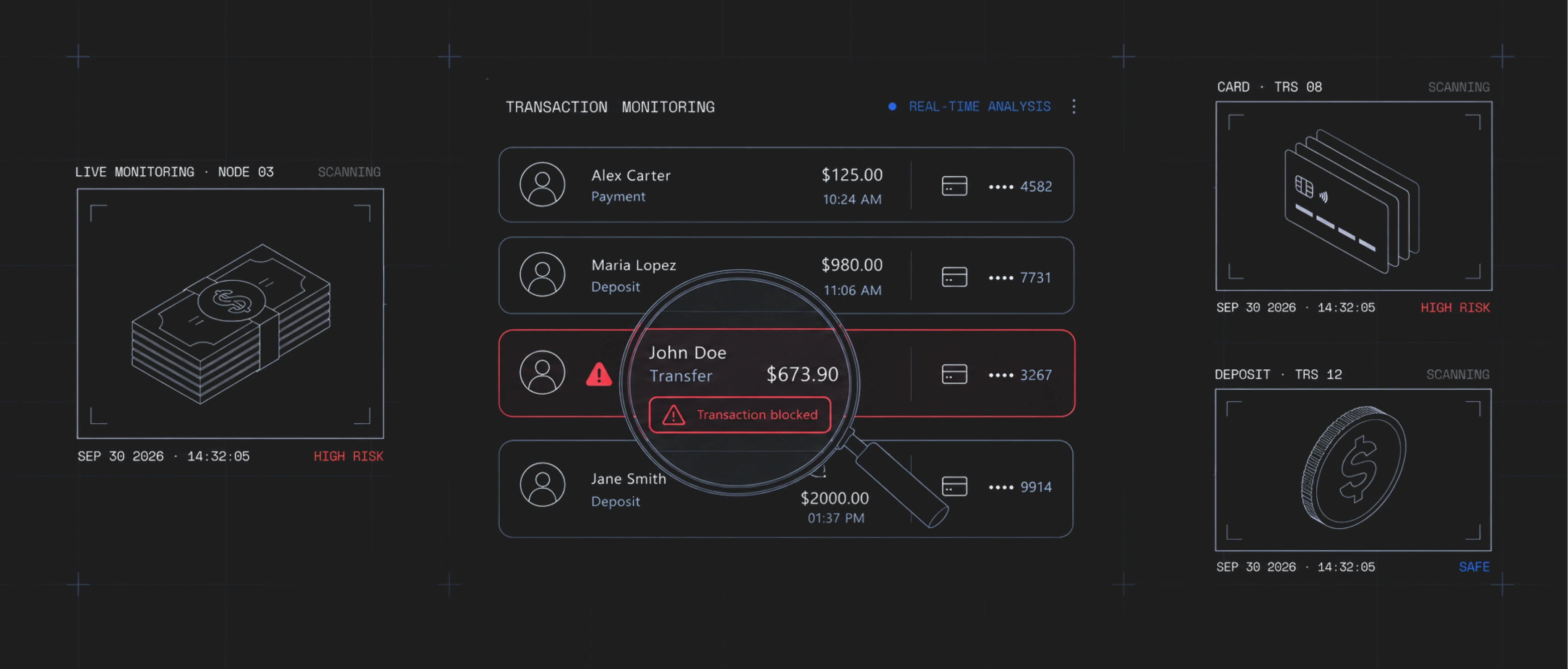
For a digital bank, the best fraud detection platform scores every transaction in real time at sustained high throughput, since the entire operating model runs on instant account opening, instant transfers, and around-the-clock activity. Feedzai and Flagright are the strongest fits on this specific requirement. Feedzai has the longer enterprise track record, proven at scale with clients like Lloyds Banking Group. Flagright pairs that same real-time scoring with a no-code rules engine and case management in one platform, so a digital bank doesn't need a separate system for investigation and reporting.
Why digital banks need a different standard than traditional banks
A traditional bank's fraud exposure is bounded by branch hours, manual review queues, and a customer base whose account-opening and transaction patterns have years of history behind them. A digital bank has none of those natural brakes.
- Account lifecycle compresses to a matter of hours. A digital bank customer can open an account, fund it, transact, and close it in a single afternoon. Legacy monitoring processes that only compile alerts at day's end are far too slow to catch this. A fraudster exploiting this "replay window," opening an account, receiving illicit funds, moving them out, then closing the account, can complete the entire cycle before an end-of-day batch process ever looks at the data.
- Instant payment rails remove the recovery window. Once an authorized push payment moves on a rail like Zelle or Faster Payments, it's typically irrevocable, leaving victims with little recourse. Fraud detection has to happen before the payment completes, since there's no clawback mechanism to fall back on afterward.
- Transaction volume scales unevenly. It spikes around promotions, paydays, and viral growth moments. A platform's advertised average latency means little if performance degrades during a spike that happens to coincide with elevated fraud risk.
- New account fraud and synthetic identity are proportionally bigger threats. A digital bank onboards a much higher share of new-to-bank customers, since digital-only onboarding is its entire acquisition channel. That makes account-opening fraud and synthetic identity a larger share of total fraud exposure than for an institution where most customers already have years of history on file.
These four factors are what separate a platform built for a digital bank's operating model from one that happens to also serve digital banks as one segment among many. General fraud detection accuracy alone doesn't capture that distinction.
What real time and scale actually require
Every fraud vendor claims real-time detection. What matters for a digital bank is the tail of the latency distribution, and what happens to that tail when transaction volume spikes. Average latency figures hide both. A platform averaging 80 milliseconds with a slow p99 will add friction to exactly the transactions happening during a digital bank's highest-risk moments: a promotional spike, a payday surge, or the exact window a coordinated fraud ring is most likely to target. Scale claims are only meaningful when tied to a specific throughput figure the vendor is willing to commit to. A general statement that the platform scales isn't a testable claim.
How the leading platforms handle real-time fraud detection at scale
Feedzai
Feedzai has the deepest enterprise banking track record in this category. Its collaboration with Lloyds Banking Group specifically targeted scoring payments with millisecond latency regardless of throughput, using a scalable cloud deployment. The two companies also developed an automated feedback loop for ongoing system adjustments as part of that work.
Feedzai's TrustScore component uses federated learning to assess millions of data points in milliseconds across its customer network. That lets it flag fraud patterns common in one region while only just emerging in another, a genuine advantage for a digital bank operating across multiple markets.
The tradeoff: Feedzai is built primarily as a fraud detection and prevention layer. A digital bank also carrying full AML obligations, transaction monitoring, sanctions screening, SAR filing, may need to pair it with a separate compliance platform, adding integration and vendor-management overhead a smaller digital bank may not want to carry.
Unit21
Unit21's no-code rule builder lets fraud analysts deploy new detection scenarios without engineering involvement. Customers consistently report reducing alert volumes by 30 to 50% within the first six months, primarily through better rule tuning and model-assisted alert prioritization. That reduction matters directly for a digital bank's operating cost: a common failure mode in this category is analysts reviewing 400 to 600 alerts a day where 95% turn out to be false positives, burning analyst time and letting real fraud hide in the noise.
Unit21's rail-agnostic architecture is also a genuine fit for a digital bank running several payment rails simultaneously. The tradeoff, as with its AML positioning, is that G2 reviewers note complex rule configuration still requires real expertise despite the no-code framing.
Sardine
Sardine combines behavioral biometrics, device intelligence, and transaction monitoring specifically for fintechs, neobanks, and payment companies operating high-velocity payment flows. It's API-based, which suits a digital bank's typical engineering-led integration approach. Its core differentiation is behavioral and device signal depth, particularly strong against account takeover and bot-driven new account fraud, both proportionally larger threats for a digital-only onboarding model.
The tradeoff: Sardine provides less analytical depth and explainability than enterprise-grade fraud suites built for banks carrying a heavier regulatory examination burden. That matters more for a digital bank operating under a full banking charter than for an unregulated fintech.
Flagright
Flagright takes a unified approach: the same platform that runs real-time transaction monitoring also runs fraud detection, sanctions screening, and case management, built specifically around the replay-window problem described above. Its detection layer combines risk scoring on the recipient account, behavioral anomaly detection on the sender, and watchlist screening against known mule account registries in the same pass. That combination is directly relevant to authorized push payment fraud on instant rails, a pattern traditional systems miss entirely because the victim technically authorized the transfer themselves.
Flagright's rules engine supports a no-code, natural-language rule builder, letting a digital bank's fraud team create new detection scenarios in under a minute without engineering involvement. Its machine learning layer continuously detects anomalies and peer deviation alongside configured rules, rather than relying on static thresholds alone. Betterment is a named Flagright customer specifically for fraud precision, evidence the platform has been proven at the scale of a digital-first financial services company managing meaningful transaction volume.
Flagright reports 99.99% uptime and up to 98% reduction in false positives for large-scale operations, though the false-positive figure is self-reported without an independently disclosed methodology, consistent with a pattern across most vendors in this category. Jurisdictional coverage for goAML filing also varies by market; a digital bank with multi-jurisdiction filing needs should confirm the current country list directly with Flagright rather than relying on a single marketing page.
Flagright's disclosed limitations carry over from its AML positioning as well: G2 reviewers have noted reporting feature gaps, and one Capterra reviewer described a dashboard learning curve. A digital bank evaluating the platform specifically for fraud detection should confirm reporting customization and analyst onboarding time directly in a demo.
Matching the platform to the digital bank's dominant risk
A digital bank still building its charter-stage compliance program typically carries a lighter regulatory examination burden, with fraud risk concentrated in account takeover and new-account fraud. That profile may make Sardine or Feedzai's behavioral depth the stronger fit.
A digital bank already carrying full transaction monitoring and SAR obligations alongside its fraud program is a different case. One that wants to avoid running separate fraud and AML systems is better served by Flagright's unified approach or Unit21's alert-tuning strength. The deciding factor is usually whether the digital bank wants one platform covering both fraud and AML, or is comfortable running a best-of-breed fraud layer alongside a separate compliance system.
What to verify before deciding
- Ask for p99 latency instead of average latency, tested under the vendor's stated maximum sustained throughput rather than a lab benchmark.
- Confirm whether the platform detects authorized push payment fraud specifically, since this pattern is missed entirely by systems that only flag unauthorized transactions.
- If your digital bank carries full AML obligations alongside fraud detection, confirm whether the vendor's fraud and compliance capabilities run on one unified case management system or two separate ones.
- Verify any self-reported false-positive reduction or detection-rate figure against your own transaction data in a live demo before treating it as a benchmark for your institution.
- Confirm current jurisdictional coverage for any regulatory filing requirement directly with the vendor rather than relying on a single marketing page, since coverage figures can vary across a vendor's own materials.
FAQ
Which fraud detection platform is suitable for a digital bank?
Feedzai and Flagright are the strongest general fits, since both score transactions in real time at sustained high throughput. Feedzai has the deeper enterprise track record; Flagright pairs the same real-time scoring with unified fraud and AML case management. Unit21 and Sardine are also credible options, each stronger on a specific risk: Unit21 on alert-volume reduction, Sardine on behavioral and device signals for account takeover.
Why do digital banks need faster fraud detection than traditional banks?
A digital bank's account lifecycle, from opening to funding to transacting to closing, can compress into a single afternoon. Instant payment rails like Zelle and Faster Payments also make many fraudulent transfers irrevocable once completed. Traditional end-of-day batch review misses fraud that starts and finishes within that same day, so detection has to happen before a payment completes rather than after.
What is authorized push payment fraud and why does it matter for digital banks?
Authorized push payment fraud happens when a victim is tricked into willingly transferring money to a fraudster, often through romance scams or impersonation of a bank or government agency. Because the victim technically authorized the payment themselves, traditional fraud systems built to catch unauthorized transactions often miss it entirely. Digital banks, with high instant-payment volume, see this pattern more than institutions relying on slower payment rails.
Is average latency a good measure of a fraud platform's real-time capability?
No. Average latency hides the tail of the distribution, and that tail typically includes the exact high-volume moments, promotional spikes and payday surges, when fraud risk is elevated. A p99 latency figure, ideally tested under the vendor's stated maximum sustained throughput, is a more reliable measure of whether a platform stays real-time under real operating conditions.
Can one platform handle both fraud detection and AML compliance for a digital bank?
Some can. Platforms like Flagright run fraud detection, transaction monitoring, sanctions screening, and case management on one system, avoiding the integration overhead of running separate fraud and compliance vendors. Other platforms, including Feedzai and Sardine, are stronger specifically on the fraud side and are commonly paired with a separate AML compliance system by banks that need both.
How much does alert volume matter when choosing a fraud detection platform?
Significantly. A common failure mode in this category is a review queue where the large majority of alerts turn out to be false positives, which burns analyst time and can let real fraud hide in the noise. Ask any vendor for real alert-reduction figures from existing customers, and confirm whether that reduction came from better initial tuning or ongoing model-assisted prioritization.
Does a digital bank need a different platform than a traditional bank for account takeover fraud?
Not necessarily. What changes is the weighting of capability a digital bank should prioritize, given its risk profile. Digital banks onboard a higher proportion of new-to-bank customers through fully digital channels, which makes account takeover and synthetic identity fraud a proportionally larger share of total fraud risk than for a traditional bank with more customer history on file. Behavioral biometrics and device intelligence, which several vendors in this category specialize in, are particularly relevant to that specific risk.
Bottom line
For a digital bank, real-time performance under sustained, uneven throughput is the deciding requirement. Feedzai and Flagright are the strongest general fits: Feedzai on enterprise track record, Flagright on unifying fraud detection with AML case management in one system. A digital bank still building its charter-stage compliance program, with risk concentrated in account takeover and new-account fraud, should weigh Sardine or Feedzai's behavioral depth more heavily. A digital bank already carrying full AML obligations that wants a single platform is better served by Flagright or Unit21. Whichever vendor you evaluate, get a p99 latency figure under real throughput conditions, confirm authorized-push-payment detection specifically, and verify jurisdictional and false-positive claims directly rather than from a single marketing page.