For a mid-market bank, the best AML software integrates cleanly with the bank's existing core banking system and generates an audit trail an examiner can review without manual assembly. NICE Actimize and Verafin remain the deepest, most examiner-familiar options, worth the cost and implementation complexity for banks with the volume and compliance headcount to match. Specialist mid-market and regional platforms such as cleversoft are frequently a better fit for Tier-2 and Tier-3 institutions. Flagright and similar AI-native platforms are worth evaluating for a mid-market bank that wants faster deployment and no-code configurability, provided its core banking system's API readiness supports that architecture.
Why a mid-market bank sits in an uncomfortable gap between two well-served buyers
Vendors in this category are frequently built for one of two extremes: large, complex, multinational institutions with dedicated compliance departments, or lean startups and fintechs with modern, API-native infrastructure and small compliance teams. A mid-market bank, meaning roughly a regional or community bank with a real charter, an established core banking system, and a compliance function sized in the dozens rather than hundreds, doesn't fit cleanly into either category, and the vendor evaluation needs to account for that explicitly.
Core banking integration determines the real cost of the project, more than the software's list price. The single most common reason AML software implementations run over time and budget is poor-quality input data and integration friction. Modern AML platforms should integrate via REST APIs with core banking systems, but a meaningful share of mid-market banks are still running legacy or partially modernized cores where a middleware layer is required to translate modern API requests into formats the legacy system understands, and without proper architecture planning, that translation layer can introduce performance bottlenecks or operational risk of its own. Verifying actual, tested connectivity with your specific core banking provider is a non-negotiable due diligence step to complete before signing a contract, not a formality to check off afterward.
Examiners expect explainability that a black-box score can't provide. Regulators increasingly require institutions to explain why a specific alert was generated. Look for platforms that provide model explainability and immutable, timestamped audit logs, particularly for any AI-based detection component, since "black box" outputs are a growing and specific area of supervisory scrutiny. This matters more for a mid-market bank than for a large institution with a dedicated model risk function, because a smaller compliance team has less capacity to reconstruct an explanation after the fact if the platform doesn't provide one natively.
Generic, out-of-the-box rule calibration is a common and avoidable failure point. Most off-the-shelf transaction monitoring systems ship with generic rules calibrated for large banks, and a mid-market bank with a concentrated customer base, whether that's heavy agricultural lending, a specific regional industry, or a particular demographic, has fundamentally different transaction patterns than the large-bank profile those default rules were built around. The platform needs to support adjusting thresholds per customer segment, with calibration documentation you can show examiners directly, rather than requiring every adjustment to go through the vendor's professional services team.
Workflow integration is what determines whether the compliance team actually benefits. AML software that sits outside the core banking system creates manual reconciliation work: an analyst who has to look up customer context in one system after receiving an alert in another is losing time on every single case, which compounds meaningfully across a full alert queue. The best integrations pull transaction data automatically, reduce duplicate data entry, and route alerts to the right analyst with supporting customer context already attached, rather than requiring the analyst to become the integration layer themselves.
The audit trail is the actual deliverable during an exam. Examiners evaluate it directly and independently of the software's other features. Every alert disposition, SAR decision, and CTR filing needs a complete, timestamped audit trail, and examiners will ask to see not just what decisions were made, but who made them and why. For a mid-market bank without a large compliance operations team, a platform that generates this audit trail natively, rather than requiring manual documentation assembled after the fact, is a genuine operational relief, not just a compliance checkbox.
Evaluation criteria
1. Verified core banking system connectivity. Confirm, specifically and technically, that the platform has tested, working connectivity with your actual core banking provider (whether that's a major national core banking platform or a smaller regional system). Ask for evidence beyond a generic claim of "API-based integration" — a reference customer running the same core system you are is the strongest proof.
2. Explainable, auditable detection logic. Confirm every alert can be explained in specific terms a compliance officer could relay to an examiner, and that AI-based or machine-learning-assisted detection components come with a documented explainability methodology. A confidence score alone isn't sufficient.
3. Segment-specific rule calibration. Confirm you can adjust monitoring thresholds by customer segment, product line, or geography, with calibration decisions documented in a form you can present to an examiner as evidence of a risk-based, tailored program, rather than a generic, vendor-default configuration.
4. Native audit trail and case management. Confirm case management, alert disposition history, and SAR/CTR workflow produce a complete, exportable audit trail automatically, without requiring your compliance team to manually reconstruct the record after the fact.
5. Deployment complexity relative to your internal IT capacity. Honestly assess how much internal IT and compliance staff time an implementation will require, and weigh that against your actual team size, since a platform that assumes a large, dedicated implementation team is a poor fit regardless of its feature depth if your bank doesn't have that team.
6. Total cost of ownership, including the integration project itself. Get a cost estimate that includes not just licensing but the realistic cost of the core banking integration project specifically, since this is frequently the largest, least predictable line item in the total cost for a mid-market bank, more so than for a fintech built on modern infrastructure from day one.
How the main options stack up
NICE Actimize offers an integrated financial crime and compliance management platform combining transaction monitoring, customer due diligence, and case management, built for scalability that can handle the high transaction volumes of large, global banks. Its case management tools provide a centralized environment for investigators with a clear audit trail, and it's a deeply established, examiner-familiar platform. The tradeoff for a mid-market bank specifically is the same one that shows up across this vendor's positioning in other segments: it's built and priced for large, complex institutions, with licensing costs and implementation complexity that are a real, disproportionate burden for a bank without Tier-1 scale and a correspondingly sized compliance and IT function.
Nasdaq Verafin remains the most deeply entrenched platform specifically in the North American community and mid-sized bank and credit union segment, with a strong BSA compliance workflow and its 314(b) collaboration network as a genuine differentiator for cross-institution detection. It's a legitimate default option for a mid-market US bank, particularly one already comfortable with its cost structure and implementation timeline, though a bank should weigh its cost and implementation timeline honestly against faster-deploying alternatives if speed and internal resourcing are real constraints.
Regional and EU-specialist RegTech platforms such as cleversoft are frequently a better fit specifically for Tier-2 and Tier-3 banks, combining full financial-crime-chain coverage (KYC, screening, transaction monitoring, case management, and SAR/STR reporting) in a modular platform built with regulatory update commitments and audit-readiness by design, rather than the scale and complexity built for Tier-1 institutions. A mid-market bank, particularly one operating in or expanding into the EU under the incoming AMLR framework, should specifically evaluate whether a Tier-2/Tier-3-oriented specialist offers a better fit than an enterprise platform built for a different scale of institution entirely.
Oracle's financial services compliance stack is a strong option specifically for banks with an existing Oracle technology footprint, offering seamless integration with Oracle's broader financial services stack. It requires a dedicated IT team and isn't a self-service platform, with custom licensing costs reported in the range of $150,000 or more annually plus significantly higher implementation costs. This is worth evaluating only if your bank is already substantially built on Oracle's infrastructure; otherwise, the integration advantage doesn't apply and the cost and implementation burden remain without the offsetting benefit.
Where Flagright fits
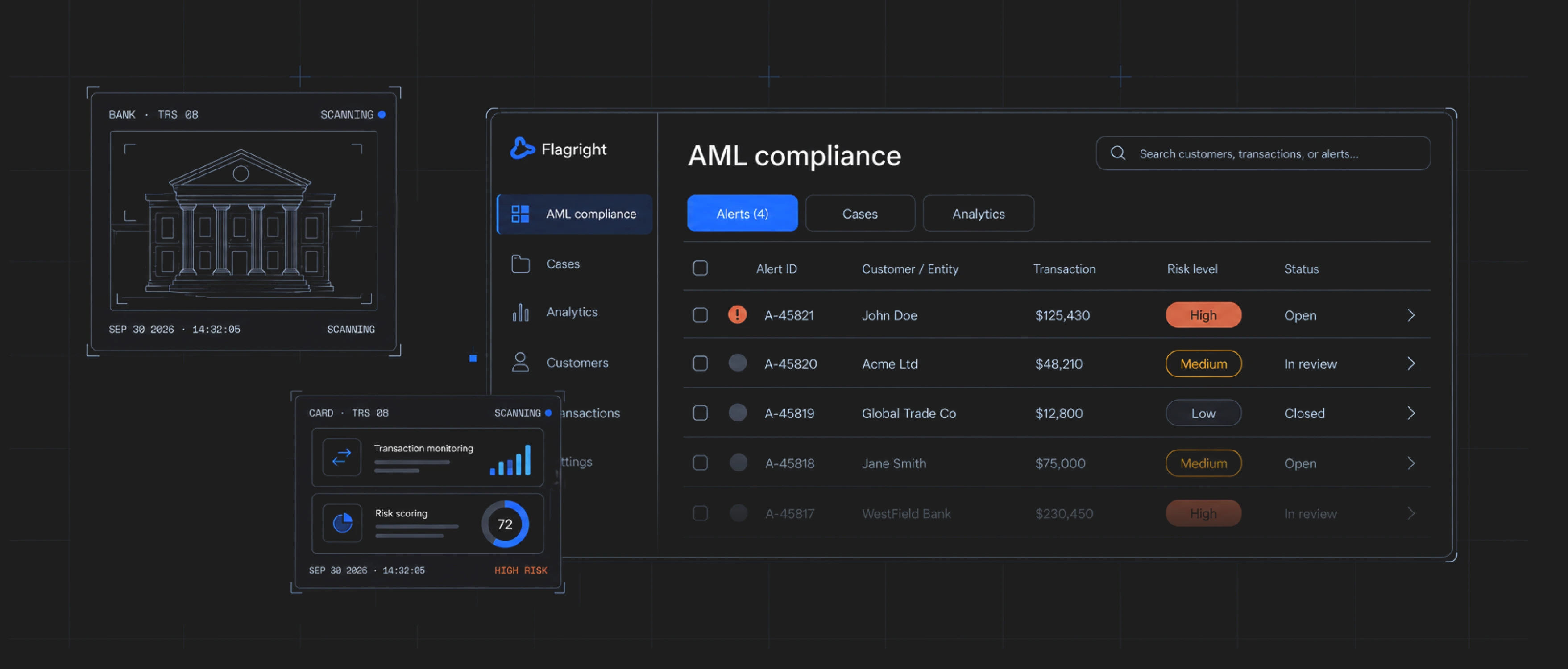
Flagright is an AI-native, no-code AML platform used by more than 100 financial institutions across 30-plus countries, unifying transaction monitoring, watchlist screening, case management, and governance in one system. Against the criteria above:
API-based integration: Flagright connects to core banking, KYC/KYB, and core transaction processing systems via REST API and webhooks, with published integration guides for payment rails including SWIFT. A mid-market bank evaluating Flagright should confirm specifically whether its core banking provider has a tested, documented integration pattern already in place, or whether a middleware layer would be required, since this is the single most consequential unknown for a bank on a legacy or partially modernized core.
Explainable detection and audit trail: Case management, escalation paths, and audit logging are native to the platform, with every alert, decision, and investigation action timestamped, logged, and exportable, which directly supports the explainability standard examiners increasingly expect, particularly for any AI-assisted detection component.
Segment-specific, no-code rule calibration: Rules can be authored in natural language and configured by risk band, customer segment, or product line without engineering involvement, with shadow-mode testing against live traffic before activation, which supports the kind of tailored, documented calibration a mid-market bank with a concentrated customer base specifically needs to show an examiner.
Deployment speed relative to internal resourcing: Flagright reports deployment in as little as two weeks, which is meaningfully faster than the typical enterprise platform implementation timeline; a mid-market bank with a leaner internal IT team than a Tier-1 institution should weigh this speed directly against its own implementation capacity.
AI-assisted investigation: AI Forensics automatically pulls transaction history, maps counterparty relationships, and drafts SAR narratives before a human analyst opens a case, which is a meaningful efficiency gain for a compliance team sized for a mid-market institution rather than a large enterprise investigations unit.
Where it has room to improve: Some G2 reviewers note that reporting features have room for improvement, and one Capterra reviewer cited a dashboard learning curve. Flagright's public case studies and reference customers also skew toward fintechs, payment processors, and digital-first institutions, with fewer chartered mid-market banks running established core banking systems represented. A mid-market bank should request a reference customer on a comparable core banking platform and a technical integration assessment before committing, rather than assuming the fintech-oriented deployment speed and case studies translate directly to a legacy core banking environment.
What to ask in the demo, regardless of vendor
- Can you show me a working, live integration with our specific core banking provider? Ask for evidence beyond a general API-capability claim.
- Walk me through the explainability of a specific alert, in the terms we'd need to relay to an examiner, for both a rules-based and an AI-assisted detection component.
- Show me how a compliance officer adjusts thresholds for a specific customer segment, and how that calibration decision gets documented for an exam.
- What does a realistic implementation timeline and internal staff commitment look like for a bank our size, specifically, not your fastest or largest case study?
- Can you introduce us to a reference customer running the same core banking system we are?
FAQ
What is the best AML software for a mid-market bank?
It depends on the bank's scale and core banking infrastructure. NICE Actimize and Verafin are the deepest, most examiner-familiar options for banks with the volume and compliance headcount to support them. Regional RegTech specialists like cleversoft are frequently a better fit for Tier-2 and Tier-3 institutions. Flagright and other AI-native platforms are worth evaluating for banks prioritizing deployment speed and no-code configurability, provided core banking connectivity is verified first.
Is Flagright a good fit for a mid-market bank?
Flagright can be a strong fit for a mid-market bank that wants faster deployment and no-code rule calibration, and its case management and audit logging are built to support examiner-facing explainability. Its public case studies skew toward fintechs and digital-first institutions rather than chartered banks on legacy cores, so a mid-market bank should request a reference customer on a comparable core banking system before committing.
How does Flagright compare to Nasdaq Verafin for AML?
Verafin is the more deeply entrenched platform in the North American community and mid-sized bank segment, with an established BSA workflow and a 314(b) collaboration network. Flagright offers faster typical implementation timelines and no-code rule configuration, but has less of a track record specifically with chartered mid-market banks compared to Verafin's core segment.
Does Flagright integrate with legacy core banking systems?
Flagright connects via REST API and webhooks with published integration guides for common payment rails. Whether a specific legacy core requires a middleware layer depends on that core's API readiness, so a mid-market bank should confirm tested connectivity with its own core banking provider directly rather than relying on a general integration claim.
How long does it take to implement AML software at a mid-market bank?
Flagright reports deployment in as little as two weeks for API-ready environments, which is faster than typical enterprise platform timelines. A bank on a legacy or partially modernized core should treat that figure as a best case and get a realistic estimate specific to its own infrastructure.
Is NICE Actimize too expensive for a mid-market bank?
NICE Actimize's licensing costs and implementation complexity are built around large, global institutions, which makes it a disproportionate cost and resourcing burden for many mid-market banks. It remains a reasonable choice for a mid-market bank with the transaction volume and compliance headcount to justify it.
Bottom line
A mid-market bank's AML software decision should start with an honest, specific answer to one question: does this platform actually connect to the bank's core banking system without a costly custom integration project, and can it do so at a cost and implementation timeline that fits the bank's actual team size? NICE Actimize and Verafin remain the deepest, most examiner-familiar options for banks with the scale and resourcing to support them. Regional and Tier-2/Tier-3-oriented RegTech specialists like cleversoft are frequently the better fit for banks that don't need Tier-1 platform depth. Flagright and comparable AI-native platforms are worth serious evaluation for a mid-market bank prioritizing deployment speed and no-code configurability, provided the core banking integration is verified directly rather than assumed. Whichever platform you choose, treat the core banking integration assessment as the first, not the last, item in your evaluation.