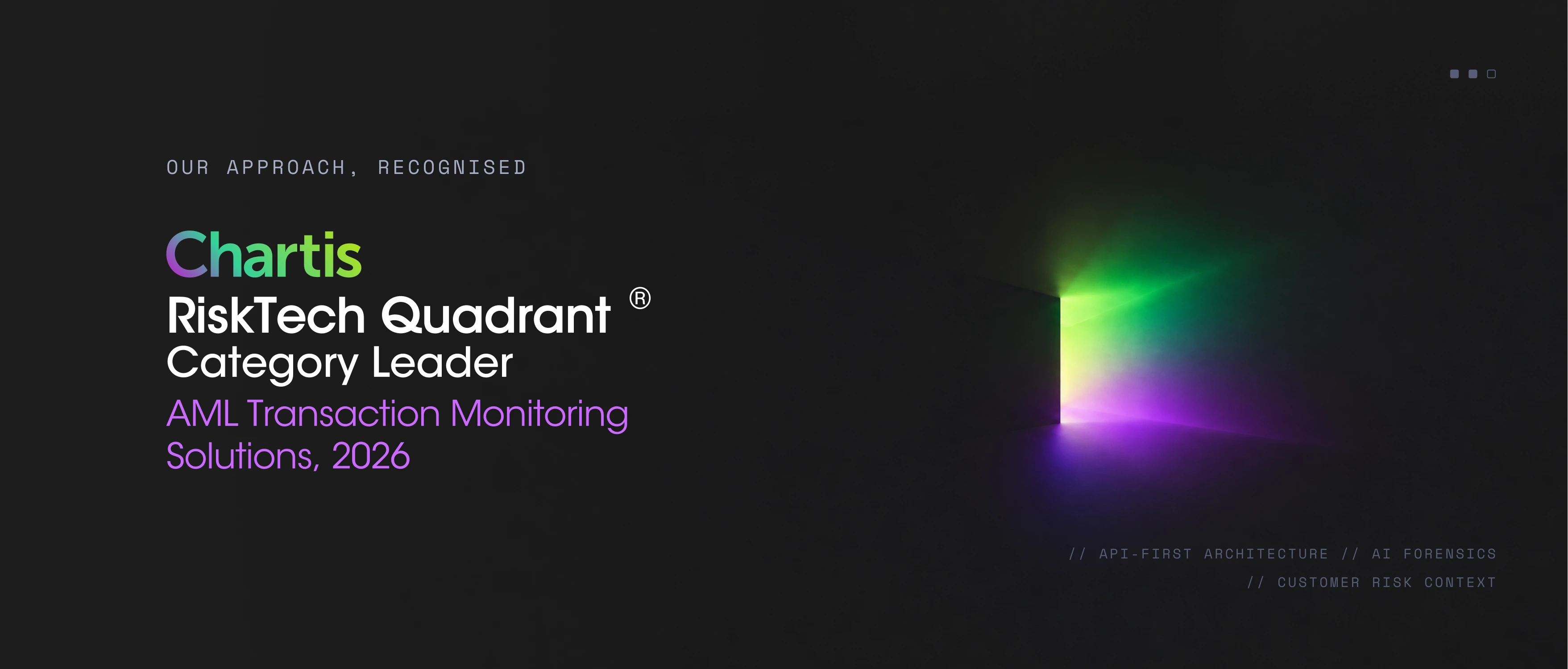
Flagright has been named a Category Leader in Chartis Research’s AML Transaction Monitoring Solutions, 2026: Quadrant Update, published on 9 September 2026.
The recognition reflects capabilities at the center of how we build Flagright: connecting the data institutions need, helping teams investigate suspicious activity and bringing customer risk into the decision.
For a compliance team, the work continues after an alert fires. Someone must establish what happened, assess it against the customer’s circumstances and determine whether the evidence supports closure or escalation. The usefulness of a monitoring platform depends on how well it supports that work.
Chartis’s assessment addresses each of these areas.
“Flagright received a Category Leader designation in Chartis Research’s 2026 AML report, due in part to its API-first architecture that enables flexible integration across core banking platforms, third-party services and custom environments. In addition, its AI-powered forensics can accelerate complex investigations and support evidence-backed alert closure,” said Sean O’Malley, Research Director, Financial Crime and Control, at Chartis. “By continuously analyzing transaction, customer and behavioral patterns, the platform identifies deviations from normal activity and surfaces potentially suspicious behavior. Combined with customer-level risk scoring and a consolidated view of account and investigation data, these capabilities support more holistic risk assessment and help compliance teams focus on higher-risk activity.”
Customer context makes monitoring useful
A transaction has to be understood in context. An increase in payment activity might reflect a growing business. It might also be inconsistent with what an institution knows about that customer. Distinguishing between those possibilities requires access to relevant history and a way to assess the change.
That is why integration matters to the investigation itself. Relevant information can sit across core banking systems, third-party services and an institution’s own applications. Bringing it into the workflow gives the team more of the context needed to assess an alert.
Chartis specifically highlighted Flagright’s API-first architecture and its consolidated view of account and investigation data. Those capabilities support a connected approach to monitoring, where customer risk and activity can be assessed together.
Our transaction monitoring capabilities combine configurable rules with behavioral anomaly detection. Teams can use customer risk scores to apply thresholds appropriate to different risk bands. This gives an institution a way to reflect its risk assessment in how it monitors activity.
AI should help investigators reach supported decisions
An investigation has to make its reasoning inspectable. The team needs to understand which evidence supports a conclusion and where further review is required. A faster process is valuable when it helps people reach a sound decision and retain the basis for it.
Flagright’s AI Forensics operates within the investigation workflow, gathering relevant evidence, analyzing activity and preparing narratives with traceable context. Institutions can configure agents around their own standard operating procedures and test their behavior against historical cases.
Teams can assess agents in shadow mode or use recommendations subject to human review. That lets an institution evaluate how an agent performs within its own processes and decide where automation is appropriate. The institution remains responsible for setting those boundaries and reviewing outcomes.
The analyst commentary links AI-powered forensics to evidence-backed alert closure. That is a practical standard for evaluating investigative AI: can the team inspect the evidence, understand the conclusion and act on it with the appropriate oversight?
Monitoring must remain testable as it changes
An institution’s monitoring needs evolve as its products and customer activity change. Compliance teams need to adjust controls while retaining a clear record of what changed and why.
Flagright supports testing rules against historical transactions and running them in shadow mode on live activity before deployment. Rule versioning and configurable approval workflows help teams govern changes to their monitoring environment.
This makes testing part of the operating process. Teams can examine how a proposed rule behaves before introducing it into their active workflow, then preserve the history needed to review later decisions.
These are capabilities buyers can examine directly during an evaluation. Ask a provider to demonstrate a rule change, its test results and the approval process.
A connected approach to financial crime compliance
Flagright is the AI operating system for financial crime compliance. We connect transaction monitoring, investigations and customer risk so teams can carry the relevant context from detection through to a documented decision.
The Category Leader designation recognizes Flagright within AML transaction monitoring. For buyers, the next step is to examine these capabilities in practice: how the platform identifies a change in activity, assembles the evidence and supports the investigation that follows.
Book a demo to see how Flagright connects transaction monitoring, customer risk and investigations in your workflow.
.webp)

.webp)