
If you lead a compliance, fraud, or financial crime function at a bank, fintech, or payments provider, you have probably sat through a dozen AI pitches that promised to transform your operations. Most of them failed to answer the questions that actually matter in a regulated environment: Can I explain this to an examiner? Can I audit every decision? What happens when the AI is wrong?
AI forensics is a different kind of answer. It was built from the ground up for the specific demands of financial crime compliance, where explainability is not a feature but a legal requirement, and where a single unexplainable result can set an institution back years in its technology adoption journey.
This piece is a primer. By the end, you will understand what AI Forensics is, how it works, where it fits in your existing operations, and why it is becoming a strategic priority for financial crime leaders who want to scale without sacrificing control.
The Investigation Problem No One Talks About
Most of the conversation around financial crime technology focuses on detection; better models, sharper rules, fewer false positives. Detection is important. But detection is only half the problem.
Every alert your systems generate has to be investigated. Every screening hit on a sanctions list, every transaction monitoring flag, every adverse media match — each one requires a trained analyst to review it, gather supporting evidence, apply your institution's procedures, and reach a defensible conclusion. That process typically takes somewhere between five and fifteen minutes per alert, even for experienced investigators.
Now consider the scale. Transaction volumes are growing. Real-time payments are expanding. Regulatory scrutiny is intensifying. The result is a relentless, compounding volume of investigative work that no amount of hiring can keep pace with. Many compliance teams today are not just busy; they are structurally unable to clear their queues.
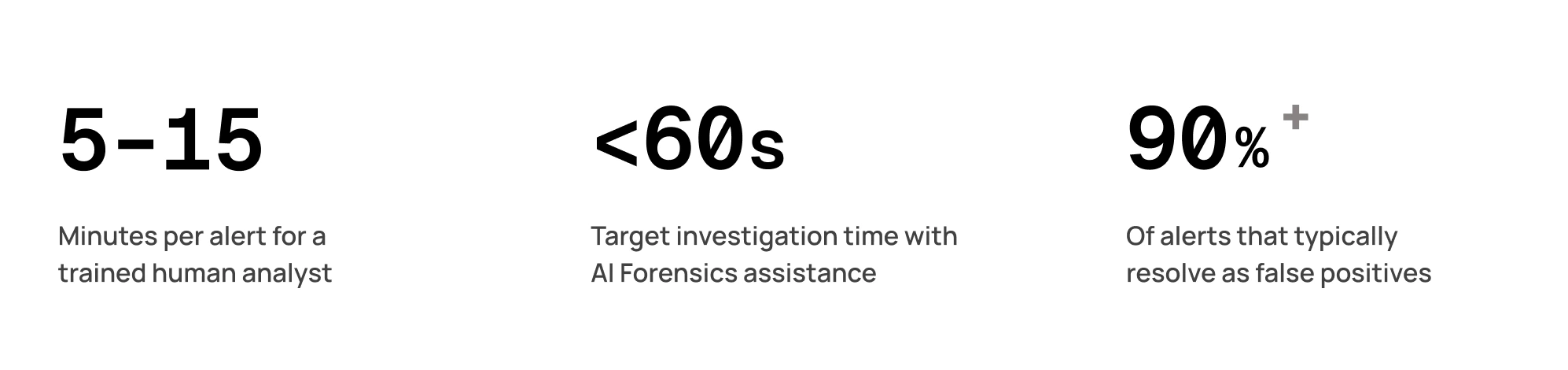
AI forensics was built to solve the investigation problem; not the detection problem.
What AI Forensics Actually Is
AI Forensics is a family of specialized AI agents, each purpose-built to perform a specific investigative task across AML compliance and fraud prevention. Think of them as digital investigators; autonomous, configurable, and governed by your institution's own standard operating procedures.
The key word in that description is "configurable." These agents do not arrive with a black-box logic that your team has to accept on faith. They work the way your institution works. They follow your SOPs. When you onboard onto an AI forensics platform, you upload your existing investigation procedures, and the system configures the agents to execute those procedures step by step, exactly as your analysts would, but in seconds and at unlimited scale.
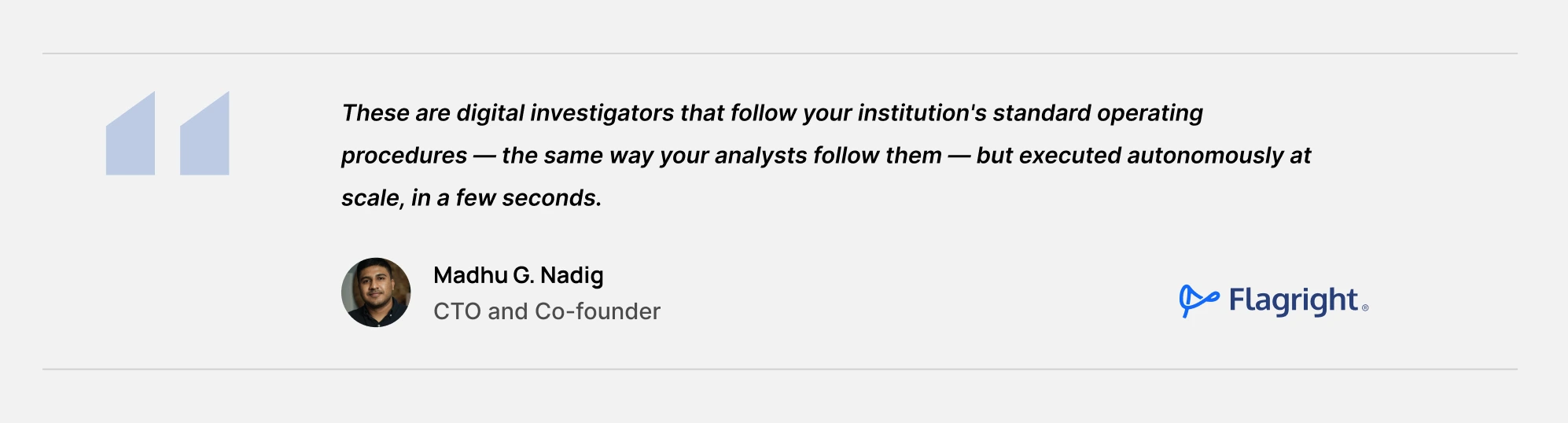
This distinction matters enormously for compliance leaders. You are not adopting a foreign AI logic. You are scaling the logic your institution has already approved, documented, and examined.
The Two Modes of Deployment
One of the most important design decisions in AI forensics is that institutions can choose how much autonomy the agents have. This is not a binary choice. It is a spectrum that allows compliance leaders to build confidence gradually and expand automation as trust develops.
Mode One: AI-Assisted Investigation
In this mode, AI forensics agents work alongside your human analysts. The agent handles the time-consuming groundwork: pulling data from multiple systems, gathering supporting evidence, cross-referencing against watchlists, summarizing findings, and generating a recommended disposition. The human analyst reviews the agent's work and makes the final judgment call; whether to close the alert, escalate it, or file a Suspicious Activity Report.
The impact here is significant even without full automation. Reducing the average investigation time from ten minutes to under two minutes effectively multiplies your team's capacity by a factor of five. A team that could previously clear one thousand alerts a week can now clear five thousand, without adding a single headcount.
Mode Two: Full Autonomy
As institutions build confidence in the agents and as regulators become more familiar with the compliance program's AI governance, many teams opt for full autonomy on defined categories of alerts. These are typically the high-volume, low-risk queues: routine sanctions screening hits where the entity is clearly not a match, or transaction monitoring alerts that consistently resolve to the same benign pattern.
Full autonomy does not mean unsupervised. Every action the agent takes is logged, reasoned, and auditable. The difference is that the human review happens at the governance level rather than the alert level; reviewing a sample of the agent's decisions rather than every individual case.
Getting Started: From SOP to Deployed Agent
The setup process for AI forensics is designed to be accessible to compliance teams without engineering resources. The typical path from zero to a deployed agent looks like this:
- Upload your institution's standard operating procedures to the platform — the same documents your analysts already use.
- The AI system parses the SOP and automatically generates an agent workflow that mirrors your procedures step by step.
- Your team reviews the proposed workflow, adjusts individual steps if needed, and signs off on the configuration.
- Before going live, you back-test the agent against your historical alert data, comparing its dispositions to what your analysts actually decided on those same cases.
- Once back-test results meet your confidence threshold, you deploy — either in assisted mode or full autonomy, depending on your risk appetite.
The entire process is no-code and self-serve. For most institutions, a first agent can be deployed in a matter of hours, not months.
The Trust Architecture: Why Explainability Is Built In
For executives, the trust question is the central question. AI that cannot be explained to an examiner is not usable in a regulated environment. Period.
Flagright's AI forensics platform addresses this through what might be called a trust architecture with explainability and auditability baked into the core of how the system works, not added as a reporting layer on top.
For every alert an agent investigates, the system generates a complete reasoning chain. Not a summary but a full trace of every step the agent took, every data source it consulted, every piece of evidence it considered, and the exact rationale it used to reach its conclusion. Auditors and examiners can follow that chain from the initial alert trigger to the final disposition, tracing every decision in between.
Agents are grounded in customer-defined SOPs and validated checklists. If the AI cannot support a finding with actual data from your systems, it simply does not make the finding. This constraint is architectural, not aspirational.
Continuous monitoring also prevents model drift over time — a common failure mode in production AI systems where performance degrades as the underlying data distribution changes. In AI forensics, governance is ongoing, not a one-time deployment event.
Why This Matters Now
The financial crime compliance landscape is changing in ways that make the status quo increasingly unsustainable. Regulatory expectations are rising. Transaction volumes are growing faster than headcount can follow. And the best analysts, the ones who know the nuances of your institution's risk appetite and have the judgment to handle complex cases, are spending the majority of their time clearing alerts that have no business being on their desks.
AI forensics does not replace the compliance function. It restructures it by taking the high-volume, procedural, data-intensive work off human analysts and handling it autonomously, so that skilled professionals can focus on the cases that actually require their expertise.
For compliance and technology executives who have been waiting for AI that is genuinely enterprise-ready for regulated environments, AI forensics represents a meaningful step forward.