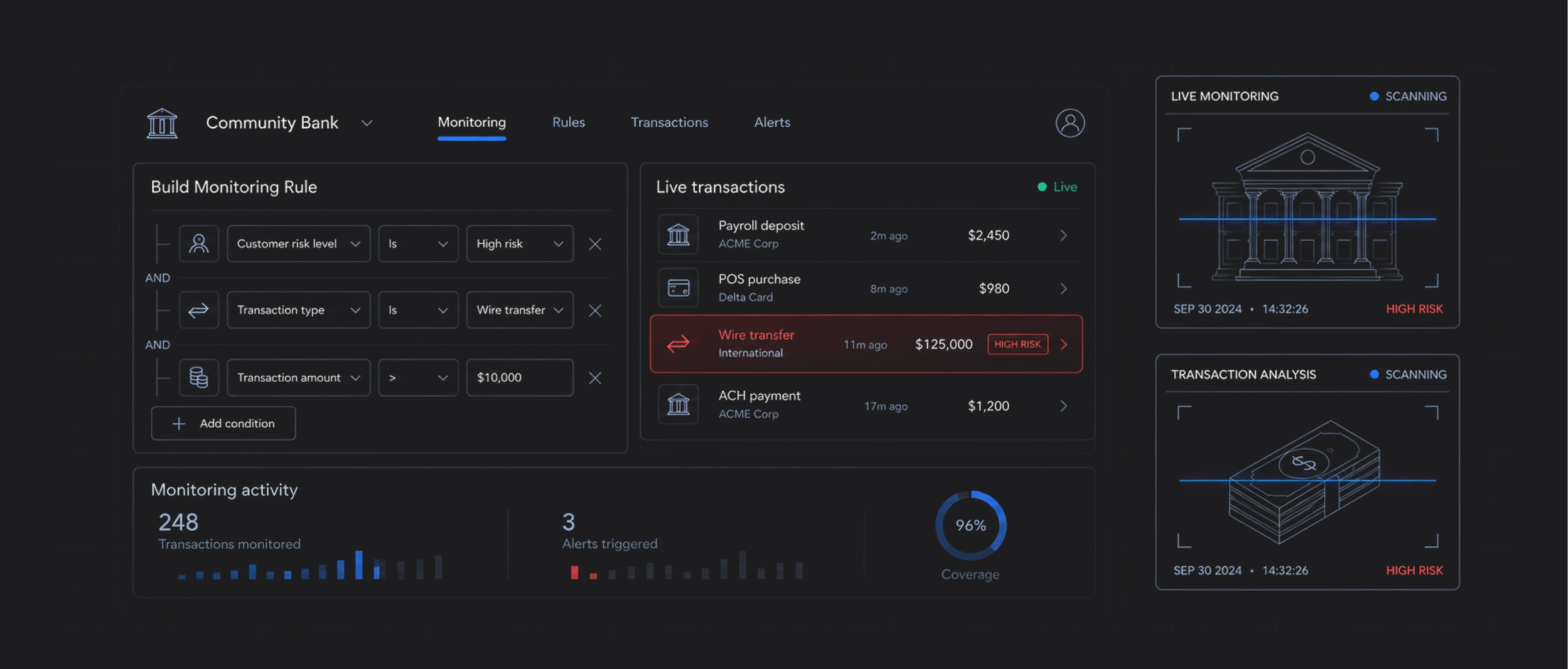
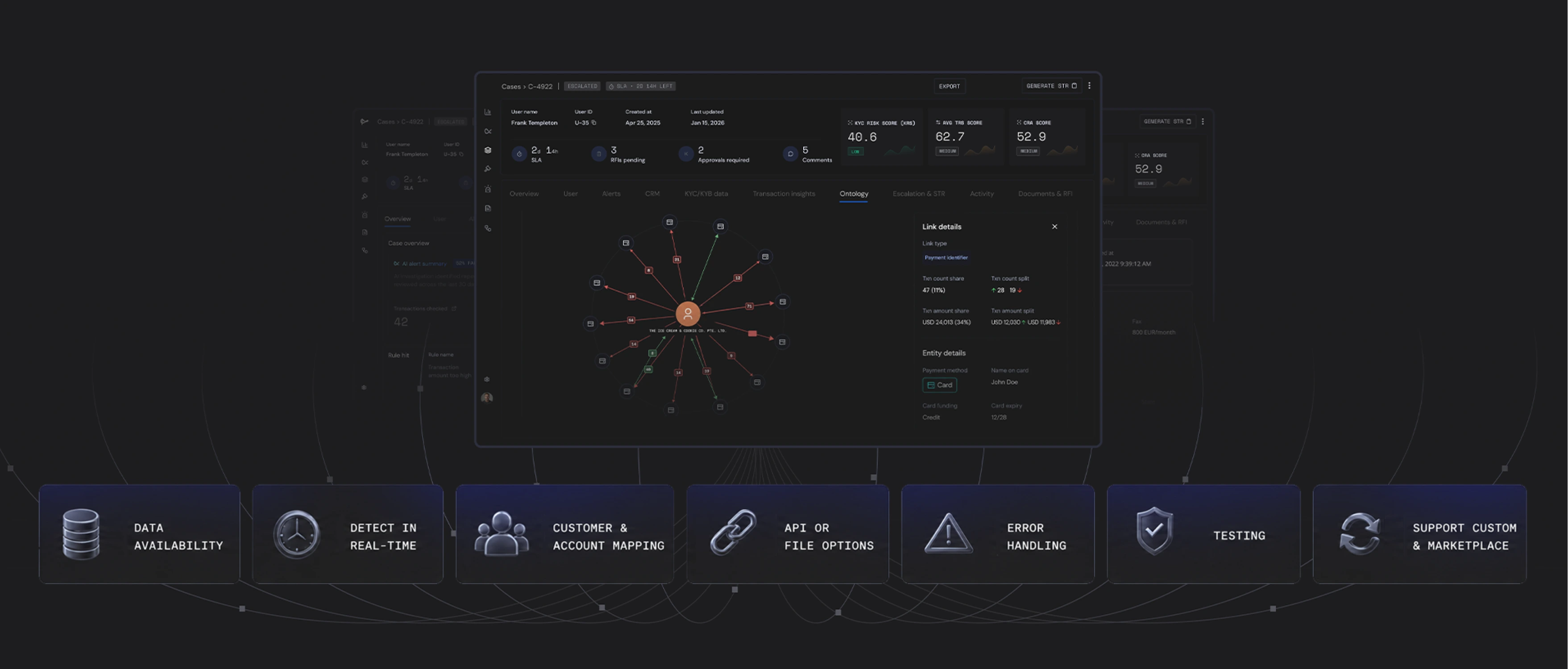
A community bank choosing AML software should assess eight integration requirements before signing: what core data is actually available, whether the core supports batch or real-time feeds, how customers and accounts map across systems, whether the vendor offers an API or file-based connection, how errors are handled, how integration testing is scoped, how reconciliation works on an ongoing basis, and what maintenance the integration requires after go-live. Which of these matters most depends heavily on which core provider the bank runs, since Fiserv, Jack Henry, and FIS each have their own integration layer and their own limitations. A vendor's generic claim of "API-based integration" says very little on its own, whether the vendor is a long-established core-adjacent AML provider or a newer entrant like Flagright; what matters is whether that claim holds up against the bank's specific core and its specific version.
Why core integration is usually the deciding factor for a community bank
Fiserv, Jack Henry, and FIS collectively power more than 70% of U.S. financial institutions, so a community bank evaluating AML software is very likely evaluating it against one of these three specific systems, not a generic "core banking platform." Each vendor's integration layer looks different in practice: FIS offers Code Connect, Fiserv offers DNAapp and Fiserv Exchange, and Jack Henry offers jXchange, Symitar, and its Banno digital toolkit. Some deployments of each core still run on older, batch-oriented versions that process data overnight rather than exposing a modern real-time API, and which version a specific bank runs matters more than which vendor it runs.
The integration path a bank ends up on has real cost consequences. Analysts estimate the difference between a clean API integration and a legacy batch-file integration can swing total cost of ownership by 30 to 60%, and that's before accounting for the ongoing maintenance burden a fragile integration creates.
Customer and account mapping deserves its own attention, separate from the data-feed question. Banks commonly run different systems for different products, mortgages, checking, credit cards, and the same person can appear slightly differently in each one, "John Smith" in one system and "J. Smith" in another. An AML platform that can't resolve that they're the same customer will monitor each account in isolation, which quietly defeats the purpose of holistic risk-based monitoring even when every individual data feed is technically working.
The eight integration requirements to assess
Data availability comes first: confirm which specific fields, customer identifiers, account numbers, transaction details, KYC data, actually exist in exportable or accessible form in your core, rather than assuming a field is available because the core theoretically supports it. A field that exists in the core's data model but isn't exposed through your specific integration layer or file export is not actually available to you. Flagright's implementation process starts with a discovery and requirements-gathering stage specifically meant to surface this kind of gap before configuration begins, rather than during integration itself.
Batch versus real-time feeds determines how current the AML system's picture of your transactions actually is. A nightly batch feed may be acceptable for a bank with lower transaction velocity and no instant payment rails; it's a real gap for a bank processing anything through FedNow, RTP, or same-day ACH, where a suspicious transaction can complete well before an overnight batch job ever picks it up. Flagright's own architecture is built to process transactions in real time, but that only helps a bank whose core can actually feed it data that way; if your specific core only exposes a given data type on a batch schedule, Flagright will only be as current as that feed.
Customer and account mapping should be tested against your own data's actual messy cases, joint accounts, DBAs, nicknames, and name variations across systems, not just a clean demo dataset. Ask the vendor to show you how their entity resolution logic handles a record that doesn't match perfectly across your systems, since that's the case that actually matters. This is a fair question to put to any vendor, including Flagright, since no platform's published materials substitute for testing it against your own bank's actual entity records.
API or file options vary by core and by version. FIS Code Connect, Fiserv Exchange, and Jack Henry's jXchange all support modern API-based integration, but a bank running an older version of any of these three may still be limited to file-based exports, and the vendor should be able to state plainly which mode applies to your specific setup rather than describing capability in the abstract. Flagright connects via REST API and webhooks, with separate sandbox and production environments and keys, and publishes integration guides for specific payment rails like SEPA and SWIFT rather than describing "API support" only in general terms.
Error handling needs to be tested against realistic failure conditions, not just the happy path. API timeouts, malformed responses, and authentication failures all need a defined behavior, and each core has its own quirks: FIS Code Connect enforces rate limits that need to be tested under load, Fiserv Exchange has specific error codes that need to be handled correctly, and Jack Henry's jXchange has transaction sequencing requirements that need to be respected or data can arrive out of order. Flagright's API documentation defines specific failure responses, a 400 for an invalid payload or a 401 for an invalid API key, for example, and requires webhook signatures to be verified via HMAC-SHA256, which is the kind of documented, testable error behavior worth asking any vendor to match.
Testing should cover functional correctness, performance under expected production volume, security, and operational resilience, not just a successful initial data pull. Ask specifically how the vendor tests edge cases, accounts with unusual characteristics, high-value transactions, and error conditions specific to your core. Flagright provides a separate sandbox environment with its own API keys specifically for this kind of pre-production testing, which is worth confirming any vendor offers rather than testing directly against a live production connection.
Reconciliation needs an ongoing process, not just an initial validation at go-live. Confirm how the bank verifies, on an ongoing basis, that what the AML system received actually matches the source-of-truth core data, and who gets notified if a mismatch or a silent data gap appears. Flagright's webhook events are designed to close this loop in one direction, pushing alert resolutions and case status changes back out to a bank's other systems, though the bank still needs its own process to confirm the reverse: that everything the core sent was actually received and processed.
Ongoing maintenance is often underestimated. A core provider's version upgrade or a field-layout change can break an integration that worked perfectly at go-live, and the bank should know in advance who is responsible for catching that and revalidating the connection, the vendor, the bank's own IT staff, or a shared responsibility that isn't clearly defined yet. Flagright's published implementation process includes a 90-day post-launch program and ongoing quarterly business reviews; whether that cadence would catch a specific core-side change before it caused a problem is a fair question to ask directly rather than assume.
Where the core still sets the ceiling
No AML platform, including Flagright, can expose data your core doesn't make available in the first place. If your specific core version only supports overnight batch export for a given data type, a modern AML platform can consume that batch feed efficiently, but it can't manufacture real-time visibility the core itself doesn't provide. The core's own integration layer, not the AML vendor's architecture, sets the ceiling on what's actually achievable, which is why every criterion above should be assessed against your specific core and version, not a vendor's general capability claims.
What to verify before signing
- Ask for the vendor's specific, tested integration pattern with your exact core system and version, not a generic claim of API support.
- Confirm what happens on an API timeout or a malformed response specifically, and whether there's a retry and alerting path rather than a silent failure.
- Ask how reconciliation between the core and the AML system is verified on an ongoing basis, and who gets notified of a mismatch.
- Confirm entity and account mapping has been tested against your own data's known messy cases, not just a clean demo dataset.
- Ask what a core version upgrade requires from the integration, and who is responsible for revalidating it afterward.
FAQ
What integration requirements should a community bank assess when choosing AML software for its core system?
Data availability, batch versus real-time feeds, customer and account mapping, API or file options, error handling, testing, reconciliation, and ongoing maintenance. Which matters most depends on which core the bank runs and which specific version of it.
Does AML software need real-time integration with a bank's core system?
It depends on the bank's transaction profile. A bank with lower transaction velocity and no instant payment rails may be adequately served by a nightly batch feed. A bank processing transactions through FedNow, RTP, or same-day ACH has a real monitoring gap with batch-only integration, since a suspicious transaction can complete before an overnight batch job ever surfaces it.
What happens if a community bank's core only supports batch file exports?
The AML platform can still consume the data, just on a delay. The bank should confirm what that delay means for its specific risk exposure, particularly for any instant payment rail it offers, and treat closing that gap as a priority even if a full real-time upgrade isn't immediately available.
Why does customer and account mapping matter for AML software integration?
Because banks commonly run separate systems for different products, and the same customer can appear differently across them. If the AML platform can't recognize that "John Smith" in one system and "J. Smith" in another are the same person, it monitors each account in isolation, which undermines risk-based monitoring even when every individual data feed is technically working correctly.
How is AML software integration tested with a core banking system?
Testing should cover functional correctness, performance under expected production volume, security, and error handling, including core-specific quirks like API rate limits, specific error codes, and transaction sequencing requirements. Ask the vendor how they test edge cases and failure conditions specific to your exact core, not just a successful initial data pull.
Who is responsible for maintaining an AML software integration after go-live?
This should be defined explicitly before signing, not assumed. A core provider's version upgrade or field-layout change can break a working integration, and the bank needs to know in advance whether the vendor, its own IT staff, or a shared arrangement owns catching and fixing that.
Bottom line
For a community bank, the AML software decision is inseparable from the specific core system and version it runs. Data availability, batch versus real-time feeds, customer and account mapping, API or file options, error handling, testing, reconciliation, and ongoing maintenance all need to be assessed against that specific core, not a vendor's generic integration claim. The core's own integration layer sets the ceiling on what any AML platform can actually achieve, so a bank should confirm a vendor's tested track record with its exact core and version before evaluating anything else about the platform itself.