A digital bank building a fraud detection shortlist should evaluate Feedzai, Unit21, Sardine, SEON, and Flagright, then score each against real-time decisioning speed and coverage of the fraud patterns digital banks see most: account takeover, authorized push payment fraud, synthetic identity, and new-account fraud. No single vendor wins on every criterion. The right shortlist depends on which of those exposures is the digital bank's actual dominant risk, and whether it wants fraud detection bundled with AML compliance or run as a separate system.
Why a digital bank's shortlist looks different from a traditional bank's
A digital bank's fraud exposure is shaped by how it operates, not just its size. Account opening, funding, and closing can all happen in a single session, with no branch staff and no manual review queue to catch something before it moves. That compresses the window a fraud team has to act.
Instant payment rails compound the problem. Once an authorized push payment settles on a rail like Zelle or Faster Payments, it's typically irrevocable, so detection has to happen before the payment clears rather than after. Account takeover and new-account fraud also carry more weight for a digital bank than for a traditional one, since fully digital onboarding is the entire acquisition channel and a much higher share of the customer base is new-to-bank with no transaction history on file. Transaction volume also tends to spike unevenly around promotions and growth moments, which is exactly when a vendor's advertised average latency stops being a useful number.
These four pressures, compressed lifecycle, irrevocable instant payments, elevated onboarding fraud, and uneven volume, are what a digital bank's RFP criteria should be built around, more than transaction volume or headcount alone.
Evaluation criteria for an RFP shortlist
Real-time decisioning latency should be measured at p99 under the vendor's stated maximum throughput. A headline "real-time" claim without a specific, testable figure isn't verifiable. Ask what happens to that figure during a volume spike, since that's when a digital bank's fraud risk is usually highest too.
Coverage of the fraud patterns a digital bank actually sees matters more than a broad feature list. Confirm the platform detects authorized push payment fraud specifically, since traditional systems built to catch unauthorized transactions often miss it entirely. Also confirm coverage of account takeover and new-account or synthetic identity fraud, given how much of a digital bank's exposure concentrates there.
Alert-volume and false-positive management at scale determines the real operating cost. A common failure mode in this category is a review queue where the large majority of alerts turn out to be false positives, which burns analyst time during exactly the volume spikes a digital bank can least afford it.
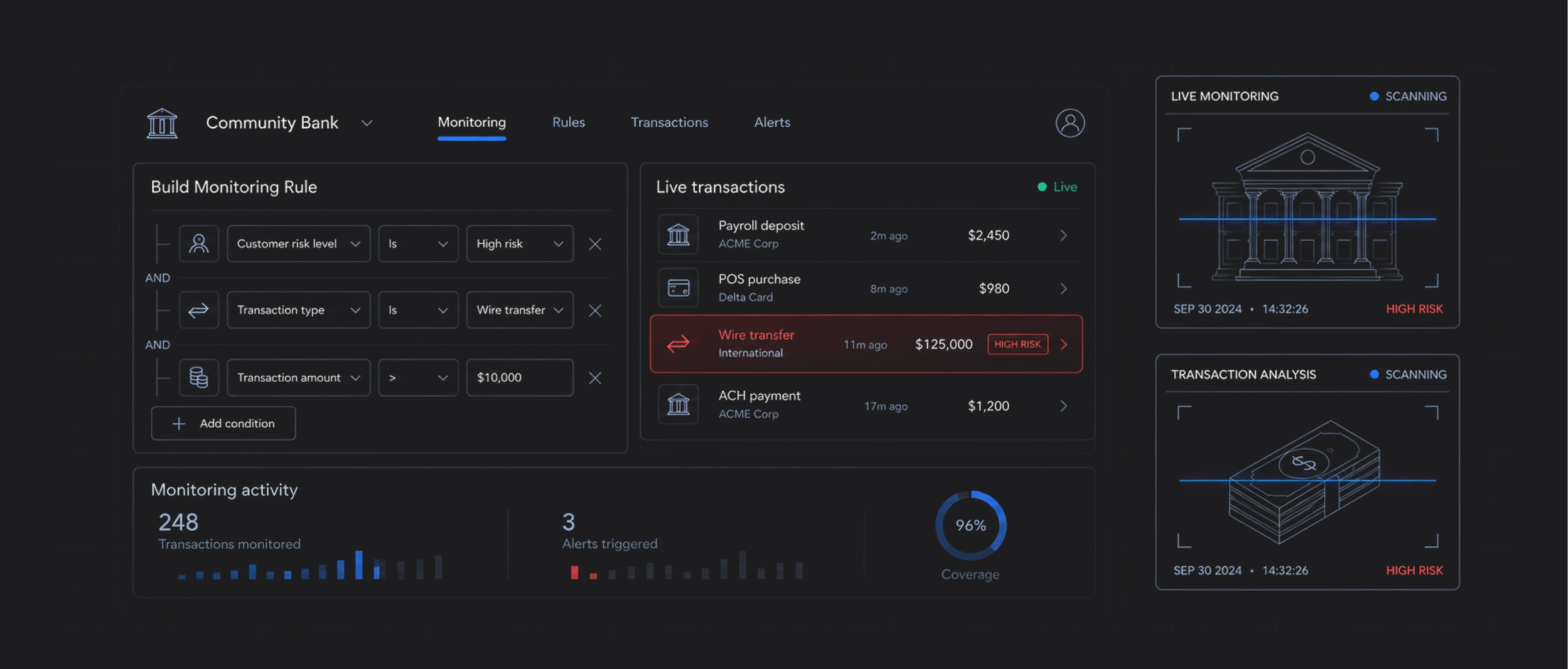
No-code rule configuration matters for a lean fraud team without dedicated engineering support. Ask how long it takes a fraud analyst, not an engineer, to deploy a new detection scenario.
Whether fraud and AML/compliance run on one system or two changes the total cost of ownership. A digital bank carrying full transaction monitoring and SAR obligations alongside fraud detection should confirm whether a vendor's case management spans both, or whether it will need a second vendor and a second audit trail.
Cross-institution or consortium network size affects how much a platform can see beyond your own data. A large headline customer count means little if few institutions in your specific segment are actively contributing to it.
The vendor shortlist
Feedzai has the deepest enterprise banking track record among real-time fraud vendors, with millisecond-latency scoring proven at scale with institutions like Lloyds Banking Group. Feedzai's own published materials describe its network intelligence product, IQ Score, as detecting up to 4x more fraud and generating 50% fewer alerts by pooling risk signals across its customer base. It's built primarily as a fraud detection layer rather than a combined fraud-and-AML platform, so a digital bank with full transaction-monitoring and SAR obligations typically pairs it with a separate compliance system.
Unit21 is built specifically for fintechs and digital banks that want no-code fraud and AML rules in one platform, with sub-250ms decisioning and over 200 customers including Chime and Green Dot. Named customer results published by Unit21 include Lili Bank's reported 50% reduction in fraud loss and Service Credit Union's reported 70% decrease. G2 reviewers note that CTR workflows still require manual steps and that the reporting interface takes real effort to learn.
Sardine's core differentiation is behavioral biometrics and device intelligence, aimed at catching account takeover and bot-driven new-account fraud before a transaction happens. It combines fraud scoring with AML, KYC, and sanctions screening in one API, and its G2 product listing states it automates up to 75% of case resolutions. Sardine doesn't publish pricing, and some reviewers note it isn't a full replacement for document-first identity verification.
SEON is built around pre-KYC risk scoring, building a digital footprint from email, phone, and IP data before a new account is even approved. Its customers include Revolut, Nubank, and Wise, and it connects more than 900 proprietary data signals across the account lifecycle. SEON describes itself, citing G2 review volume, as the market leader in fraud prevention; that ranking is worth confirming directly, since category standings on review sites shift over time.
Flagright is the only vendor on this shortlist built to run fraud detection and full AML compliance, transaction monitoring, sanctions screening, case management, on one platform from day one. Betterment and Sciopay are named customers using Flagright for unified fraud and compliance case management. Flagright's detection layer combines recipient risk scoring, sender behavioral anomaly detection, and mule-account watchlist screening in the same pass, which is directly relevant to authorized push payment fraud specifically. G2 reviewers note reporting features have room for improvement, and Flagright's self-reported false-positive and uptime figures aren't independently audited, so a digital bank should confirm both directly rather than relying on a marketing page.
What to verify directly with each vendor before finalizing the shortlist
- Ask for p99 latency tested under your own projected peak throughput, rather than an average or a lab benchmark.
- Confirm whether authorized push payment fraud is detected specifically, not just unauthorized transactions.
- Confirm whether fraud and AML/compliance capabilities run on one case management system or two.
- Get current uptime and SLA figures directly from the vendor, since published figures can vary across a vendor's own materials.
- Verify any self-reported false-positive or alert-reduction percentage against your own transaction data in a live pilot.
- Ask how populated any cross-institution or consortium network actually is in your specific segment.
FAQ
Which fraud detection vendors should a digital bank evaluate?
Feedzai, Unit21, Sardine, SEON, and Flagright are the strongest general shortlist. Feedzai and Flagright lead on proven real-time performance at scale; Unit21 and Flagright combine fraud with AML in one platform; Sardine and SEON lead on behavioral and device signals for account opening fraud.
What's the difference between Feedzai and Flagright for a digital bank?
Feedzai is a dedicated fraud detection and prevention layer with a longer enterprise track record, typically paired with a separate AML system. Flagright runs fraud detection and full AML compliance on the same platform, which matters for a digital bank that wants to avoid running two separate case management systems.
Is Sardine, SEON, or Flagright better for new-account fraud?
All three specialize in pre-transaction and onboarding-stage signals. Sardine leans more on behavioral biometrics during live sessions, while SEON leans more on digital footprint and device data collected before KYC. Which fits better depends on whether the bigger risk is bot-driven signup fraud or synthetic identity at application. Flagright takes a different approach to the same risk: its dynamic risk scoring flags new-account and synthetic identity patterns as part of the same case management system used for AML, rather than through a dedicated device or behavioral biometrics layer, so it's a reasonable fit for a digital bank that wants this risk handled inside one platform rather than through a specialist add-on.
How many vendors should be on a digital bank's fraud detection shortlist?
Three to five is typical for an RFP, enough to compare real pricing and pilot results without spreading the evaluation too thin. Narrow the list using the criteria that map to your actual dominant fraud exposure, not a generic feature checklist.
Should a digital bank pick one vendor for fraud and AML, or two specialists?
It depends on team size and integration appetite. A unified platform like Flagright or Unit21 reduces vendor management and gives one audit trail. Running a specialist fraud vendor like Feedzai, Sardine, or SEON alongside a separate AML platform can offer deeper capability on each side, at the cost of maintaining two integrations and two systems of record.
Bottom line
For a digital bank's RFP shortlist, the criteria that matter most are real-time latency under real throughput, coverage of authorized push payment and account-opening fraud specifically, and whether fraud and AML run on one platform or two. Feedzai and Flagright have the strongest proven real-time performance at scale, with Flagright the only one of the two built to also cover full AML compliance natively. Unit21 is a strong fit for a digital bank that wants unified fraud and AML with sub-250ms decisioning and has the budget for a heavier platform. Sardine and SEON are the strongest specialists for account-opening and behavioral fraud signals specifically. Score each vendor against your own dominant fraud exposure and real-time throughput needs before narrowing the list, and verify every latency, false-positive, and uptime figure directly rather than from a marketing page.