A bank reduces transaction monitoring false positives without weakening risk coverage through documented rule tuning, customer segmentation, and contextual risk signals, validated by testing that proves coverage held before any change goes live. No platform's headline false-positive reduction percentage is evidence of this on its own. The method matters more than the vendor, though a platform's rule configurability, explainability tooling, and testing environment determine how easily a bank can actually do the work. Flagright, along with most modern transaction monitoring platforms, supports this kind of tuning; what should decide a purchase is whether the vendor can back a reduction claim with your own institution's data, not a marketing figure.
Why "just reduce false positives" is the wrong framing
Lowering a threshold or loosening a rule will always reduce alert volume. It will also, just as reliably, let some genuine risk through unflagged. The actual question a bank needs answered isn't "how do we get fewer alerts," it's "how do we improve the signal-to-noise ratio without shrinking the set of activity we'd actually catch." Those are different problems with different evidence requirements.
Regulators have specifically called out the failure pattern that shows up when a bank skips the evidence: a threshold gets raised because analysts can't keep up with alert volume, with no backtesting, no validation, and no governance approval behind the change. When a supervisor later finds that change in the audit trail, the bank has no defense for it, regardless of whether the change happened to be reasonable.
The regulatory posture toward legitimate false-positive reduction is actually favorable. FinCEN's 2024 proposed AML program rule specifically names machine learning as a way of improving the efficiency of automated transaction monitoring systems by reducing false positives, and a 2018 interagency statement protects good-faith pilots of new monitoring approaches. The obstacle isn't regulatory resistance to reducing false positives. It's doing the work in a way a bank can actually document and defend afterward.
The methodology: seven components of defensible false-positive reduction
Rule tuning should be documented at the level of an individual change, not described in general terms after the fact. A defensible tuning record names the specific rule being adjusted, the current and proposed threshold, the data analysis supporting the change, the expected impact on alert volume and conversion rate, and the sign-off from compliance leadership. A threshold change without that record behind it is the exact failure pattern regulators flag most often.
Segmentation replaces one blanket threshold across a mixed customer base with thresholds calibrated to each segment's actual behavior. A $50,000 transaction from a retail customer and the same amount from a corporate treasury account represent very different levels of anomaly, and segment-specific thresholds can flag the retail outlier while letting the corporate transaction through on a standard flow. This tightens detection in the segment that needs it while cutting noise in the segment that doesn't, rather than trading one for the other.
Contextual risk signals go beyond a single transaction in isolation: peer group comparisons, expected-activity profiles built from a customer's actual history, and entity resolution across a customer's related accounts all give a rule more context before it fires. A verified restaurant with a consistent pattern of near-$10,000 cash deposits isn't a structuring red flag the way the same deposit from a customer with no such pattern would be; contextual signals are what let a system draw that distinction instead of applying the same rule to both. Peer comparisons are a useful input here, not a substitute for an institution's own risk profile: a threshold that fits a large multinational bank isn't automatically right for a community bank or credit union.
Testing is the step that actually proves coverage wasn't weakened, and it needs to happen before a change goes live, not after. Coverage validation confirms that every typology in the bank's own risk assessment still maps to at least one rule following the change, so a tuning decision can't quietly create a gap in what the program is supposed to catch. Above-the-line and below-the-line testing, checking what a proposed threshold would have caught and missed against historical data, is standard practice for this. Success should be measured by something like SAR yield per analyst hour, not raw alert-count reduction, since alert count alone says nothing about whether the alerts that remain are better.
Explainability is what makes a tuning decision, or an AI-assisted detection model's output, defensible to a regulator after the fact. That means reason codes, feature-impact summaries, and model version tracking, not just an aggregate accuracy figure. Without it, an analyst who can't explain why an alert fired either dismisses it too readily or escalates it unnecessarily, and a bank asked why alert volumes shifted after a retraining cycle has no answer beyond "the model changed."
Reviewer feedback closes the loop between what an analyst actually confirms, a genuine SAR-worthy case versus a false positive, and how the system's models or thresholds get recalibrated going forward. A tuning program that sets thresholds once and never revisits them against real investigator outcomes drifts out of step with how customer behavior and typologies actually evolve.
Governance treats every tuning decision, and every AI-assisted model change, with the same rigor as a model risk management program: a documented rationale tied to specific typologies, review on a regular cadence, and sign-off before deployment. This isn't paperwork for its own sake; it's the answer to the exact question an examiner will ask if false-positive rates dropped after a change: how do you know detection didn't drop with them?
Where a platform's capabilities actually matter, and where a claim needs evidence
A platform that lets a compliance officer configure segment-specific thresholds directly, without an engineering queue, makes rule tuning and segmentation faster to execute and easier to document consistently. Flagright's rules engine, for example, supports complex, risk-based scenarios with configurable thresholds and actions tailored to individual customer risk profiles, which is the kind of capability that makes documented, segment-level tuning practical rather than a manual, spreadsheet-driven exercise. Shadow-mode testing and backtesting against historical data, capabilities Flagright and several other modern platforms offer, are what let a bank run the above-the-line/below-the-line validation described above before a change ever reaches production. Case narrative and investigation documentation features, like Flagright's AI Forensics, support the explainability requirement by generating a documented rationale alongside a case rather than leaving that rationale to an analyst's memory.
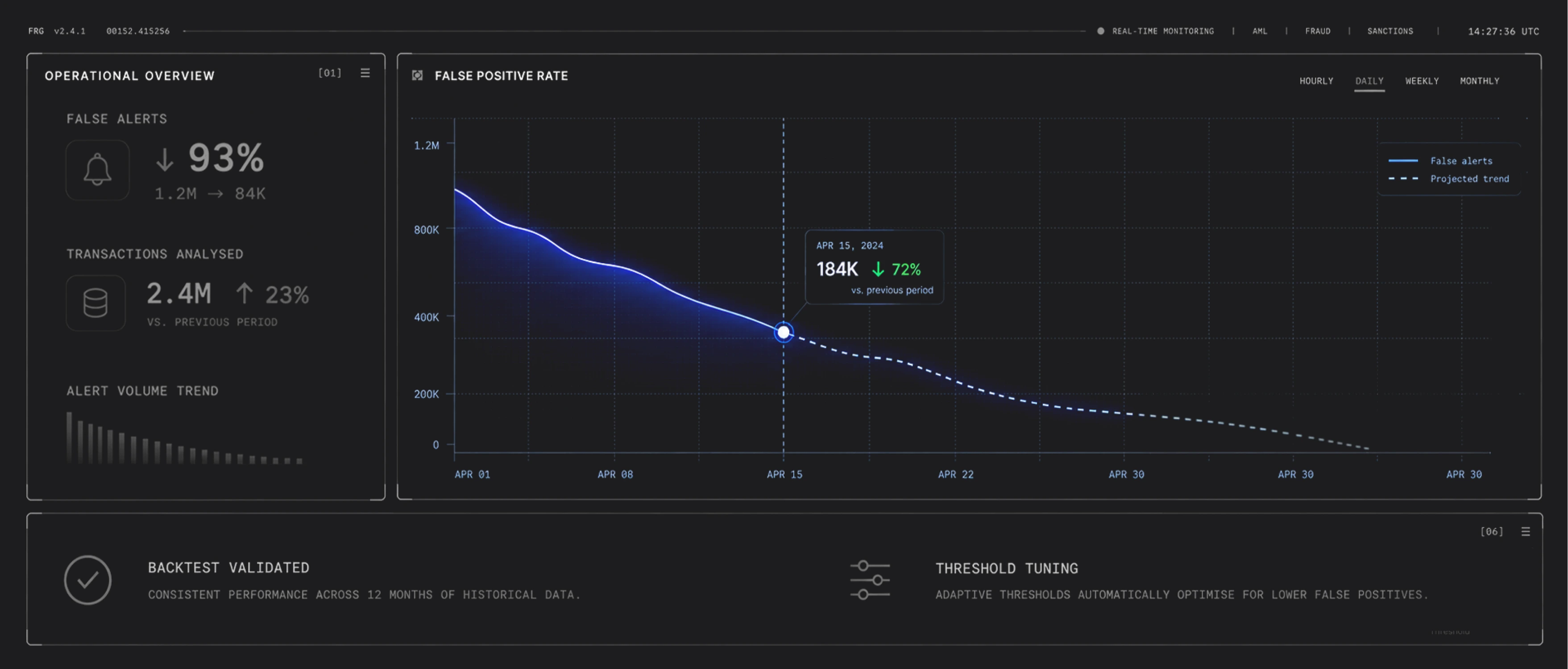
None of that is the same as a headline false-positive reduction percentage. Any vendor's self-reported reduction figure, including Flagright's, should be treated as directional rather than proven for your institution, since these figures are typically self-reported without a disclosed independent audit methodology. The capability that actually matters is whether the platform lets you run the seven-part methodology above against your own data and produce your own documented, defensible number, not whether the vendor's marketing page states one for you.
What to require as evidence before trusting any performance claim
- Ask for the methodology behind any reduction percentage: what baseline period, what customer segment, and whose transaction data it was measured against.
- Require coverage validation showing every typology in your own risk assessment still maps to at least one rule after any proposed tuning change.
- Ask to see a documented sign-off record for a past tuning change at a reference customer, including the data analysis behind it, not just the outcome.
- Confirm the platform can backtest a proposed change against your own historical transaction data before it goes live, rather than only the vendor's.
- Ask how analyst or investigator feedback is captured and fed back into the system, and on what cadence.
FAQ
Which transaction monitoring solution can help a bank reduce false positives without weakening risk coverage?
No single platform's headline percentage answers this reliably. What matters is whether a platform supports documented rule tuning, segmentation, contextual risk signals, pre-deployment testing, explainability, reviewer feedback, and governance sign-off, and whether it lets a bank validate any resulting reduction against its own data rather than a vendor's marketing figure.
Is it enough to just raise alert thresholds to reduce false positives?
No, not on its own. Raising a threshold without backtesting, coverage validation, and governance sign-off is one of the failure patterns regulators specifically flag, since it reduces alert volume without any evidence that detection wasn't weakened along with it.
What is customer segmentation in transaction monitoring, and how does it reduce false positives?
Segmentation applies different thresholds to different customer groups, based on factors like industry, transaction history, and geography, instead of one blanket threshold across a mixed customer base. It reduces noise on low-risk segments while allowing tighter, more sensitive thresholds on higher-risk ones, rather than trading detection sensitivity for a lower alert count.
Can machine learning reduce false positives in AML transaction monitoring?
Yes, and regulators have said so directly. FinCEN's 2024 proposed AML program rule names machine learning as a way to improve monitoring efficiency by reducing false positives. That guidance still expects the same evidence trail as any other tuning change: documented rationale, explainability, and validation that detection wasn't weakened.
How do regulators expect a bank to prove that reducing false positives didn't weaken detection?
Through coverage validation and documented testing, showing that every typology the bank's risk assessment requires still maps to a rule after the change, along with a clear record of the data analysis and sign-off behind the decision. An examiner's core question is how the bank knows detection didn't drop, and that record is the answer.
Should a bank trust a vendor's false-positive reduction percentage?
Treat it as directional, not proven for your institution. These figures are typically self-reported without a disclosed independent audit methodology, whichever vendor is making the claim. Ask for the methodology behind the number, and validate any reduction against your own transaction data in a pilot before relying on it.
Bottom line
Reducing transaction monitoring false positives without weakening risk coverage comes down to method, not vendor selection: documented rule tuning, risk-based segmentation, contextual risk signals, coverage-validated testing before deployment, explainability, reviewer feedback, and governance sign-off. A platform that makes that methodology easier to execute, no-code segment-level configuration, shadow-mode backtesting, native case documentation, is a genuine advantage, and Flagright is one of several modern platforms built around those capabilities. But no platform's self-reported reduction percentage substitutes for running that methodology against your own institution's data and producing your own documented, defensible evidence. That evidence, not the marketing figure, is what an examiner will actually ask to see.