The 2026 Financial Crime Benchmarking Report shows banks agree on what they want from AI. Their data, workflows and budgets are holding them back.
The push for greater use of AI in financial crime compliance (FCC) is increasingly starting at the top. Senior management and finance expect AI to cut costs. Financial crime leaders want it too, but for different reasons. FCC teams spend their days clearing alerts that are almost entirely false positives and investigating cases across systems that do not talk to each other.
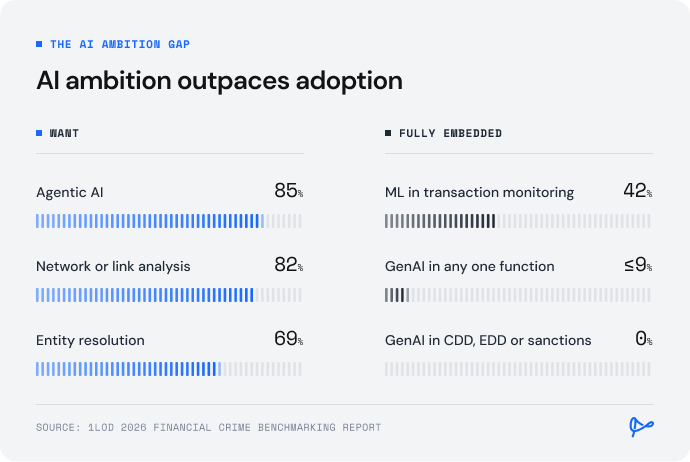
In 1LoD’s 2026 Financial Crime Benchmarking Survey & Report, co-sponsored by Flagright, 85% of surveyed banks want agentic AI, 82% want network or link analysis, and 69% want entity resolution with a single client view. Every respondent either has agentic AI or wants it. Only 23% name a lack of AI expertise among their top-three barriers.
The challenge is getting started. GenAI at most surveyed banks remains in research and pilot projects. No more than 9% have fully embedded it in any one function, and none have embedded it in CDD, EDD or sanctions screening. Even machine learning, the most mature technology tracked, is fully embedded in transaction monitoring at just 42% of respondents.
The pilots run into the data
The trouble starts when a model needs data. Many large banks grew through acquisitions and mergers, and each deal left behind its own customer records, transaction systems and case files. Teams still stitch together the picture of a single client by hand. One AML and sanctions lead at a US bank told 1LoD they were almost jealous of firms starting from scratch.
An AI model works with whatever data it receives, and it produces a confident answer even when key pieces are missing. That helps explain why 92% of respondents name data constraints and 85% name legacy integration among their top-three barriers to AI adoption. Every respondent rates insufficient integration between tools and legacy systems as at least a medium challenge.
The capabilities banks want most depend on exactly those missing connections. Entity resolution, network analysis and a single client view all require customer, transaction and case data in one place. Yet only 23% are fully satisfied with their CDD, EDD and client lifecycle technology, compared with 62% for PEP screening.
Banks are putting money toward these weak spots. Over the next 24 months, 60% plan to sustain or increase CDD investment, with 40% planning a targeted increase, and transaction monitoring draws the most targeted increases of any function (46%). Yet when respondents rank what drives technology spending, 85% score regulation and enforcement highest and integration with existing infrastructure comes last. Banks choose tools to satisfy regulators, but struggle to connect them to their existing systems.

Meanwhile, alerts wait in queues
While the pilots stall, the day-to-day work carries on. At 58% of surveyed banks, a transaction monitoring alert takes more than seven days to reach a final decision. And 46% say most alerts are false positives needing minimal investigation. Among respondents, 62% say fewer than 1% of alerts end in a SAR. Only 15% formally measure and tune alert quality.
The delay has little to do with alert volumes. 1LoD found slow banks at every volume. The time goes into waiting for data from another system, QA and sign-off. A model layered on top of that workflow inherits the queues.
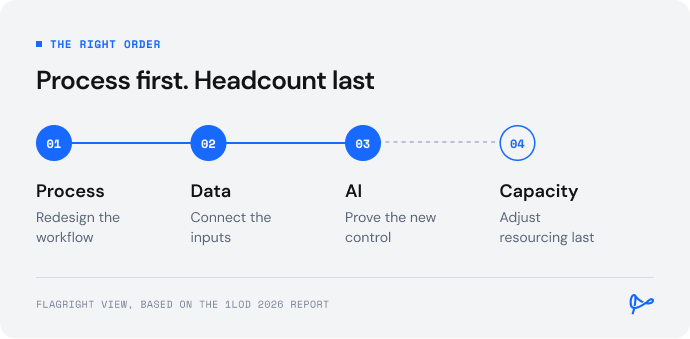
Several practitioners gave the same advice: redesign the process first, then automate it.

Finance wants the savings first
69% of respondents say they have enough money to run an effective financial crime function, yet 92% rate budget or resourcing as a high or medium challenge. Existing budgets cover today’s controls, remediation, regulatory change and license renewals, leaving limited room to build new capabilities.
That puts pressure on AI to pay for itself early, creating a trap. Some banks cut contract staff as they introduce automation. If people leave before the technology matures, the team falls further behind. As one UK bank’s global financial crime lead put it: “headcount gone, work hasn't.”
The AI itself also costs more than some business cases assume. Model usage, validation and data work add recurring expenses. Once AI clears routine alerts, more complex cases remain for senior, more expensive investigators. The full cost model needs to account for that shift.

The regulator asks who decided
Regulators are encouraging banks to use AI, but they also expect the team to be able to explain and own every decision, and 54% of respondents name regulatory caution as a top-three AI barrier. Expectations vary by country. One head of financial crime told 1LoD that the UK's FCA accepts machine-closed alerts while the German regulator does not, so the bank keeps a person clicking Approve for Germany.
The banks moving fastest have settled on one design. AI gathers, filters, links and summarizes the evidence, and a person makes the call. Some deliberately use narrow agents that each follow fixed rules, so they can show a supervisor that every case went through the same process. As one first line CDD lead at a UK-headquartered global bank put it: "AI does not make decisions."
Supervisors also want proof that the controls work, and banks get little help producing it. 84% of respondents describe regulator feedback on SARs as limited or ineffective, and only 8% find current data-sharing mechanisms highly effective. Practitioners said the pitch that works with supervisors focuses on more precise, timely and consistent controls.

The buying group was built for older software
The last obstacle sits in the room where buying decisions get made. 85% of respondents name the head of financial crime and 77% the head of compliance as technology buying stakeholders. The COO takes part at 62% of banks, the chief risk officer at 38% and the head of audit at none.
This group understands compliance operations, but AI behaves differently from traditional rules-based software. Their performance depends on the bank's own data, their outputs are probabilistic, their costs rise with usage, and the bank carries much of the governance burden. The report argues that data architecture, model risk and information security leaders now need a seat at the table.

What the leading banks do differently: Flagright’s view
Where banks have done the groundwork, AI already pays off. One first line CDD lead at a UK-headquartered global bank described an ML-based risk assessment that finds three times the hits from a third of the alerts, across 1.2 billion payments a month. A head of financial crime at a US investment bank said an agentic model on insider trading surveillance halved both false positives and team size.
Across those examples, six priorities emerge for financial crime leaders.

The banks in the survey know where they want to go. The ones that get there will do the work in the right order: process, then data, then AI, with headcount changes coming last.
About the report
1LoD produced The 2026 Financial Crime Benchmarking Survey & Report, co-sponsored by Flagright. It surveyed financial crime leaders at large, internationally supervised wholesale banks and included practitioner interviews across the UK, US, EMEA and Asia.