Summary of the Coinbase Ireland Enforcement Action
Coinbase Europe, the Dublin-based arm of the U.S. crypto exchange, has been hit with a €21.5 million fine by the Central Bank of Ireland (CBI) for significant anti-money laundering (AML) failures. The fine, imposed as part of a November 2025 settlement, addresses breaches of Ireland’s Criminal Justice (Money Laundering and Terrorist Financing) Act 2010 between April 2021 and March 2025. According to the CBI’s findings, Coinbase’s transaction monitoring system was misconfigured, leaving over 30 million transactions (worth €176 billion) unmonitored during a 12-month period. This lapse meant that a large share (around 31%) of Coinbase’s transactional activity went unscreened for suspicious behavior. Critically, Coinbase Europe failed to file Suspicious Transaction Reports (STRs) in a timely manner, it took the firm almost three years to retrospectively review the flagged transactions and report 2,708 suspicious transactions to authorities. These delayed STRs involved suspected cases of money laundering, fraud, drug trafficking, cybercrime, and even child exploitation, underscoring the severity of the monitoring blind spot. In short, the CBI identified delayed reporting of suspicious activities and poor transaction monitoring controls at Coinbase Europe, failings which the exchange admitted in full as part of the settlement. The €21.5 million penalty reflects these compliance gaps and is intended to send a clear signal about the importance of real-time AML controls and prompt reporting of suspicious activity.
A Record-Breaking Fine Amid Rising EU Regulatory Pressure
The €21.5 million fine represents the largest AML-related penalty ever issued by the Irish regulator, far exceeding previous cases. In fact, CBI officials noted this “record-high” AML penalty shatters the prior Irish AML fine record of €4.5 million (levied on Permanent TSB in 2016). It also marks the first enforcement action CBI has taken against a crypto firm, signaling that virtual asset service providers are now firmly on regulators’ radar. This enforcement comes amid a broader trend of intensifying regulatory pressure on crypto exchanges across Europe. For example, the U.K.’s Financial Conduct Authority, although outside the EU, issued its first crypto-platform fine in 2024, penalizing a Coinbase affiliate £3.5 million for AML control failings. In that case, the FCA found Coinbase’s UK arm had defied restrictions by servicing thousands of high-risk customers without proper controls. Elsewhere in the EU, authorities have also cracked down: the Dutch central bank fined Coinbase €3.3 million in early 2023 for operating without registration (a breach of AML registration rules), and previously fined Binance (the world’s largest exchange) for similar violations. These actions underscore that crypto companies are facing unprecedented scrutiny from European regulators. The Coinbase Ireland fine, the largest of its kind in Ireland, fits into this pattern: it’s a high-profile warning that regulators across Europe are no longer hesitant to enforce AML laws in the crypto sector with real teeth.
Lessons for Crypto Firms under EU AML Laws (MiCA and AMLD6)
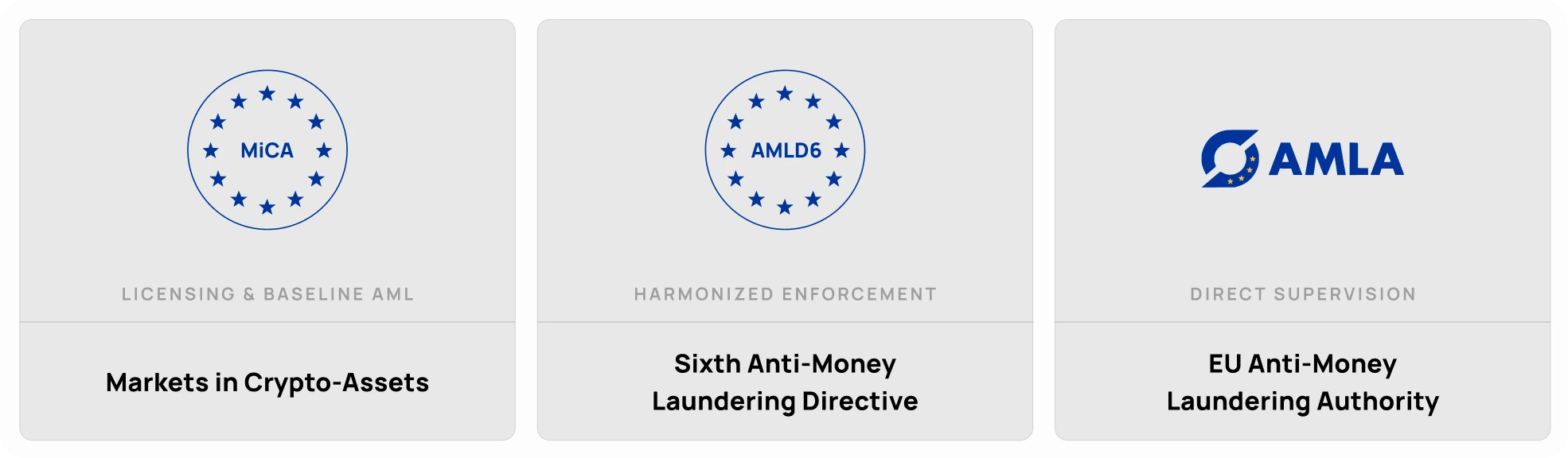
Coinbase’s failings serve as a cautionary tale for all crypto businesses operating under European AML laws, especially with major regulatory changes like MiCA and the EU’s Sixth Anti-Money Laundering Directive (AMLD6) on the horizon. The EU’s new Markets in Crypto-Assets (MiCA) Regulation, which takes effect in 2024-2025, will, for the first time, require crypto-asset service providers (CASPs) to be licensed and to comply with strict AML/KYC obligations across the entire bloc. Under MiCA, any exchange or wallet provider serving EU customers must implement robust customer due diligence and transaction monitoring controls as a baseline legal requirement. The Coinbase case, a large exchange failing to properly monitor €176 billion in transactions, highlights the risk of non-compliance as MiCA’s standards kick in. It signals that regulators will expect firms to preemptively shore up their AML systems in line with the new rules, rather than treat compliance as an afterthought.
At the same time, the EU’s broader AML reform package (often dubbed AMLD6 along with a new AML Regulation) is elevating expectations. These reforms will further harmonize how member states enforce AML/CFT requirements and will create a new EU Anti-Money Laundering Authority (AMLA) with direct oversight powers. By 2025-2026, the AMLA will begin directly supervising high-risk, cross-border firms, including some of the largest crypto companies, for AML compliance. This means a crypto exchange licensed in one EU country could be subject to EU-level scrutiny if it’s big or risky enough, ensuring no major player can fly under the radar. The implication is clear: under MiCA and AMLD6, crypto firms must meet a unified, rigorous standard of AML control or face penalties and possible exclusion from EU markets. Coinbase’s fine drives home that point – even before these new laws fully kick in, authorities are demonstrating zero tolerance for serious AML lapses. For compliance officers at exchanges and fintechs, the message is that “good enough” AML is no longer good enough. The EU is entering a new era of crypto compliance maturity, and firms are expected to invest accordingly in systems, staff, and processes to detect illicit finance. In short, Coinbase’s stumble in Ireland is a wake-up call: those in the crypto industry must strengthen their AML programs now to align with incoming European standards, or risk severe consequences.
No More Siloed Compliance: EU-Wide Expectations and Partnerships
One key takeaway from the Coinbase enforcement is that crypto compliance can no longer be siloed by country. In the past, a crypto exchange might have seen AML as primarily a local obligation, e.g. meeting Ireland’s requirements to get an Irish license. But with the advent of MiCA’s passporting regime and the EU’s centralized approach to AML, an exchange licensed in any single member state will effectively be judged against bloc-wide expectations. Regulators and banks across Europe communicate and share concerns; a serious compliance failure in one jurisdiction can quickly become a pan-European problem for a crypto firm’s reputation. The CBI explicitly described Coinbase Europe as an “entry point” for European and international customers into the group’s platform, underscoring that Ireland’s lapse had broader relevance beyond one country. Under the new MiCA framework, once an exchange is authorized in an EU member state, it can operate throughout the EU, but with that opportunity comes the obligation to uphold common AML standards everywhere. The newly launched AMLA has made it clear that it “places a strong emphasis on CASPs providing services across the EU to implement AML/CFT standards consistently.” National authorities are expected to ensure crypto firms have effective controls “from day one” of authorization, precisely to avoid weak links. In practice, this means a firm cannot relax just because one local regulator might seem less strict; the most stringent expectations are becoming the norm across the union.
For crypto businesses, there is also a very practical concern: banking and licensing partnerships depend on a clean AML bill of health. If an exchange develops a reputation for weak AML controls or delayed suspicious reporting, it risks being shut out by banking partners and even other regulators. Mainstream financial institutions, which provide fiat on/off-ramps, are highly sensitive to AML risk, they will sever ties with crypto clients that could jeopardize their own compliance standing. (Notably, regulators in the UK and EU have pressured banks to scrutinize crypto relationships; in one high-profile case the UK blocked a major exchange’s licensing attempt over AML concerns.) Likewise, under MiCA, if one EU country’s regulator flags serious issues with a firm’s AML program, other countries could hesitate to honor its passport or could impose additional conditions. In short, crypto compliance is now a pan-European endeavor. Exchanges must align with the EU’s unified expectations or face exclusion: failing to meet the standards in any one jurisdiction may result in enforcement actions that echo across all markets they serve. The Coinbase fine exemplifies this new reality; it’s Ireland’s penalty, but the lesson applies EU-wide.

Key AML Pain Points Exposed for Crypto Firms
The Coinbase case shines a light on specific pain points that often challenge crypto firms’ AML programs. First is the issue of delayed suspicious activity reporting. Coinbase Europe’s backlog of 2,708 STRs, filed long after the transactions occurred, is a textbook example of how late SAR filing undermines effective financial crime prevention. Regulators consider timely reporting essential, as the CBI emphasized, real-time monitoring and prompt STR filing are “cornerstones” of an effective AML regime, and failure to report suspicions without delay can seriously hinder investigations. Many crypto companies, especially fast-growing ones, have struggled with SAR backlogs or slow escalation of red flags. The Irish enforcement highlights that regulators will penalize reporting delays, which indicate that internal escalation procedures and compliance triage may be inadequate.
Another pain point is rule tuning gaps and transaction monitoring blind spots. Coinbase’s monitoring system had coding errors that caused 5 out of 21 alert scenarios to malfunction, meaning huge swaths of transactions weren’t actually screened in 2021-2022. This kind of technical misconfiguration or poorly tuned detection rules can create dangerous blind spots. Crypto platforms often handle millions of transactions across various tokens and blockchains, so their monitoring rules (whether scenario-based or machine-learning models) must be carefully calibrated and tested. If thresholds are set too narrowly, or (as in Coinbase’s case) if a software update inadvertently turns off certain alerts, suspicious activity slips through unnoticed. Over 30 million Coinbase Europe transactions, valued at €176 billion, were not properly monitored over a year due to these faults. The lesson for peers is to invest in robust QA and continuous tuning of monitoring systems to avoid such gaps. Regulators expect firms to proactively identify and fix any “blind spots” in their surveillance controls, and to do so quickly, not years later.
The case also underscores the importance of strong internal policies, controls, and escalation procedures. The CBI found that Coinbase Europe “neglected to develop and implement internal policies, controls and procedures” sufficient to identify and block illicit finance attempts. In practice, this suggests weak governance around AML: perhaps the local compliance team relied too heavily on the U.S. parent’s systems, or didn’t have clear processes to escalate system failures up the chain. Effective AML programs require formalized procedures for when alerts trigger, how analysts investigate and escalate suspicious cases, and how to rapidly address any systemic failures. Coinbase also failed to “conduct additional monitoring” on a subset of ~185,000 transactions that warranted closer review, indicating potential lapses in enhanced due diligence for higher-risk activities. Poor internal escalation can mean that known problems (like a broken rule or a suspicious pattern) don’t get timely attention from decision-makers or regulators. The enforcement should prompt crypto companies to ask: Do we have clear internal protocols to raise the alarm when something goes wrong? If a key compliance system fails, will it be promptly reported and remedied, or will it linger unaddressed? The CBI’s Deputy Governor noted that any system failure must be “reported to the Central Bank without delay” so that risk can be mitigated, implying that Coinbase should have been more transparent earlier. In sum, the pain points that crypto firms need to watch out for are late SARs, mis-tuned monitoring rules, technical and human blind spots in oversight, and breakdowns in internal AML governance and escalation. Each of these can lead to the kind of compliance failure that invites enforcement action.
Raising the Bar: Best-in-Class Compliance Under EU Standards
Given these expectations, what does “best-in-class” crypto AML compliance look like today in the EU? It starts with real-time transaction monitoring that is both effective and comprehensive. Leading firms are implementing monitoring systems that screen transactions as they occur (or very close to real-time), rather than doing batch reviews weeks or months later. The rationale is simple: if suspicious patterns are caught immediately, STRs can be filed without delay, enabling authorities to react and preventing bad actors from exploiting time lags. Real-time monitoring goes hand-in-hand with dynamic risk scoring of customers and transactions. This means continuously adjusting the risk profile of users based on their behavior and new information, instead of a static one-time risk rating. In fact, regulators now view “real-time, contextual risk scoring” as a baseline expectation, not just a best practice. European guidelines (and FATF recommendations) emphasize continuous, lifecycle-based risk assessment, from onboarding through ongoing account activity, to promptly detect when a low-risk customer starts engaging in high-risk behavior, for instance. A dynamic risk-based approach allows crypto compliance teams to prioritize alerts and apply enhanced scrutiny where it’s needed most, reflecting the risk-based approach enshrined in EU AML laws.
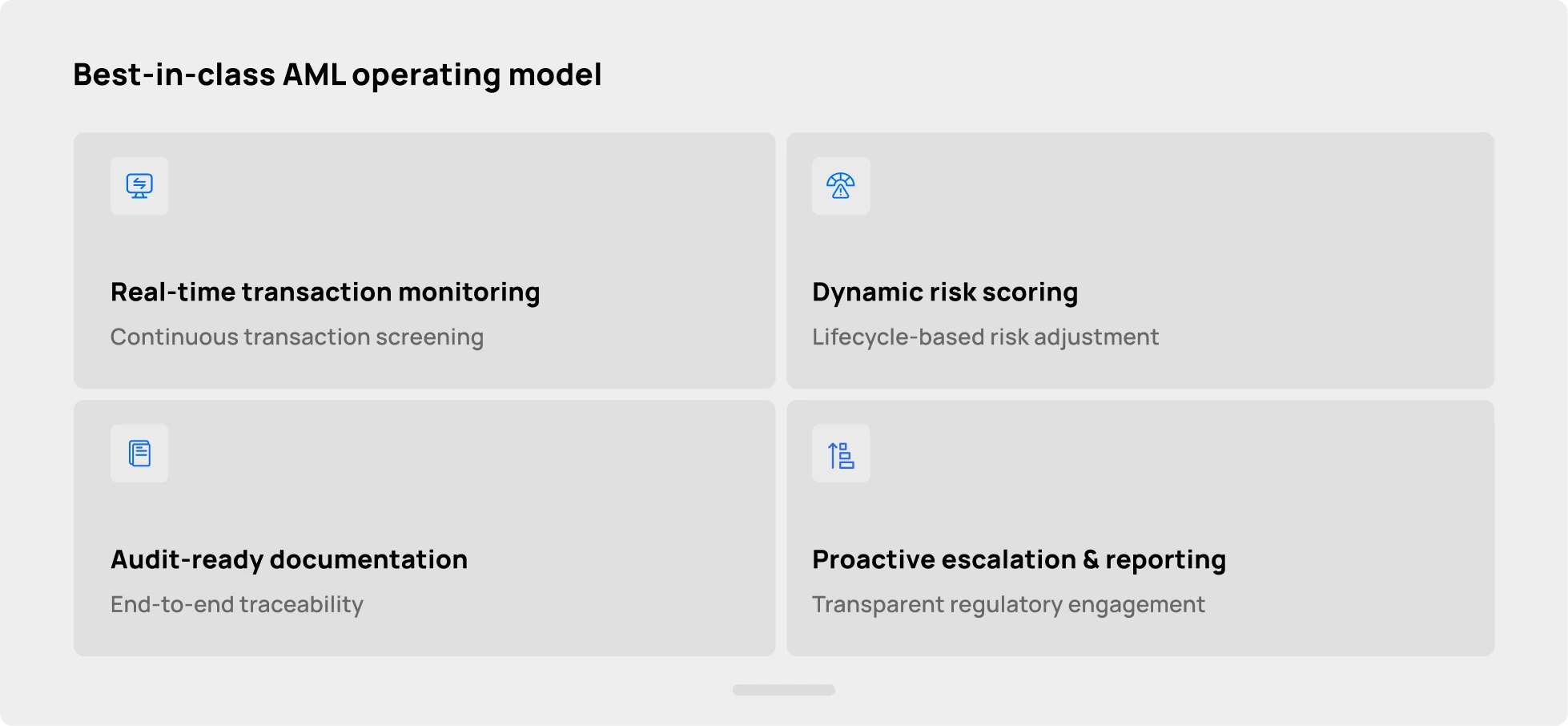
Another hallmark of top-tier compliance is robust documentation and audit trails for every step of the AML process. This includes maintaining clear records of customer due diligence (KYC files, source of funds inquiries), alert investigations, decision rationale for closing or reporting a case, and communications with regulators. In the EU, regulators and auditors expect to be able to reconstruct the trail of decisions, in other words, firms must be “audit ready.” Workflows should be designed so that every alert and its resolution are logged, with timestamps and analyst notes. Such comprehensive audit trails not only demonstrate transparency, but also help internally for quality assurance and improving the program. As one regtech commentary notes, having “end-to-end, governed workflows” that “demonstrate audit readiness” is crucial for institutions to prove their AML controls are effective. Proper documentation also extends to policy governance: firms need up-to-date AML/CFT policies that incorporate the latest regulatory requirements (for example, new lists of high-risk jurisdictions, or the EU’s “travel rule” for crypto transfers), and these policies should be followed in practice and evidenced.
Furthermore, proactive reporting and escalation is a key aspect of best-in-class compliance. This means not only filing STRs quickly when suspicious activity is confirmed, but also alerting regulators or relevant partners if a material compliance issue occurs. The CBI’s guidance implicitly encourages this, if a system failure happens, the firm should notify the regulator and work to mitigate immediately. The era of quietly fixing problems in-house and hoping no one notices is over. Leading crypto compliance teams cultivate a culture of “if you see something, say something” internally, ensuring that analysts and MLROs (Money Laundering Reporting Officers) escalate issues to senior management and boards. Many firms are also engaging in regular third-party audits or independent testing of their AML controls to catch gaps (sometimes even hiring ex-regulators or consultants to simulate supervisory inspections). In summary, a best-in-class AML program for a crypto exchange under EU standards would feature: real-time monitoring with well-calibrated rules, dynamic risk scoring that evolves with customer behavior, thorough documentation and auditability of all compliance actions, and a proactive stance on reporting both suspicious activities and any control failures. This level of preparedness not only satisfies regulators but also builds confidence with banking partners and investors that the firm is managing financial crime risks responsibly.
Strengthening Compliance with Unified Risk Infrastructure and Real-Time Alerting
To achieve these high standards, many crypto companies are turning to advanced regtech solutions and a “unified risk infrastructure” approach. Rather than patchwork tools and siloed teams, a unified risk infrastructure means integrating all facets of AML compliance, from customer onboarding risk assessment, to transaction monitoring alerts, case management, and regulatory reporting, into one cohesive system. This holistic approach helps ensure nothing falls through the cracks. For instance, if a customer’s risk score spikes due to a new darknet exposure, the system can automatically tighten that customer’s transaction thresholds and flag any large transfers in real time. Real-time alerting is a critical feature of such modern systems: the moment a suspicious pattern is detected (be it unusual token mixing, rapid in/out transfers, or links to blacklisted wallets), the compliance team is notified immediately, not days later. With crypto’s 24/7, fast-moving nature, real-time responses are essential. Industry thought leaders note that real-time, risk-based monitoring and alerting has “moved from a best practice to a regulatory expectation,” especially in the crypto sector.
A unified platform can also incorporate advanced analytics and AI, such as machine learning models to detect novel patterns or “explainable AI” that assists analysts in decision-making. By having customer due diligence data, blockchain analytics, and case investigation tools in one place, compliance officers can more efficiently connect the dots. This prevents the left hand/right hand problem, e.g., a customer’s risky activity on one product (like a crypto wallet) being invisible to another product line (like an exchange service) due to siloed systems. Some regtech providers are spearheading this unified approach. For example, Flagright offers an integrated platform that unifies AML monitoring, risk scoring, case management and reporting with real-time capabilities. Flagright’s infrastructure unifies AML with real-time, risk-based monitoring, and end-to-end, governed workflows that help reduce false positives and speed up investigations. In practice, this means crypto businesses can detect suspicious transactions across all their services instantly and ensure every alert is tracked through resolution with a full audit trail. Such real-time risk infrastructure not only helps in catching bad actors more quickly, but also provides confidence to regulators that the firm’s controls are active and effective. As firms scale up, having this kind of unified system supports consistent compliance across different markets and products, which, as noted, is exactly what EU regulators are expecting under MiCA/AMLD6. By investing in unified risk technology and real-time alerting, crypto companies can more readily adapt to evolving risks (e.g. new fraud typologies or sanctions updates) and demonstrate a mature compliance posture. Providers like Flagright in the regtech space are positioning these solutions as ways to future-proof compliance programs as scrutiny on crypto finance intensifies. In short, leveraging a unified, real-time risk infrastructure can be a force multiplier for crypto AML compliance, enabling teams to do more with less and to keep pace with both criminals and regulators’ rising expectations.
Conclusion: A New Phase of Regulatory Maturity for Crypto
The enforcement action against Coinbase in Ireland heralds a new phase of regulatory maturity for the crypto industry in Europe. No longer viewed as an unregulated Wild West, major crypto players are being held to the same high standards as traditional financial institutions when it comes to anti-money laundering controls. Going forward, the firms that will earn the trust of regulators, banking partners, and the public will be those that can prove their AML controls are active, adaptive, and transparent. “Active” means controls that are not just paper policies but actually intercepting suspicious activity in real time and prompting swift reporting. “Adaptive” means continuously evolving measures, incorporating new typologies (e.g. DeFi, mixers), scaling as transaction volumes grow, and adjusting to the risk profile of emerging threats. “Transparent” means an open book approach with regulators: strong documentation, willingness to submit to audits, and candid communication about compliance efforts and issues. Those crypto firms that embrace this mature approach will be well-placed to thrive under the EU’s tightened regulations. They will find it easier to obtain licenses across Europe, maintain essential banking relationships, and even attract customers who increasingly prefer compliant platforms.
On the other hand, companies that fail to modernize their compliance programs risk enforcement or exclusion. As seen, regulators are prepared to levy record fines and even restrict a non-compliant firm’s operations. In extreme cases, an exchange could be forced to suspend certain activities or could lose its authorization if it doesn’t remediate critical AML breaches. Beyond direct regulatory action, there’s also the risk of being shut out of the market indirectly, for example, if major payment processors or banks refuse to do business with an exchange that is seen as high-risk. The writing is on the wall: under the coming EU regime, there is effectively “no safe harbor” for weak compliance. This sentiment was echoed by the head of the new AML Authority, who stressed that while innovation in crypto is welcome, it is *“essential that Europe is adequately protected from the risks of money laundering and terrorist financing stemming from this sector.”* In other words, if crypto firms do not themselves ensure that protection through robust controls, the regulators will ensure it through enforcement.
The case of Coinbase Europe in Ireland will likely be remembered as a turning point, a reminder that even the biggest exchanges must continually earn their license to operate by investing in compliance. The crypto industry in the EU is entering a period of regulatory rigor and operational scrutiny unprecedented in its short history. But this is also an opportunity: those exchanges and crypto service providers that rise to the challenge and build truly state-of-the-art AML programs can differentiate themselves. They can legitimately claim to be safe and trustworthy bridges between the traditional finance system and the new world of digital assets. In time, such trust will be a competitive advantage. In the meanwhile, the CBI’s €21.5 million fine is a stark warning, adapt and mature, or face the consequences. The path forward is clear: compliance excellence is no longer optional for crypto firms, but a core requirement for survival and success in a regulated European market.