Establishing a New Standard in AML Rule Monitoring: Flagright’s platform transforms traditional rule management through AI-powered rule performance monitoring, real-time observability, and intelligent tuning tools. This explainer outlines how Flagright’s innovative features empower compliance heads, risk leads, AML analysts, and product stakeholders to dramatically reduce false positives, improve detection accuracy, and continuously adapt their monitoring rules to evolving risks.
The Challenge: Static Rules & Excess Noise
- Legacy Rule Limitations: Traditional AML/Fraud rule engines rely on static thresholds and rigid scenarios, causing high volumes of irrelevant alerts. Teams drown in noise from false positives, diverting attention from real threats. Limited transparency into why alerts trigger further hampers oversight.
- Slow, Risky Tuning Cycles: Adjusting rules is often manual and infrequent. Compliance teams lack safe sandboxes to test changes, so even minor tweaks risk misconfiguration. Misconfigured rules can overwhelm analysts with meaningless alerts or, worse, let suspicious activity slip through.
- Evolving Risk Outpacing Rules: Financial crime patterns and regulatory expectations change constantly. Firms using fixed rule sets struggle to keep up. Without intelligent assistance, maintaining alignment with new typologies or shifting customer behavior is resource-intensive and error-prone.
Impact: Compliance operations face inefficiency and blind spots. High false-positive rates waste analyst time and frustrate customers, while static rules may miss emerging risks. A new approach is needed to make rule management more agile, data-driven, and precise. Flagright addresses these pain points head-on.
Flagright’s Intelligent Rule Management Solution
- No-Code, AI-Driven Rules Engine: Flagright provides a flexible no-code rule builder that empowers non-technical teams to create or modify even complex rules in minutes. Integrated AI agents continuously assist in optimizing those rules for maximum efficacy.
- Holistic Rule Lifecycle Tools: Five key capabilities; Rule Simulations, Shadow Rules, Rule Analytics & Observability, Rule Threshold Recommender, and Rule Recommender, work in unison to enable continuous improvement. Together, they allow compliance teams to test, monitor, and enhance their scenarios both before and after deployment.
- Thought Leadership in Compliance: By combining advanced simulation, real-time testing, and machine learning guidance, Flagright positions itself as a thought leader in intelligent rule management. These features exemplify industry best practices (e.g. proactive back-testing, dynamic thresholds, and typology-driven rules), setting a new benchmark for effective AML monitoring.
Outcome: Flagright’s platform shifts rule management from a static, reactive exercise to a dynamic, intelligence-led process. Compliance officers gain confidence that their ruleset is always finely tuned; minimizing noise, maximizing true positives, and ready for new risks.
Rule Simulations: Test and Tune with Historical Data
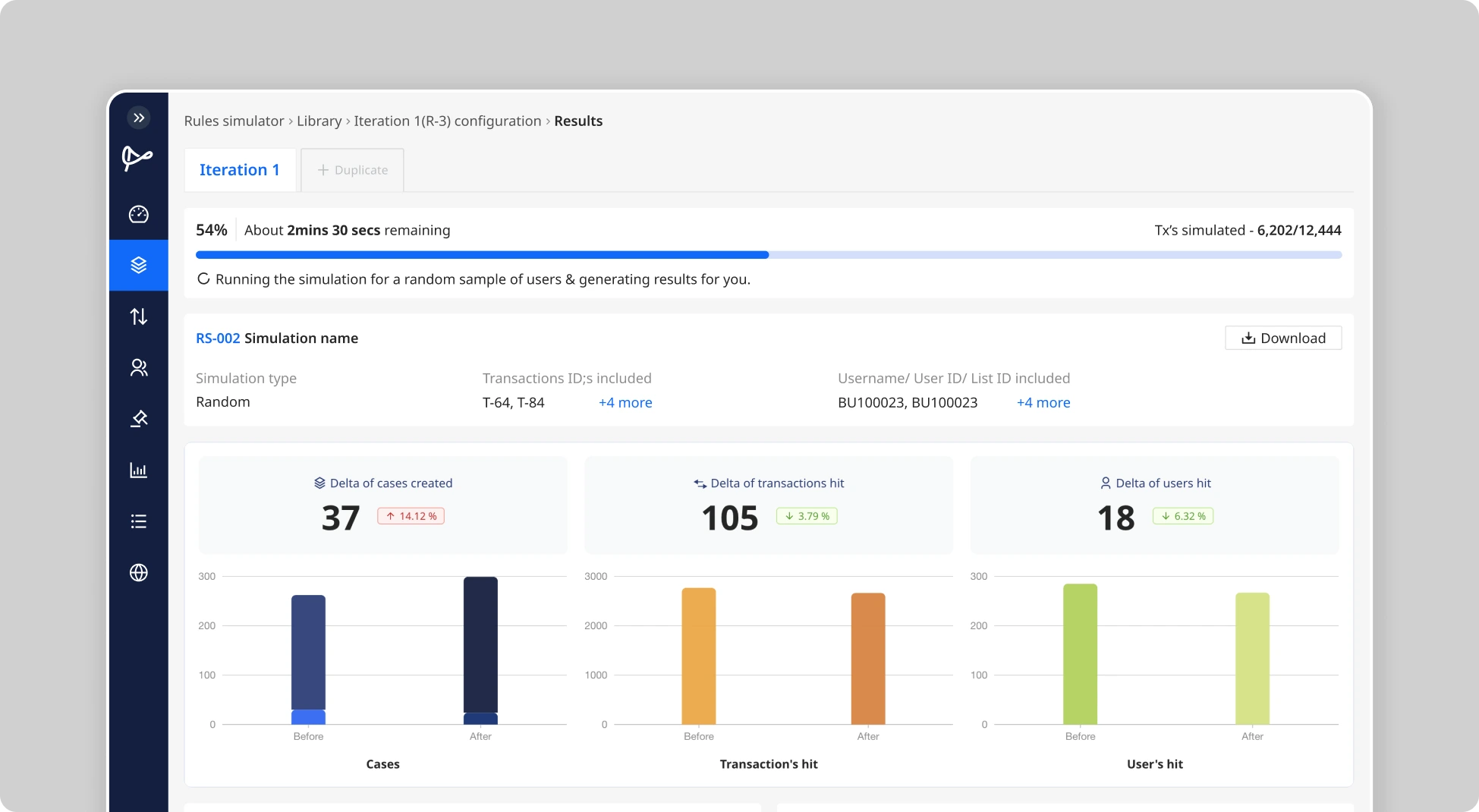
- What It Is: A Rule Simulator that lets you safely trial rule changes on past transactions. Users can run any rule logic against historical data to see exactly how it would have performed before deploying it live.
- How It Works: Simply adjust rule parameters (thresholds, conditions, etc.) in the no-code builder and execute a simulation. The system instantly returns analytics on how many alerts the rule would trigger, which accounts/transactions would be flagged, and the projected false positive rate. This back-testing is done in seconds, with no engineering effort.
- Benefits in Practice: Compliance teams use simulations to fine-tune accuracy and reduce false positives prior to rollout. For example, if raising a threshold drops alert volume 50% with minimal impact to true hits, the team can confidently implement the change. Rule Simulation eliminates guesswork and lengthy trial-and-error in production. It accelerates tuning cycles (what once took weeks of monitoring now takes minutes) and prevents compliance blind spots by confirming that new rules actually catch the intended behavior.
With Flagright’s simulator, teams can iteratively refine rules in a sandbox. One can adjust a suspicious transaction amount threshold and immediately see if it would have caught past illicit activity or just generated noise. This empowers analysts to optimize detection logic upfront, ensuring each rule strikes the right balance between sensitivity and precision. By the time a rule goes live, it has already proven its merit on historical data, giving stakeholders confidence in its performance.
Shadow Rules: Safe Real-Time Rule Testing
.webp)
- What It Is: A Shadow Rule is a rule deployed in “silent” mode alongside live monitoring. It processes incoming transactions in real time without actually raising alerts or interfering with operations. Think of it as a parallel test environment running on production data.
- How It Works: When a new rule or an adjustment is created, you set it as a shadow rule. It runs invisibly on all transactions, logging any would-be alerts and hit statistics (which events, how often triggered). Compliance teams monitor these results via dashboards. The shadow rule can be tweaked on the fly, thresholds, logic, until performance is optimal. Only then do you promote it to an active rule, at which point it will start generating real alerts.
- Benefits in Practice: Shadow Rules provide a risk-free sandbox in production. Teams can validate rule effectiveness in real time, ensuring it catches true suspicious activity and generates minimal false positives before it ever impacts analysts’ queue. This feature virtually eliminates misconfigurations going live. In fact, firms using Flagright see an 80% reduction in false positive alerts caused by bad rule settings, by catching those issues during shadow testing. Compliance officers can experiment confidently: e.g. trial a tighter anti-fraud rule during a spike in scam attempts, knowing it won’t overwhelm the team with alerts if it overshoots. Shadow mode also fosters a culture of continuous improvement, rules aren’t set-and-forget, but rather can be fine-tuned iteratively (often 2-3 versions) over a week before finalizing.
Flagright’s Shadow Rules enable compliance teams gain real-time observability into a rule’s impact: “Would this change have caught that suspicious transfer we missed? Is it flooding us with benign alerts?” By answering these questions upfront, shadow rules ensure that only well-calibrated logic makes it to production. This leads to significantly fewer noisy alerts and more precise detection. In short, Shadow Rules let you never misconfigure a rule again, preserving both operational efficiency and regulatory integrity.
Rule Analytics & Observability: Continuous Performance Monitoring
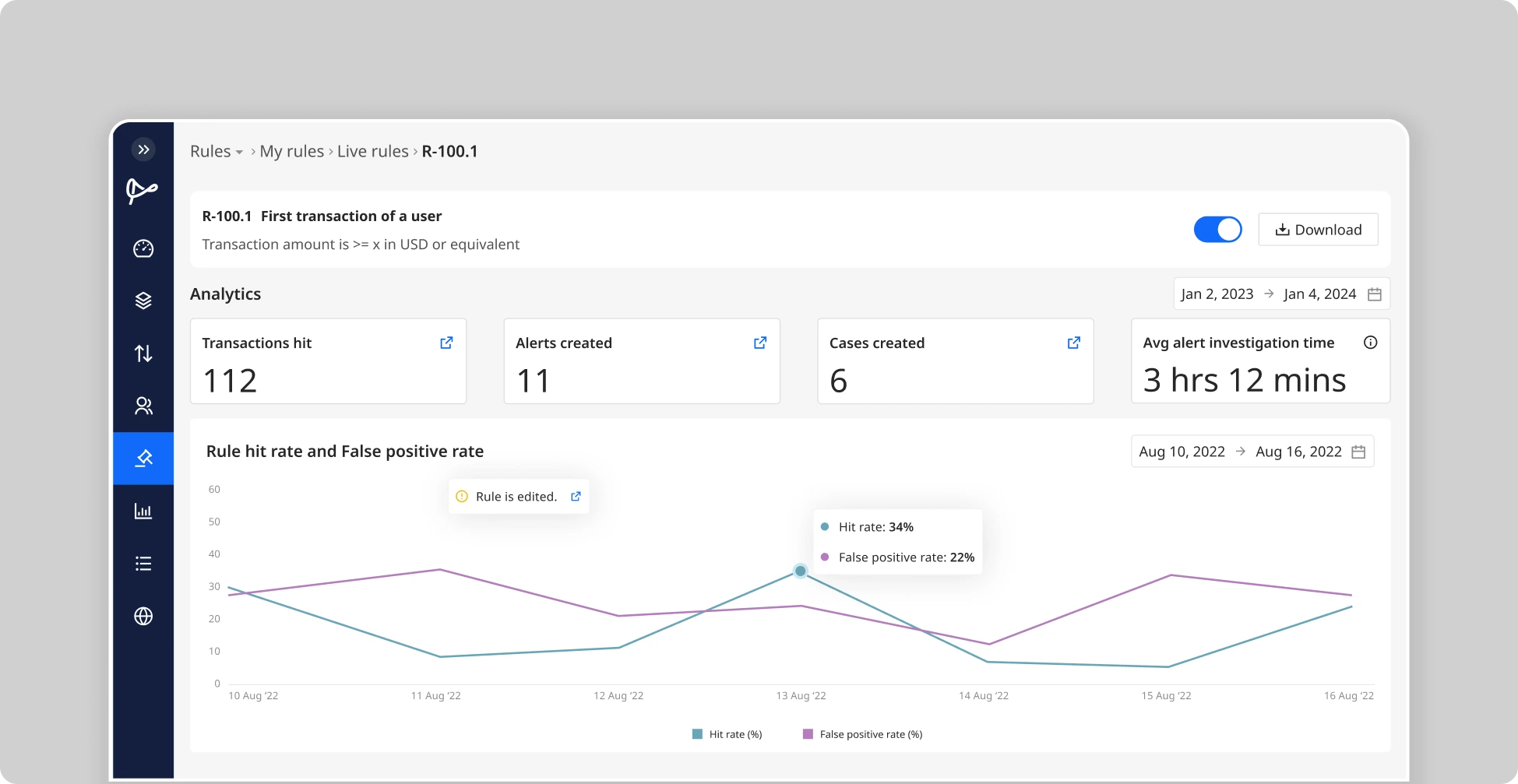
- What It Is: Rule Analytics is a comprehensive monitoring dashboard that provides full observability into each rule’s performance. Flagright tracks real-time and historical metrics for every rule, alert trigger frequency, affected users/transactions, false positive rate, and more, giving teams data-driven insight into how their controls are operating.
- How It Works: As alerts are generated and cases resolved, the platform aggregates outcomes per rule. For example, analysts can see that “Rule A triggered 100 alerts this week, of which 5% were true hits and 95% false alarms.” Key indicators like false positive ratios, average value of flagged transactions, conversion to cases or SARs, and trend lines over time are presented in a unified dashboard. The system also provides audit trails, every change to a rule’s logic or threshold is logged for compliance review, so you can trace why a rule behaved a certain way on a given day. Moreover, Flagright’s observability tools include real-time compliance performance charts and even notifications if certain rules spike in activity, enabling proactive management.
- Benefits in Practice: With these analytics, compliance and risk teams can quickly identify which rules are high-volume alert generators and drill down into whether they’re effective or just creating noise. This makes it easy to spot a rule that needs tuning or might be out of date. Operational visibility is vastly improved, no more black-box rules firing unbeknownst to anyone. Instead, teams have an open view of the system’s alert logic, which enhances internal oversight and confidence during audits or regulatory exams. In practice, this means faster tuning cycles and better resource allocation: if one scenario produces mostly false positives, you have the data to justify refining or replacing it. Conversely, if a certain rule rarely triggers, analytics might reveal a gap in coverage or an overly tight threshold. Continuous observability ensures your rule set stays effective over time, with adjustments guided by empirical evidence rather than hunches.
Flagright’s rule analytics turn raw alert data into actionable intelligence. For example, a risk lead can open the dashboard and immediately see the false-positive rate per rule, focusing tuning efforts where it matters most. If a new fraud pattern emerges (say a surge in mule account activity), you might notice one rule’s triggers shooting up, the platform will not only display this but can also suggest threshold adjustments before risk escalates further. This level of insight is transformative: compliance teams move from passively receiving alerts to actively managing and optimizing their detection logic. In sum, observability means no surprises, you understand exactly how each rule is performing and can make informed decisions to improve the program continuously.
AI-Powered Rule Threshold Recommender: Data-Driven Tuning
.webp)
- What It Is: An AI-driven threshold optimization tool that automatically suggests the optimal values for your rule parameters. Flagright’s Rule Threshold Recommender analyzes your alert data and outcomes to find the sweet spot where a rule will catch the risky activity while minimizing false positives.
- How It Works: The system’s machine learning models ingest historical transaction data, alert dispositions (which alerts were false vs true), and rule trigger statistics. It then evaluates how varying a rule’s threshold (or other numeric criteria) would impact performance. For example, for a rule flagging transfers above $5,000, the AI might determine that raising the threshold to $5,500 would cut false alerts by 20% with negligible impact on true detection. Conversely, it may find a threshold is too high and suggest lowering it to catch more incidents. These recommendations are presented to analysts directly in the interface, highlighting expected changes in false positive rate, total alerts, and affected users if applied. The team can accept, adjust, or ignore the suggestion, but over time, these AI insights help continuously refine each rule’s settings.
- Benefits in Practice: This is a critical differentiator for Flagright. Instead of relying solely on human trial-and-error, compliance teams get data-backed guidance on how to improve rules. The AI can surface adjustments that might not be obvious, especially as transaction patterns shift. In practice, the Threshold Recommender greatly reduces noise: rules stay calibrated to current behavior, so they generate alerts only when truly warranted. It also ensures better detection quality, by removing arbitrary or stale threshold values, you’re less likely to miss suspicious events that fell just under an old hard limit. For the team, this means less time crunching numbers in Excel or guessing at new settings; the AI does the heavy lifting. Analysts remain in control, they review and implement changes but with the confidence that recommendations are rooted in actual performance data.
Flagright’s threshold optimization exemplifies how AI augments the compliance workflow. Imagine an AML analyst regularly tuning a rule for unusual account login frequency. Instead of manually evaluating outcomes for different limits, they receive an alert: “Threshold Recommender suggests increasing daily login limit from 50 to 70, expected false positives would drop from 30% to 10% with no missed incidents.” Backed by such concrete analytics, the analyst can swiftly update the rule, immediately cutting out noise. These incremental improvements add up. Over time, Flagright’s users keep their scenarios finely balanced, neither too sensitive nor too lax, with the AI continuously learning from new data. The result is a monitoring system that adapts in real-time to evolving customer behavior and risk patterns, without waiting for quarterly rule reviews. In short, the Rule Threshold Recommender is like an expert advisor always tuning the dials of your system for peak performance.
AI-Driven Rule Recommender: Proactive New Rule Suggestions
- What It Is: An AI-based Rule Recommender that proposes entirely new rules or scenarios for your program. This feature leverages Flagright’s global intelligence and pattern recognition to suggest rules you may be missing, for example, emerging typologies or common suspicious patterns relevant to your business.
- How It Works: The recommender analyzes a combination of inputs: your institution’s transaction data and risk profile, configurations used by similar organizations, prevalent typologies across Flagright’s client network, and even external factors like recent regulatory advisories. By comparing your active rules against this knowledge base, it can identify gaps. For instance, if peer institutions have a rule for monitoring rapid sequence micro-deposits (a known fraud indicator) and you don’t, Flagright will flag this as a recommended rule. Recommendations come with an explanation of the pattern or risk addressed (e.g. “Unusual device fingerprint changes linked to account takeover”), and can often be auto-configured from a template. The AI essentially curates a set of high-value rules that you’re not currently using but probably should, given your operations and the latest financial crime trends.
- Benefits in Practice: This proactive approach helps compliance teams stay ahead of evolving risks. Instead of waiting to discover a vulnerability after an incident, the system prompts you to deploy controls that others have found effective or that data suggests are necessary. It also reduces the burden on analysts to research typologies; busy teams get the benefit of Flagright’s broad view across industries and geographies. In effect, the platform acts like a virtual advisor, ensuring you’re not overlooking a scenario (for example, a mule account behavior pattern or a new regulatory red flag). Adopting recommended rules can both improve detection quality, by covering more threat scenarios, and reduce noise, by sharing in the collective intelligence of what thresholds and conditions have worked well elsewhere. Furthermore, this feature accelerates rule deployment: instead of crafting every rule from scratch, teams can import recommended ones and then tweak as needed, drastically cutting development time.
Flagright’s Rule Recommender underscores its role as a partner in compliance strategy, not just a tool. For example, a fintech focusing on remittances might get a suggestion for a rule targeting “unusual intermediary hops in fund transfers,” drawn from patterns seen in other remittance providers. Or an AML lead might receive a recommended rule set when a new FATF typology report is released, ensuring their program addresses those risks promptly. Each recommendation is grounded in real-world data and expert knowledge: Flagright’s AI considers factors like your business model, customer demographics, typical transaction behaviors, and known criminal methods. This breadth of insight is something even the most seasoned compliance officer would find hard to gather alone. By implementing these suggestions, institutions can fortify their defenses preemptively, aligning their rule set with both industry best practices and emerging threats. The result is a continuously evolving rule library that keeps your monitoring sharp, relevant, and comprehensive.
Real-World Impact: Better Detection, Less Noise, Greater Agility
- Dramatic False Positive Reduction: Through intelligent rule management, Flagright clients have vastly lowered their alert noise. The combination of simulation tuning, shadow testing, and AI threshold optimization has enabled false positive reductions up to 98% for some institutions. This means compliance analysts spend their time on real risks, not chasing harmless alerts.
- Improved Detection Quality: Flagright’s dynamic approach catches suspicious behavior that static systems miss. By incorporating customer-specific baselines and continually recommending new rules, the platform helps teams identify anomalies earlier without raising unnecessary flags. Rules are always up-to-date against the latest fraud and AML patterns, so genuine threats don’t slip by.
- Accelerated Rule Tuning & Deployment: What used to require lengthy rule development and weekslong observation can now happen on-the-fly. Users routinely test and perfect rules within days using simulations and shadow mode, 65% of new rules are first run as shadow rules for about a week to ensure accuracy. Pushing a change live is a confident decision backed by data, not a gamble. This agility lets compliance programs respond immediately to new insights or regulatory changes, rather than waiting for the next audit cycle.
- Adaptive, Future-Proof Compliance: Flagright’s intelligent rule management keeps rulesets aligned with evolving risk. The system’s ongoing recommendations and analytics function like an early warning system for your controls, if customer behavior shifts or a new typology emerges, your rules adjust in step. This ensures continuous alignment with both business risk appetite and regulatory expectations, even as the landscape changes.
In Conclusion
Flagright’s capabilities in rule performance monitoring, observability, and intelligence collectively redefine how financial institutions approach transaction monitoring. By injecting AI and real-time feedback loops into rule management, Flagright enables a compliance program that is always learning, improving, and focusing on what matters most. Compliance heads, risk leads, and analysts can trust that their rules are not only effective today but are being actively optimized for tomorrow’s challenges. In an industry where precision and adaptability are paramount, Flagright stands out as the partner that delivers both, significantly less noise, superior detection outcomes, and the agility to stay ahead of financial crime.