AT A GLANCE
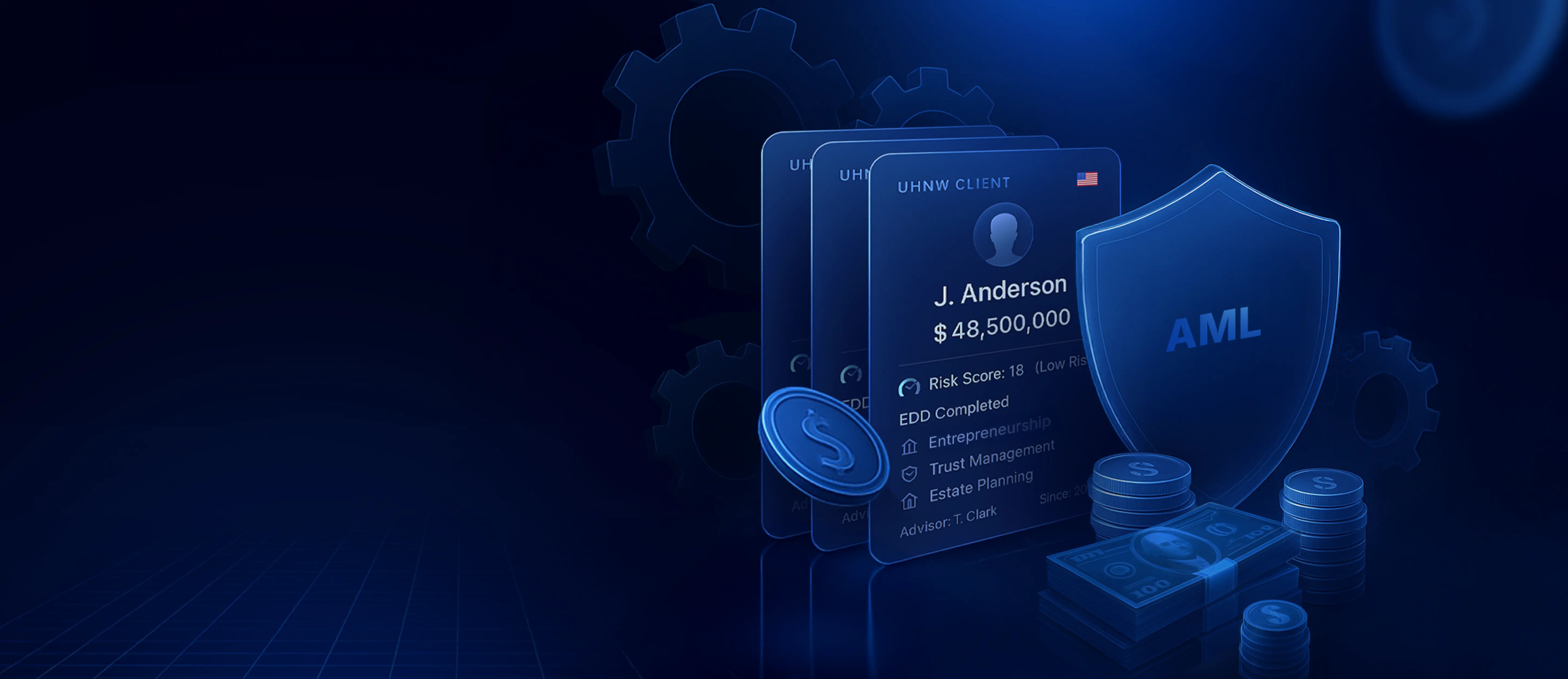
Ultra-high-net-worth (UHNW) individuals with $30+ million in liquid assets present unique anti-money laundering challenges. Their complex ownership structures, cross-border activities, high-value asset holdings, and frequent PEP status create elevated compliance risks. Global regulators from FinCEN to Singapore's MAS now mandate enhanced due diligence, comprehensive source-of-wealth verification, and continuous monitoring for this client segment. Financial institutions that fail these standards face severe penalties, including license revocations and multi-million dollar fines.
What Are Ultra-High-Net-Worth (UHNW) Individuals?
Ultra-high-net-worth individuals are people with over $30 million in liquid assets, excluding their primary residence and collectibles. This wealth threshold places them in an elite category requiring specialized financial services through private banks, family offices, and wealth management firms. For wealth managers and RIAs, this means serving clients with complex structures, cross-border assets, and heightened regulatory expectations.
UHNW clients operate differently than retail banking customers. They maintain multiple residences across countries, hold citizenships in several jurisdictions, and structure wealth through complex legal entities. Their financial footprints span continents, asset classes, and investment vehicles that most people never encounter.
From a compliance perspective, this complexity matters. When someone manages tens or hundreds of millions through layered trusts, special purpose vehicles (SPVs), and offshore holding companies, tracking the true beneficial owners becomes exponentially harder.
Why Do UHNW Clients Pose Higher AML Risks?
UHNW clients create four primary risk factors that elevate money laundering concerns beyond typical banking relationships.
Complex Ownership Structures Obscure True Owners
Many UHNW individuals don't hold assets in their own names. Instead, they use layered trusts, offshore companies, family offices, and SPVs spanning multiple jurisdictions. While these structures serve legitimate purposes like estate planning, they also create perfect conditions for bad actors to hide illicit wealth.
U.S. authorities have noted that some investment advisors and private funds became entry points for channeling proceeds from foreign corruption and sanctioned oligarchs into the American financial system. When ownership passes through five different entities across three countries, unwinding this structure to identify the ultimate beneficial owner becomes a major due diligence challenge.
High-Value Assets Move Outside Traditional Banking
Wealthy clients frequently invest in assets operating with minimal transparency: fine art, luxury real estate, yachts, private jets, precious metals, and cryptocurrency. These high-value assets can store and transfer wealth outside conventional bank accounts.
The art market exemplifies this vulnerability. A client purchasing a million-dollar painting through a shell company at auction creates very little audit trail. Similarly, real estate purchases through anonymous LLCs or cryptocurrency transfers through multiple wallets obscure money origins in ways standard wire transfers cannot.
Cross-Border Activity Complicates Monitoring
UHNW individuals are global citizens by nature. They maintain accounts worldwide, move funds through offshore financial centers, and conduct business across multiple regulatory jurisdictions. Large international wire transfers, private banking relationships in high-secrecy jurisdictions, and frequent fund flows between countries all constitute red flags requiring enhanced scrutiny.
Politically Exposed Persons Create Heightened Risk
A significant portion of UHNW clients qualify as politically exposed persons, current or former senior politicians, government officials, or individuals connected to state contracts. By definition, PEPs carry a higher risk of bribery and corruption, so banks are required to apply enhanced due diligence to them.
In the European Union and UK, this scrutiny extends even to domestic PEPs, not just foreign officials. Banks must apply enhanced due diligence and obtain senior management approval for PEP relationships. The presence of a PEP anywhere in an UHNW client's ownership structure automatically elevates the risk rating and triggers mandatory enhanced controls.
What Are the Global Compliance Requirements for Managing UHNW Clients?
Regulators worldwide have raised compliance standards for wealth management, with enforcement becoming increasingly aggressive across all major financial centers.
United States: FinCEN and SEC Expand Coverage
The Financial Crimes Enforcement Network (FinCEN) recently finalized rules extending AML/CFT program requirements and suspicious activity report (SAR) filing obligations to certain investment advisers. This change directly addresses findings that investment advisers have been used to funnel illicit wealth from foreign corruption, fraud, tax evasion, and sanctioned individuals into U.S. markets.
U.S. regulations now expect these firms to identify beneficial owners, verify sources of funds, file SARs on suspicious activity, and implement risk-based program. For UHNW clients specifically, FinCEN expects commensurately greater scrutiny than lower-risk retail customers receive.
International Standards: FATF Sets the Baseline
The Financial Action Task Force (FATF) establishes fundamental standards that virtually all major financial centers follow. FATF explicitly recommends enhanced due diligence for high-risk customers, including PEPs, those in high-risk countries, and accounts involving unusual transactions.
A core FATF principle requires knowing the beneficial owner behind legal entities and arrangements. FATF Recommendation 12 requires obtaining senior management approval, source-of-wealth information, and enhanced ongoing monitoring for PEP customers.
United Kingdom and European Union: Strictest Requirements
The UK's Financial Conduct Authority (FCA) and EU regulators enforce some of the world's most stringent AML requirements, making strong case management essential for tracking alerts, investigations, and outcomes. Under UK Money Laundering Regulations, firms must treat even domestic politically exposed persons as high-risk, requiring the same enhanced due diligence as foreign PEPs.
The UK is introducing tougher laws through a proposed Economic Crime Bill that would make failure to prevent money laundering a criminal corporate offense. Across Europe, the AML directives (5AMLD/6AMLD) have brought new sectors under supervision, including art dealers and cryptocurrency exchanges.
Singapore and Asia: Zero Tolerance After 1MDB
Singapore’s Monetary Authority of Singapore demonstrated unprecedented enforcement in the aftermath of the 1MDB scandal, permanently shutting down the Singapore operations of BSI Bank in 2016 for egregious AML failures involving politically connected UHNW accounts. Shortly after, Falcon Private Bank’s license in Singapore was also withdrawn for similar breaches. Other institutions like DBS and UBS received substantial fines for similar lapses.
This sent an unmistakable signal: regulators will apply the ultimate sanction business closure when they find willful AML negligence involving powerful, wealthy clients.
How Do You Verify Source of Wealth and Funds for UHNW Clients?
Enhanced due diligence for UHNW clients goes far beyond standard KYC procedures, centering on understanding where money comes from and who truly controls it.
Source of Wealth: Understanding How Fortune Was Built
Source of wealth refers to the origin of a client's overall wealth, how they earned or accumulated their fortune over time. Financial institutions must obtain documentation supporting the wealth narrative: business sale agreements, audited financial statements, tax returns showing income history, proof of inheritance, investment portfolio performance records, or real estate sale records.
The goal is corroborating that wealth derived from legitimate activities. Simply accepting a declaration like "wealth from business proceeds" without evidence is insufficient. If anything doesn't add up, that discrepancy becomes a red flag.
Source of Funds: Tracking Specific Transactions
While source of wealth examines the big picture, source of funds focuses on the origin of specific assets or transactions entering the institution. If an UHNW client deposits $5 million, the bank should know exactly where those funds came from: stock sale proceeds, business dividend, loan from another bank.
For ongoing activity, this means scrutinizing large or unusual transactions. Robust source of funds checks ensure that even if a client's overall wealth is legitimate, they're not acting as a conduit for someone else's dirty money.
Identifying All Beneficial Owners
With complex trust or company structures, essential enhanced due diligence includes identifying all real parties behind the account. For each legal entity in the client's structure, institutions should determine beneficial owners and any controlling persons.
This requires obtaining corporate registries, trust deeds, organizational charts, or lawyer letters. Global regulators have zeroed in on beneficial ownership transparency. Banks are expected to pierce through any opacity or else refrain from doing business.
Conducting Adverse Media Checks
Enhanced due diligence involves deep dives into client backgrounds via public domain searches and databases. Any negative news fraud allegations, past regulatory fines, criminal investigations, association with criminals should be unearthed and evaluated. Firms often use specialized due diligence reports from third-party providers covering litigation history, source-of-wealth corroboration, and media profiles.
How Should Financial Institutions Manage High-Risk UHNW Accounts?
Beyond upfront due diligence, managing UHNW clients requires continuous risk assessment and monitoring throughout the relationship.
Dynamic Risk Scoring for Ongoing Assessment
Financial institutions use risk scoring models assigning each client a risk level. UHNW clients typically score high by default due to large transaction volumes, international exposure, and higher PEP likelihood. Risk scoring methodologies should include indicators specific to UHNW profiles: offshore jurisdictions, shell companies, PEP involvement, client industry and wealth source, expected transaction behavior, and negative news.
Best practice includes requiring senior management approval for onboarding high-risk UHNW clients. Risk scores should be reviewed annually or when major events occur.
Tailored Transaction Monitoring
UHNW individuals conduct transactions orders of magnitude larger than retail clients. Monitoring systems must calibrate to this reality. Scenarios should be customized for unexpected activity relative to profile, movement to secrecy jurisdictions, high-value asset purchases, payments to advisors or intermediaries, and cryptocurrency transactions.
Relationship managers should coordinate with compliance to define what "normal" looks like for each UHNW client expected transaction types, counterparties, and volumes.
Periodic Profile Reviews and Continuous Screening
Best practice requires refreshing KYC information on high-risk clients at least annually. Names should be continuously screened against sanctions and PEP lists. If a client becomes sanctioned or implicated in major fraud scandals, institutions must take swift action, such as freezing assets, reporting to regulators, or exiting relationships, backed by AI Forensics to rapidly validate findings and support audit-ready decisions.
Suspicious Activity Reporting Without Hesitation
High-risk clients require the same suspicion threshold for reporting as any customer. Compliance staff might hesitate to file a SAR on a powerful client, but regulators expect unbiased judgment. Critical to establish clear internal escalation protocols so unusual activity in UHNW accounts gets promptly reviewed and, if warranted, reported to authorities.
What Are the Real Consequences of Poor UHNW AML Compliance?
1MDB Scandal: Banks Permanently Shut Down
In 2016, the Monetary Authority of Singapore permanently shut down the Singapore branches of BSI Bank and Falcon Private Bank for egregious AML failures linked to the handling of 1MDB accounts controlled by politically exposed persons moving huge sums with little economic rationale. Swiss-based BSI Bank’s Singapore branch was ordered closed in 2016 as part of this enforcement action.
Besides license revocations, other banks like DBS and UBS received large fines. This signaled that regulators will apply the ultimate sanction for willful AML negligence.
Russian Oligarchs and Sanctions Evasion
After Russia's Ukraine invasion, investigations revealed many sanctioned oligarchs had used family offices and investment advisers to move wealth into London and New York. The U.S. Treasury's FinCEN noted that "billions of dollars" tied to sanctioned oligarchs had flowed through the U.S.-based investment advisers. One Senate investigation revealed an art auction house unknowingly facilitated $18 million in purchases by shell companies linked to a sanctioned Russian billionaire.
European Private Banking Fines
Switzerland's FINMA penalized Julius Baer for accepting suspicious Venezuelan and Russian funds, temporarily restricting the bank's growth. Danske Bank's Estonian branch handled over €200 billion in suspicious non-resident funds through accounts linked to wealthy individuals and shell companies, leading to penalties totaling billions.
Frequently Asked Questions
What defines an ultra-high-net-worth individual?
An ultra-high-net-worth (UHNW) individual has over $30 million in liquid assets, excluding their primary residence and collectibles. This distinguishes them from standard high-net-worth individuals (typically $1-5 million) and requires specialized financial services under enhanced AML scrutiny.
Why are UHNW clients automatically considered high-risk?
UHNW clients aren't automatically high-risk, but they have characteristics that frequently elevate risk: complex ownership structures, investments in opaque high-value assets, extensive cross-border activities, and higher likelihood of being politically exposed persons. These factors create opportunities to obscure beneficial ownership and fund origins.
How can private banking relationships leave institutions vulnerable to money laundering?
Private banking creates vulnerability through several channels: high-dollar transactions appear normal, making unusual activity harder to spot; wealthy clients use complex structures obscuring beneficial ownership; relationship managers may prioritize client satisfaction over compliance; and lucrative UHNW accounts can incentivize overlooking red flags.
What documents are required to verify source of wealth for UHNW clients?
Source of wealth documentation typically includes business sale agreements, audited financial statements, tax returns, proof of inheritance, investment portfolio records, real estate sale records, and employment contracts. Institutions must obtain independent verification not just client declarations proportional to the risk level.
How often should high-risk UHNW accounts be reviewed?
High-risk UHNW accounts should receive comprehensive KYC reviews at least annually, with continuous name screening against sanctions and PEP lists (ideally daily automated screening). Transaction monitoring should be real-time. Trigger events like negative media should prompt immediate interim reviews.
What is enhanced due diligence for UHNW clients?
Enhanced due diligence includes: comprehensive source of wealth verification with documentation, source of funds checks for transactions, identification of all beneficial owners, adverse media and reputation checks, PEP and sanctions screening of related parties, senior management approval for account opening, customized transaction monitoring, and more frequent periodic reviews.
What penalties do banks face for UHNW AML failures?
Penalties range from substantial fines (tens to hundreds of millions) to business restrictions to license revocation and forced closure. Singapore permanently shut down BSI Bank and Falcon Private Bank for 1MDB-related failures. Institutions also face reputational damage potentially more costly than financial penalties.
How do you monitor cryptocurrency transactions for UHNW clients?
Cryptocurrency monitoring requires understanding the client's legitimate need for crypto exposure, setting appropriate thresholds for conversions, screening wallet addresses against known illicit addresses, tracking source of funds used to purchase crypto and destination of proceeds, and maintaining enhanced documentation.
Key Compliance Strategies: Actionable Tips
Tip 1: Create UHNW-Specific Risk Scoring Models Don't use generic risk models for ultra-wealthy clients. Develop separate scoring criteria accounting for offshore structures, PEP connections, high-value asset holdings, and cross-border complexity.
Tip 2: Establish a Wealth Compliance Committee Form a dedicated committee including senior compliance officers, relationship managers, and legal counsel to review all high-risk UHNW onboarding decisions and significant suspicious activity.
Tip 3: Require Independent Source of Wealth Verification Never rely solely on client-provided documentation. Use third-party due diligence providers, public records, corporate registries, and open-source intelligence to independently verify wealth origins.
Tip 4: Implement Four-Eyes Principle for High-Risk Clients Require at least two people typically a relationship manager and a compliance officer to review and approve all critical decisions regarding UHNW clients.
Tip 5: Build Comprehensive Client Narratives Create detailed written narratives for each UHNW client explaining their wealth origin, business operations, investment strategy, and anticipated account activity. Update annually and whenever material changes occur.
Tip 6: Automate Continuous Screening Implement automated daily watchlist screening of all UHNW clients and beneficial owners against updated sanctions lists, PEP databases, and adverse media feeds.
Tip 7: Train Relationship Managers on Red Flags Front-line staff handling UHNW clients need specialized training on money laundering typologies specific to wealth management: art and real estate purchases through shells, unexplained offshore transfers, third-party funding requests, and reluctance to provide source documentation.
Tip 8: Maintain comprehensive files for every UHNW client with all KYC documents, source of wealth verification, risk assessment rationale, senior management approvals, transaction monitoring reviews, and periodic update records.
Managing elevated AML risks for ultra-high-net-worth individuals demands vigilance, sophisticated systems, and an unwavering commitment to compliance standards. The regulatory environment has made clear that private wealth institutions must maintain the same rigor as retail banks, if not more.
By understanding the unique risk factors UHNW clients present, adopting a risk-based approach to enhanced due diligence and ongoing monitoring, and leveraging technology to manage complexity, financial institutions can both satisfy regulators and protect themselves from becoming conduits for financial crime. Flagright is a scalable, AI-driven AML platform designed to streamline risk management for high-complexity clients like UHNWIs, integrating automated risk scoring, real-time transaction monitoring, and comprehensive case management as part of robust compliance infrastructure solutions.
The consequences of failure are severe, but strong compliance frameworks enable firms to confidently grow their UHNW businesses, knowing risks are identified and managed rather than ignored. Contact Flagright to learn how advanced compliance infrastructure can support secure, compliant growth.