Financial compliance teams today face unprecedented pressure to report suspicious activities quickly and accurately. Suspicious Activity Reports (SARs) have skyrocketed in volume, with U.S. financial institutions filing over 3.6 million SARs in 2022 (57% more than in 2019) and hitting a record 4.6 million filings in 2023. Regulators require each SAR to be filed within 30 days of detecting the suspicious activity, a deadline that, if missed, constitutes a regulatory violation. In this environment of rising case volumes and strict timelines, manual reporting processes are increasingly unsustainable. Many banks and fintechs still rely on manual exports and CSV uploads to submit reports to FinCEN (the U.S. Financial Crimes Enforcement Network), resulting in backlogs, errors, and late filings. It’s no surprise that SAR backlogs have become a serious risk, leading to regulatory fines, failed audits, and reputational damage when deadlines slip.
Flagright’s direct FinCEN transmission system is designed to solve this challenge. It provides a turnkey integration that allows fintechs and banks to file required reports directly with FinCEN, no more manual portal entries or CSV file juggling. Below, we explain how this system works and why it’s a game-changer for compliance, AML, fraud, transaction monitoring, and risk leaders.
The Traditional Filing Bottleneck vs. Direct Integration
In a traditional process, filing a SAR or Currency Transaction Report (CTR) often involves multiple manual steps. A compliance analyst investigates an alert, compiles the SAR details in an internal case management tool, then exports that data (often into a PDF or XML) and logs into FinCEN’s BSA E-Filing portal to upload or re-enter the information. Each handoff, from internal system to export file to FinCEN’s website, introduces delay and the chance of human error. It also requires duplicate data entry or formatting, which drains valuable time. In short, traditional filing creates a bottleneck right at the moment when speed and accuracy are paramount.
Direct FinCEN transmission removes these friction points. Flagright’s platform connects straight to FinCEN’s electronic filing system, so reports flow from your compliance case management to FinCEN in one seamless process. This is not a workaround or a semi-manual upload, it’s a secure, direct integration into FinCEN’s submission network. FinCEN itself supports this kind of automated batch filing via secure channels (e.g. VPN-based transfers), even returning an acknowledgment file with official BSA IDs for each submission. Flagright leverages these capabilities on your behalf. In practical terms, when you use Flagright, you don’t have to leave the platform to file a SAR/CTR, no separate portal logins, no file exports. With one click, the report is transmitted to FinCEN from within Flagright and you receive confirmation when it’s accepted.
Turnkey Setup with Out-of-the-Box Support
One of the biggest advantages of Flagright’s solution is how turnkey it is. The direct FinCEN integration comes out-of-the-box, meaning all the heavy lifting has been done for you. Flagright’s platform already knows how to produce FinCEN-compliant report files and communicate with FinCEN’s systems. There’s no need for your tech team to build custom file converters or secure FTP connections from scratch. In fact, Flagright provides pre-formatted workflows and templates for all required reports, including generating the official FinCEN XML output for SARs and CTRs. All the data fields, validation rules, and schema requirements that FinCEN expects are baked into the software.
Setup is straightforward. During onboarding, the Flagright team helps configure the connection to FinCEN’s e-filing system (e.g. establishing the secure transfer channel and necessary credentials). Once connected, your compliance officers can immediately start filing through the platform. It’s truly plug-and-play, a direct integration rather than a manual export-import process. Flagright’s platform is also cloud-based and no-code, so it can be deployed quickly without lengthy IT projects. In other words, you get a turnkey FinCEN filing capability that’s ready to use almost from day one, with full support from the Flagright team to ensure everything runs smoothly.
Supporting All FinCEN-Reportable Items (SAR, CTR, 314(b), and More)
Importantly, Flagright’s direct transmission system isn’t limited to a single form or use-case. It supports all FinCEN-reportable items that a fintech or bank might need to file. This includes the core reports like Suspicious Activity Reports (SARs) and Currency Transaction Reports (CTRs), as well as other reportable or shareable information like 314(b) information sharing requests. Whether it’s a SAR about suspected fraud, a CTR for a large cash transaction, or a voluntary 314(b) request to share information with another institution, the platform has you covered.
Flagright’s Regulatory Filing module was built to handle the full range of filings. For instance, the system can generate and submit SARs and CTRs directly to FinCEN (and even STRs to other jurisdictions like FINTRAC in Canada), all from the same unified interface. It adheres to FinCEN’s structured formats: behind the scenes, Flagright composes the data into the required XML schema or batch file format for FinCEN’s BSA E-Filing. If FinCEN accepts direct API transmissions or specific secure transfer protocols, Flagright’s integration is compatible with those methods as well. The key point is that every FinCEN filing type and format is supported natively. You won’t need separate tools or manual steps for different report types. This comprehensive support gives compliance leaders peace of mind that nothing will fall through the cracks, all regulatory reports can be handled in one place.
How the End-to-End Submission Flow Works
To illustrate how Flagright’s direct FinCEN transmission works in practice, let’s walk through a typical end-to-end scenario for a SAR filing:
1. Alert Generation & Case Creation:
A potentially suspicious activity is flagged by your transaction monitoring rules. Flagright’s system generates an alert, and an AML analyst opens a case in the platform’s case management module to investigate. All relevant data (transactions, customer info, risk scores) is already at their fingertips in the case record.

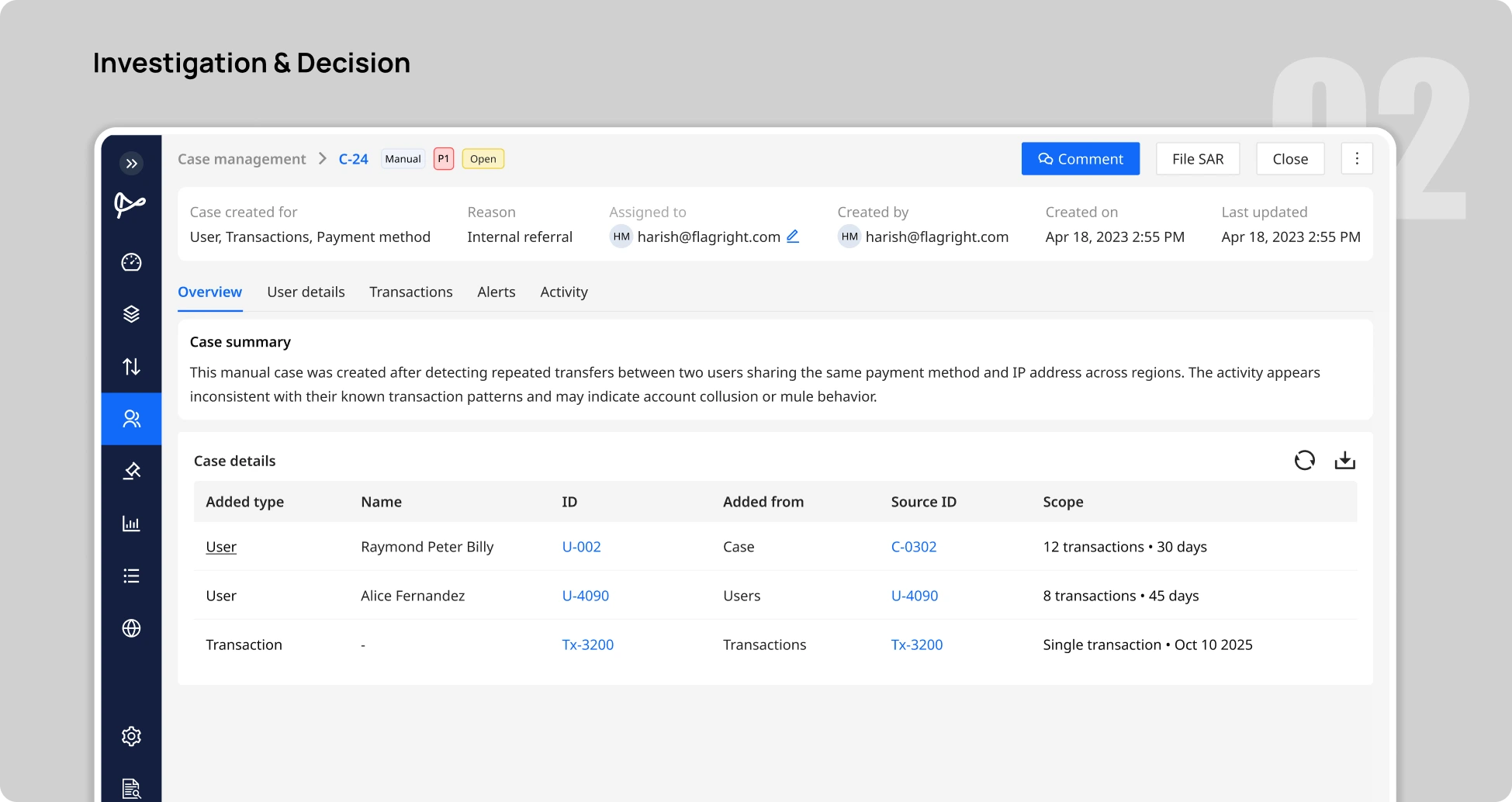
2. Investigation & Decision:
The analyst conducts the investigation within Flagright, reviewing the alert, adding notes, attaching documentation, and performing due diligence checks. If the activity is indeed suspicious, the analyst (or a manager via an approval workflow) decides that a SAR is warranted. The case status is then moved to “SAR filing” stage.
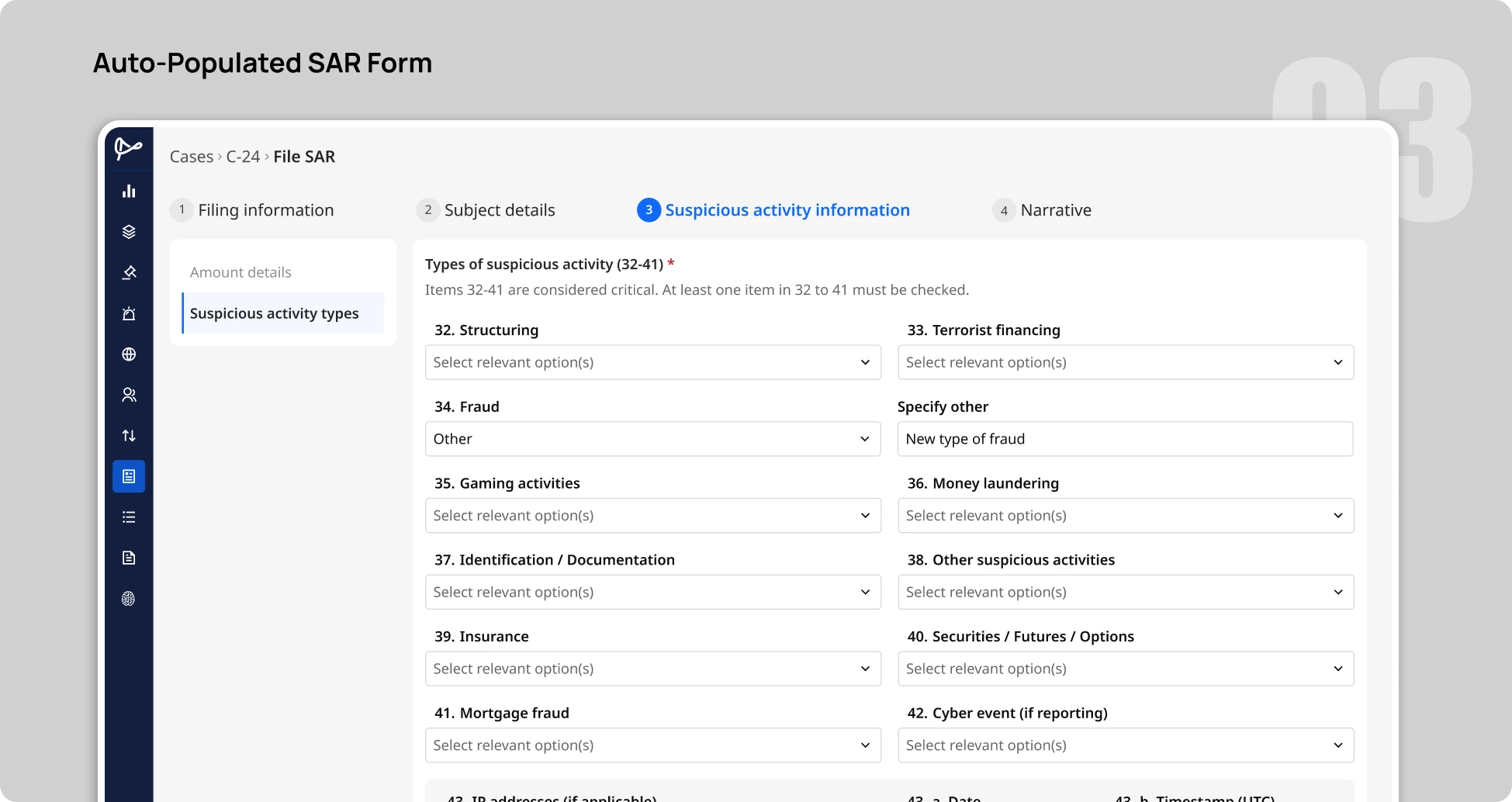
3. Auto-Populated SAR Form:
Flagright provides a built-in SAR template that is auto-populated with information from the case. The system maps your data to the official SAR fields (subject details, activity categories, amounts, narrative, etc.). The analyst can review and edit any field as needed, and compose the narrative. Because the template is aligned to FinCEN’s latest SAR format, there’s no guesswork, all required fields are clearly presented, and the system validates entries (for example, ensuring no invalid characters or missing mandatory fields). This ensures a high-quality SAR that will meet FinCEN’s requirements.
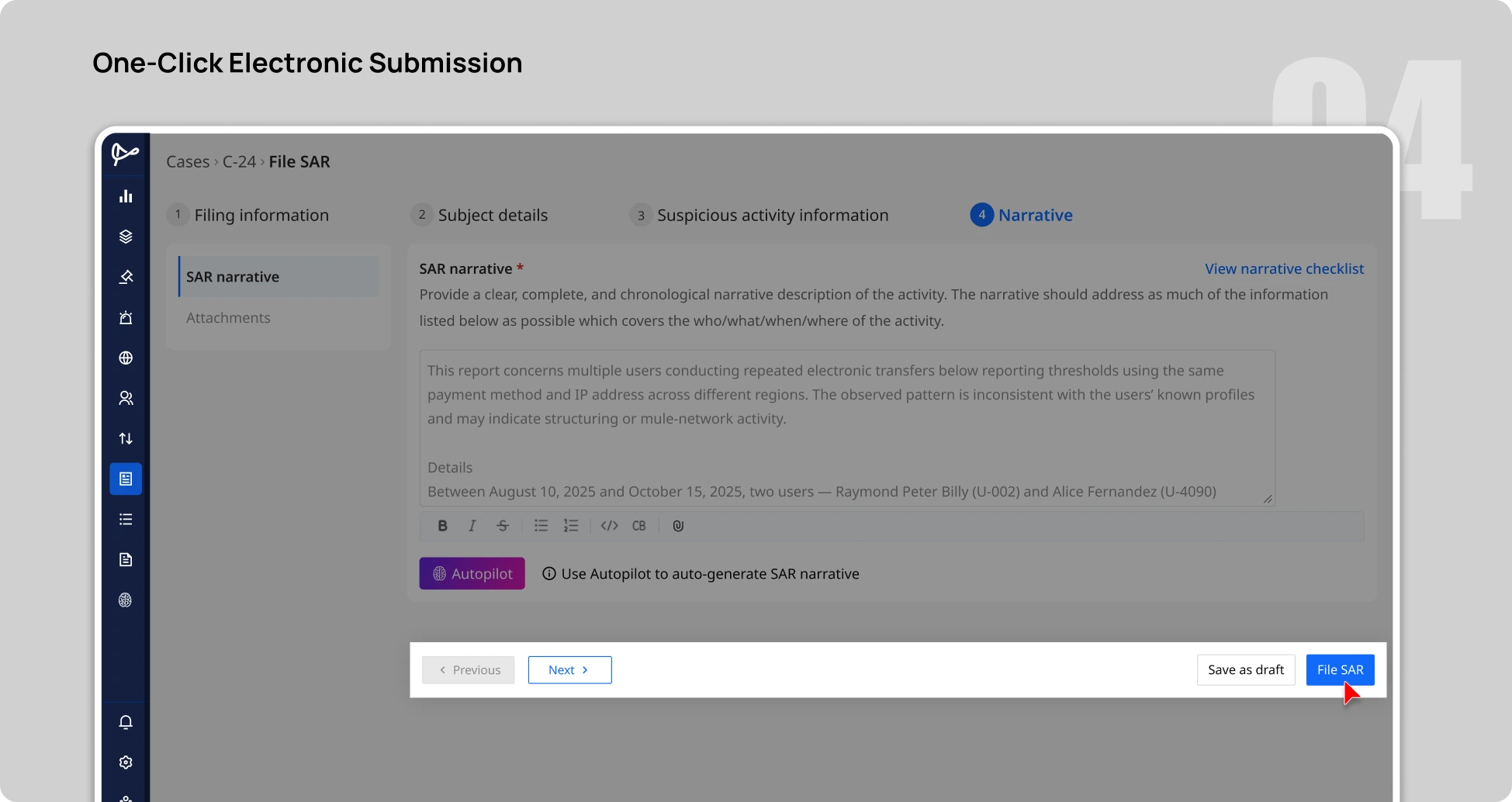
4. One-Click Electronic Submission:
Once the report is prepared and approved, the analyst submits it directly from Flagright. By clicking “Submit SAR,” the system electronically transmits the filing to FinCEN. Under the hood, Flagright’s SAR Filing engine converts the case data into the official XML and sends it through a secure channel to FinCEN’s BSA E-Filing system. No downloading or uploading files manually, the data goes straight from your Flagright environment to FinCEN. This step is fast and encrypted, akin to having an API pipeline into FinCEN’s database.
5. Acknowledgment & Tracking:
After submission, Flagright’s platform monitors for a response from FinCEN. FinCEN typically processes electronic filings and returns an acknowledgment (which includes the official BSA ID or filing reference number for each report) within a couple of days. Flagright automatically updates the case status to “Successfully Filed” and logs the FinCEN acknowledgment details, providing you a proof-of-submission right in the case file. The SAR case now shows as filed, with a timestamp and reference number. All of this is recorded in the system’s audit trail.
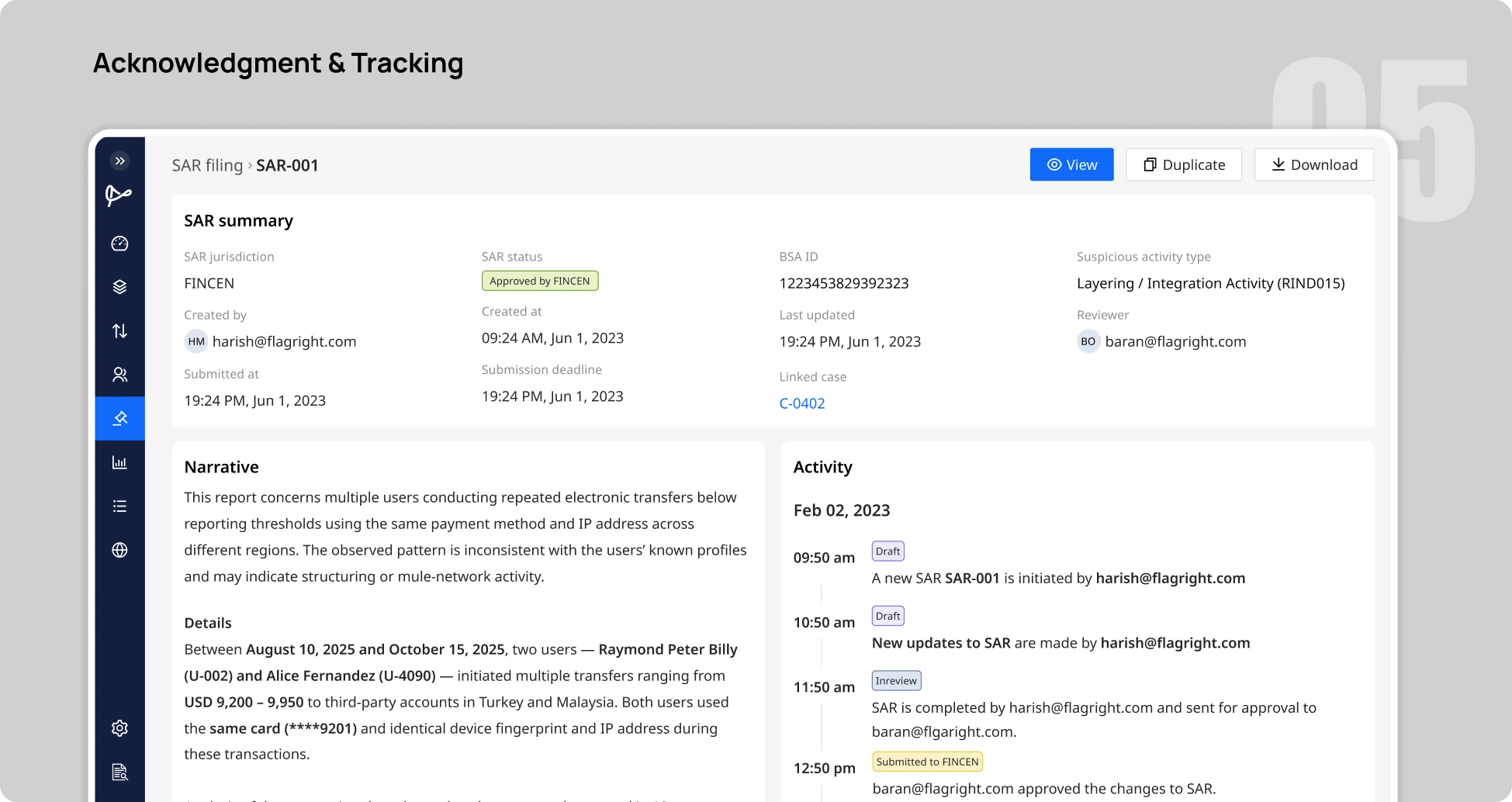
Throughout this workflow, every action is logged and auditable. Flagright’s case management keeps a timeline of when the alert was generated, when the case was opened, who approved the filing, and when it was sent to FinCEN. The SAR content is stored (often with a PDF or XML copy of the filed report for your records), and the FinCEN confirmation is attached. This end-to-end flow demonstrates how much manual effort is eliminated: analysts no longer have to re-key information into external systems or manage separate files. The integration ensures a smooth handoff from detection to investigation to reporting, all in one integrated loop.
Operational Impact: Faster Filings, Fewer Errors, Lower Backlogs
Implementing a direct FinCEN integration can significantly improve day-to-day compliance operations. Here are some of the major benefits and impacts you can expect:
- Fewer Manual Steps: By cutting out duplicate data entry and external uploads, Flagright’s solution saves analysts a tremendous amount of time. All the information needed for a SAR/CTR is captured once (in the case) and then flows into the report automatically. This reduces manual data entry and paperwork, letting your team focus on investigating suspicious activity rather than wrestling with forms. Fewer manual steps also mean fewer opportunities for mistakes, no more typos from retyping data or accidentally omitting an attachment during an upload.
- Faster Time-to-File: With a one-click submission and auto-formatted reports, the time from deciding “we need to file a SAR” to actually filing it shrinks dramatically. What might take days or weeks with batching and manual uploads can be done the same day in Flagright. Some organizations choose to accumulate SARs and file in batches when done manually, which can create delays; direct integration encourages a continuous filing workflow. The result is that SARs and CTRs get to regulators faster, keeping you well within the required timelines. In fact, many compliance teams use the efficiency gains to set internal filing targets more aggressive than the 30-day deadline, for example, aiming to file most SARs within 10–20 days of detection. Speedy reporting is not just about avoiding penalties; it also means law enforcement can get actionable intelligence sooner, which is a win for everyone.
- Lower SAR Backlog: When filing is slow and labor-intensive, backlogs of unfiled SARs can pile up (some institutions have had hundreds of cases waiting to be filed, as noted in industry reports). Automating the submission process helps prevent that backlog from building. Each analyst can clear cases more quickly, and the team isn’t constrained by a single bottleneck of “the one person who uploads SARs on Fridays,” for example. This keeps your queue moving and ensures suspicious activities are reported promptly. By eliminating many manual workflow delays, Flagright empowers teams to handle higher alert volumes without drowning in paperwork. As one process intelligence study noted, the average investigation time for a case has ballooned to over 4 days in manual environments, contributing to missed deadlines. Automating steps like report compilation and submission directly attacks that cycle time. The net effect is a visible reduction in SAR backlog and overdue cases.
- Elimination of Missed Deadlines & Errors: Automation brings consistency. Flagright’s platform can enforce that no required field is left blank and even prevent submission until all validations pass, so you don’t submit an invalid SAR. It also can send reminders or escalate cases that are approaching the deadline. By using templated workflows, you eliminate human error such as miscalculating the 30-day due date or forgetting to include a key detail. The system essentially acts as a safety net, for example, it won’t let you accidentally file a SAR with missing data that could be rejected. According to Flagright, automating the SAR filing workflow “saves time and eliminates human error (e.g., forgetting a deadline)”. In practical terms, this means greater confidence that every report sent to FinCEN is complete, compliant, and on time.
- Audit Trail & Proof of Submission: Every step in the process is recorded, which makes both internal audits and regulator exams far easier. Instead of digging through email confirmations or spreadsheets to prove that a SAR was filed, you can pull up the case in Flagright and show the exact date/time of submission along with the FinCEN acknowledgment number. Flagright’s platform tracks all submissions in one place, creating a centralized log of your BSA filings. It also provides built-in reporting: you can generate logs or summary reports of all SARs/CTRs filed in a period, including turnaround times and outcomes, at the click of a button. These records are audit-friendly. In fact, Flagright notes that its dashboards and automated reports have been useful for clients to demonstrate compliance effectiveness to examiners. For an internal compliance officer or auditor, this audit trail means less time spent gathering evidence and more trust that the program is under control. You’ll have proof-of-submission for every report, which is a strong defense in the face of any questions about whether something was filed or filed late.
Why This Matters: Keeping Pace with Rising Demands
Flagright’s direct FinCEN transmission system isn’t just a “nice to have” tech upgrade, it addresses very real challenges facing financial institutions today. SAR volumes are at all-time highs, and they continue to grow. Compliance teams must handle this surge without an exponential increase in headcount or budget. Automation and smart integrations are the only viable way to scale. By streamlining the filing process, Flagright helps institutions keep up with rising alert volumes and still meet their reporting obligations.
Regulators and examiners are also paying closer attention to filing timelines. It’s not enough to file a SAR eventually; it needs to be on time. In fact, regulators view the timeliness of SAR filings as a key indicator of an effective AML program. Consistently bumping up against the 30-day deadline, or worse, filing late will raise red flags during examinations. Recent enforcement actions have shown that authorities will levy penalties if an institution develops a pattern of tardy reporting or a backlog of unfiled SARs. With direct filing, your team is far less likely to miss a deadline. The quicker turnaround and reduced backlog directly contribute to a stronger compliance posture in the eyes of examiners. Essentially, you’re demonstrating that your institution has control over its reporting duties and isn’t letting suspicious leads languish.
Internally, the benefits resonate as well. Internal audit and risk management expectations have evolved they now often expect real-time visibility into compliance processes and assurance that controls are working. An automated filing system provides that assurance. Internal auditors can trace each alert to a case to a filed SAR, all within one system, which makes their job easier and your compliance function more transparent. If your institution’s policy is to file SARs within, say, 20 days on average, you can track and prove that performance with Flagright’s dashboard. Moreover, should your board or executives ask, “Are we keeping up with our AML reporting?”, you can confidently answer yes, and back it up with data.
Finally, consider the broader operational resiliency this brings. With fewer manual tasks, your compliance analysts are less bogged down and less prone to burnout. Instead of spending hours on clerical work to submit reports, they can dedicate more time to higher-value activities like investigating complex cases or refining monitoring scenarios. This not only improves job satisfaction but also means potentially better quality SARs (since analysts have more time to craft thorough narratives and analyze context) and better risk coverage. In a time when financial crime tactics are evolving, freeing up analyst capacity to focus on real analysis is a strategic advantage.
Conclusion
For compliance, AML, fraud, and risk leaders, Flagright’s direct FinCEN transmission system offers a compelling combination of speed, accuracy, and reliability in regulatory reporting. By providing a direct integration to FinCEN in a turnkey, out-of-the-box solution, Flagright removes the pain points of SAR/CTR filing that have long plagued compliance teams. All FinCEN-reportable filings, from SARs and CTRs to 314(b) requests can be handled in one unified platform, with structured data formats and secure delivery that meet FinCEN’s requirements. The operational impact is significant: fewer manual steps, faster time-to-file, reduced backlogs, and a complete audit trail with proof of each submission. In an era of rising alert volumes and heightened scrutiny on AML effectiveness, this kind of efficiency isn’t just about saving time it’s about staying ahead of risk and regulatory expectations.
Flagright’s direct filing capability demonstrates a blend of buyer-friendly ease (no-code setup, quick deployment) and technical credibility (using FinCEN-approved transmission methods and schemas). It’s a solution that a compliance officer can confidently champion internally, knowing it will make their program more robust and examiner-ready. By adopting a direct FinCEN integration, financial institutions can ensure that when suspicious activity is identified, the information swiftly reaches the authorities as required, with minimal friction and maximum accountability. In short, Flagright’s direct FinCEN transmission system turns what used to be a cumbersome compliance chore into a streamlined, automated workflow, allowing your team to focus on what truly matters: fighting financial crime and protecting the institution.