.webp)
Fintech companies demand compliance solutions that can keep pace with hyper-growth. Flagright was engineered from day one to support financial institutions at massive scale without sacrificing speed or reliability. Whether a client processes a thousand transactions a day or thousands per second, Flagright’s cloud-native platform handles the load effortlessly. Below, we break down how Flagright achieves high throughput, low latency, and unwavering uptime.
High Throughput & Low-Latency Performance
Flagright’s real-time decisioning layer is provisioned to handle 1,000 transactions per second by default, with up to 3,000 transactions per second in burst. And if your profile requires more, we can increase capacity further through dedicated sizing.
What that means in practical terms:
- 1,000 TPS sustained ≈ 86.4 million transactions/day
- 3,000 TPS sustained ≈ 259.2 million transactions/day
That’s why this matters: large-volume fintechs don’t fail because the “average” load is high; they fail when peak traffic causes delays, dropped events, or degraded decision quality. The burst headroom exists to prevent exactly that.

Out-of-the-box performance:
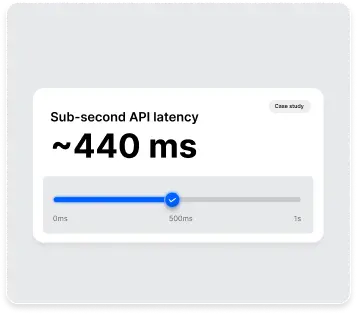
Flagright’s real-time rules engine delivers sub-second response times even under heavy volumes. In practice, the platform evaluates complex AML rules in about 0.44 seconds on average per transaction. This means compliance checks happen almost instantly, so fintechs can screen and approve payments without slowing down the user experience. Even at 1,000 requests per second, Flagright maintains high throughput and stability.
Consistency at scale:
Importantly, this speed isn’t just a laboratory figure, it holds up in production. One case study reported ~440 ms average API latency with Flagright, demonstrating near-instant decisioning in real-world use. In fact, clients have strict SLAs around response times (often needing answers in <500 ms), and Flagright comfortably meets these demands. As a result, fintechs can confidently run real-time fraud and AML checks without frustrating customers.

This high-performance design ensures fintechs can launch new products or expand transaction volumes without latency bottlenecks. Flagright’s microservices architecture and in-memory processing enable it to absorb large spikes in traffic while keeping response times around a few hundred milliseconds.
Enterprise-Grade Uptime and Reliability
In compliance, downtime is not an option. Flagright provides an enterprise-grade uptime guarantee, boasting 99.99%+ availability across its global infrastructure. In fact, Flagright operates active-active across multiple regions, with 8 data centers worldwide to ensure resilience. The result is 99.998% uptime in practice, equivalent to just a few minutes of downtime per year. Even during peak usage bursts (e.g. holiday payment surges or flash sales), the platform remains rock-solid: compliance controls stay uninterrupted and responsive.
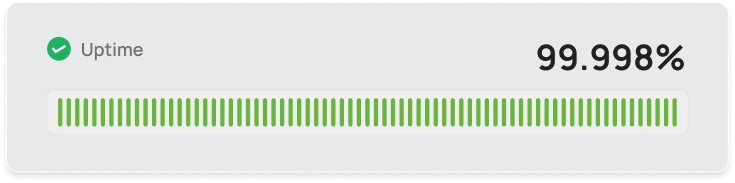
Such reliability at scale gives fintechs peace of mind. For example, the UK fintech Zero integrated Flagright and observed 99.998% uptime in live operations. This level of uptime is critical when every second counts for blocking fraud or screening a risky transaction. Flagright’s status page and case studies consistently demonstrate enterprise availability, reinforcing trust that the system can handle mission-critical workloads around the clock.

To achieve this, Flagright’s cloud platform has built-in redundancy and automatic failover. If one server or region faces an issue, traffic is seamlessly load-balanced to others, with no impact on the client. Many legacy AML systems require on-premise hardware that can become a single point of failure or choke on high load. In contrast, Flagright’s SaaS model removes that risk: every client benefits from a highly available, cloud-distributed service by default. The bottom line is reliability at scale; fintechs can grow their user base or transaction volume by orders of magnitude, confident that compliance checks will remain continuously available.
Elastic Scalability for Bursts & Growth
Payment systems don’t grow smoothly, they spike. Product launches, salary days, holiday peaks, promo campaigns, fraud waves, and partner migrations all create step-function traffic.
Flagright is designed to handle that reality with:
- Burst capacity up to 3,000 TPS (with 1,000 TPS provisioned by default)
- Elastic scaling patterns that allow the platform to absorb sudden peaks without turning compliance into a bottleneck
- Operational safeguards so that the compliance pipeline remains stable under load (instead of producing timeouts, partial decisions, or analyst backlogs)
A hallmark of Flagright’s design is elastic scalability. The system automatically scales to accommodate surges in transactions or new client growth without any manual intervention. Flagright was architected as a cloud-native, real-time solution, which the team calls a “trifecta of innovations [that] ensures unparalleled performance”. This means as a fintech’s business expands, the compliance platform seamlessly expands with it. Whether you’re monitoring 1,000 transactions a day or 1,000 per second, the platform handles it with ease. There’s effectively no upper limit; the system can process billions of transactions with millisecond-level efficiency thanks to its modern architecture.
Several design choices enable this massive scalability:
- Cloud-native microservices: Flagright’s back-end is broken into microservices that can be replicated and autoscaled across cloud servers. When transaction volume spikes, new instances spin up to share the load, then spin down when traffic ebbs. This elasticity means bursty workloads (e.g. big customer onboarding days or fraud attack waves) are handled without performance degradation.
- Horizontal scaling: Because it’s a SaaS, clients never have to worry about adding hardware or database capacity themselves. Flagright scales horizontally behind the scenes. In contrast to older systems that might require sharding databases or upgrading appliances to handle more TPS, Flagright’s cloud infrastructure expands on demand. This was influenced by the founders’ backgrounds at Palantir and AWS, where they learned to build globally distributed, mission-critical systems that can “provide 24/7 solutions” under any load.
- No single tenancy bottlenecks: The platform is multi-tenant and load-balanced globally. That means one client’s surge is handled by allocating more cloud resources, without impacting other clients. No on-premise chokepoints exist, a key difference from legacy vendors that often required deploying dedicated servers which could max out. Flagright’s SaaS approach ensures consistent high performance as volumes increase.
- Real-time streaming: All transaction monitoring is event-driven and in real time, rather than batch. The system is tuned for streaming ingestion, which allows it to keep up with rapid transaction firehoses. Internal tests and usage have shown the engine comfortably scaling to very high event rates.
From a fintech perspective, this scalability translates into future-proofing. You won’t outgrow Flagright. If your transaction volume doubles overnight, or you expand into new markets with higher throughput, the platform automatically adjusts to handle it. Flagright’s clients span 30+ countries across six continents, including fast-growing payment companies, and they operate at a massive scale without issues. This has earned Flagright a reputation as a solution that scales with growth and adapts to evolving threats.
Proven Results in Real-World Deployments
All these capabilities are not just theoretical, they have been proven in real fintech deployments. Flagright has published multiple case studies and garnered client reviews that highlight its performance and scalability in action:

Banked needed a compliance system that could keep up with rapid, cross-border transactions at scale. With Flagright, Banked achieved real-time monitoring across four continents, reducing false positives by 60% and halving the manual effort needed to review flagged transactions. Crucially, this was accomplished without slowing down payments or adding friction for clients.


B4B Payments (UK & Europe): Went live with Flagright in just two weeks, despite strict regulatory requirements. Flagright’s tailored onboarding and intuitive rule builder let B4B rapidly configure real-time monitoring, so their compliance team was investigating alerts within days of integration. Senior leadership even called the deployment a “major success story within weeks”, and the smooth rollout caused no disruption to B4B’s operations delivering immediate returns on their investment.

Seis (US remittance fintech): Skipped building an in-house tool and chose Flagright to get a scalable, low-latency AML solution running from day one. “Buying it packaged and ready makes more sense than trying to duct tape different systems together,” said Dustin Eaton, Seis’s Head of Fraud & Compliance, underscoring Flagright’s cost-efficiency over a DIY approach. The Seis team hit the ground running: within days, they were leveraging Flagright’s out-of-the-box real-time fraud detection features, without diverting engineering resources to build a system from scratch.


Sciopay (UK Payment Fintech): Sciopay integrated Flagright’s real-time AML in just 7 days and immediately saw top-tier performance. They achieved ~440ms average response times for live transactions and 99.998% uptime, enabling true real-time fraud prevention with “unmatched reliability and operational continuity.” The founders at Sciopay noted that there were “no gotchas” on performance, everything ran fast out-of-the-box, so their team “never had to worry about performance” even as compliance checks moved to real-time. In the CEO’s words, Flagright’s scalability meant the compliance function could run “effortlessly, it just works, allowing us to focus entirely on growing our core business.”

Zero (Digital Bank, UK): Zero used Flagright to power real-time transaction monitoring for its sustainable banking platform. The integration was completed in weeks, and once live, Flagright delivered 99.998% uptime for Zero’s compliance layer. Every transaction is screened and risk-scored instantly, yet the user experience remains seamless. Zero’s team built a modern, modular tech stack with Flagright as a core component precisely because of its reliability and scale. According to Flagright’s CEO, Zero’s launch “built for resilience from day one, and it shows... compliance is embedded and invisible to the user”, meaning Flagright could handle all the compliance logic in real-time without impacting Zero’s customers. High availability and speed were key to achieving that.
Client Reviews:

On G2 and other platforms, compliance officers frequently mention Flagright’s performance and support. For example, one MLRO praised “the fast paced integration... we managed to switch monitoring providers in a record time.” Another user emphasized that Flagright’s real-time monitoring “makes investigations much faster” and that easy API integration enabled “quick deployment.” Many highlight the ability to deploy complex rules without lag and to scale their program without adding headcount. The consensus is that Flagright scales fintech compliance in a way legacy systems cannot, “efficient and user-friendly” even as volumes grow. This real-world validation from fintech teams underscores that Flagright’s scaling claims are backed by tangible outcomes (e.g. one institution went live in weeks and saw immediate ROI, while another cut false positives by over 90% with no performance hit).
Flagright’s success stories demonstrate that even fast-growing fintechs can rely on the platform at scale. As one G2 reviewer summarized, Flagright is “a reliable partner for compliance and risk management” that can keep up with ambitious growth plans (5/5 stars). Fintech innovators no longer have to choose between agility and scale in their compliance operations, Flagright delivers both.
Cost-Efficient Scaling for Clients
Supporting high scale is not just about tech specs; it also has to make economic sense. Flagright’s fully-managed cloud infrastructure provides automatic scaling without burdening clients with huge costs. Because it’s offered as a SaaS subscription, clients avoid the substantial infrastructure investments that an equivalent in-house system would require. There’s no need to buy and maintain servers, databases, or data centers for peak capacity that sits idle. Flagright’s model is to handle all that under the hood, and clients simply pay for the service as they use it, enjoying a far lower total cost of ownership.
In fact, financial institutions that switched to Flagright report up to 80% lower compliance costs versus their previous solutions. Much of this comes from operational efficiency (fewer false positives, less manual work), but the cloud scalability plays a role too. By eliminating the drains of infrastructure maintenance, upgrades, and downtime, Flagright lets compliance teams focus on risk, not on managing software. Small fintech startups and large enterprises alike benefit from this efficiency: the platform scales up or down automatically, so clients aren’t overpaying for capacity they don’t need. During low volumes, resources scale down; during high volumes, additional resources are utilized only as long as necessary. This elasticity keeps the solution cost-effective at any scale.
Moreover, Flagright’s continuous improvements and optimizations (driven by AI and data from all clients) mean that as the platform becomes more efficient, those gains pass to customers. There’s no costly cycle of replacing legacy systems for more throughput, Flagright is continuously upgraded in the cloud. The low overhead makes enterprise-grade compliance accessible even to lean startups, while still meeting the needs of the largest global institutions.
In summary, Flagright enables fintechs to scale up confidently. The platform’s architecture delivers massive throughput, sub-500ms latency, and near-perfect uptime concurrently, a trifecta that ensures compliance processes won’t become a bottleneck as your fintech grows. This has been validated in case studies (e.g. 99.998% uptime with real-time decisions in production) and lauded by users who’ve seen their compliance operations become faster and more scalable after adopting Flagright. And critically, all this performance comes packaged in a cost-efficient, managed solution that avoids heavy infrastructure costs for clients.
Fintechs can thus focus on innovation and growth, while Flagright’s platform seamlessly handles the compliance workload at scale. With Flagright, there’s no need to compromise between speed, scale, and reliability; you get all three. The platform grows with you, ensuring that no matter how large your transaction volumes or customer base become, your fraud and AML defenses remain real-time, resilient, and ready.